
Published: July 1, 2026 Reading time: 8 minutes
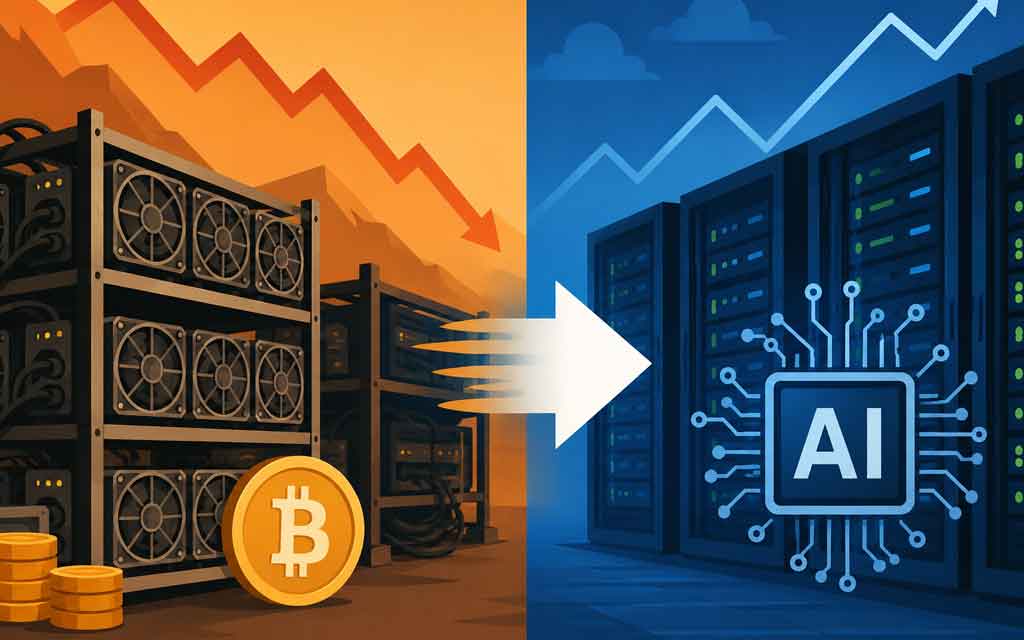
Bitcoin miners are executing one of the most significant industry pivots in tech right now. Faced with shrinking profits from cryptocurrency mining, many are rapidly converting their power-hungry facilities into AI data centers — and investors are taking notice.
What began as a niche strategy among a few forward-thinking operators has accelerated into a broad industry shift in 2025 and 2026. Companies are signing multi-billion-dollar contracts with hyperscalers and AI firms, repurposing infrastructure originally built for Bitcoin mining to support the explosive demand for high-performance computing (HPC) and AI workloads.
This transformation is reshaping both the Bitcoin mining sector and the broader AI infrastructure landscape.
Why Bitcoin Miners Are Pivoting to AI
The economics are straightforward. Bitcoin mining profitability has been under pressure since the April 2024 halving, which cut block rewards in half. Combined with rising energy costs, increasing network difficulty, and periods of softer Bitcoin prices, many miners have seen margins compress significantly.
At the same time, demand for AI computing power has exploded. Hyperscalers and AI companies are racing to secure electricity and data center capacity, creating a massive shortage of suitable infrastructure.
Bitcoin miners hold a unique advantage: access to large-scale power capacity. In many cases, they already control hundreds of megawatts of power in locations with favorable energy costs (often in Texas and other energy-rich regions). This power is now one of the most valuable and scarce resources in the AI boom.
By pivoting, miners can:
- Secure long-term, high-margin contracts (often 5–15 years)
- Generate significantly higher and more predictable revenue than volatile Bitcoin mining
- Leverage existing land, substations, and grid connections
Industry analysts project that for miners who successfully execute AI deals, revenue from cryptocurrency mining could fall from around 85% of total revenue in early 2025 to under 20% by the end of 2026, with AI/HPC becoming the dominant business.
Leading Companies Driving the Pivot
Several publicly traded Bitcoin miners have moved aggressively into AI infrastructure:
Core Scientific (CORZ) One of the most prominent examples. The company has converted a substantial portion of its operations to support AI workloads, including major deals with CoreWeave. Core Scientific’s CEO has described the AI opportunity as potentially transformative for the business.
IREN (Iris Energy) Known for one of the bolder approaches, IREN has pursued both hosting AI workloads and, in some cases, owning and operating GPUs directly. The company has secured significant contracted revenue and is viewed as a leader in the transition.
Cipher Mining (CIFR) The company has largely pivoted away from pure Bitcoin mining. It has built a substantial contracted backlog (reportedly over $9 billion in some analyses), anchored by major deals including a large agreement with AWS and arrangements involving Google-backed entities.
TeraWulf (WULF) TeraWulf has pursued joint ventures and partnerships, including high-profile deals backed by major tech players, to develop AI/HPC capacity alongside its mining operations.
Other Notable Players Hut 8 (HUT), Riot Platforms (RIOT), and Applied Digital are also actively exploring or executing AI-related strategies, though at varying speeds and scales.
Wall Street has taken note. Firms like Jefferies have initiated coverage on several of these names specifically highlighting their AI data center potential, with some receiving Buy ratings tied to the infrastructure transition.
The Economic Case: Mining vs. AI Data Centers
The margin difference is stark. Traditional Bitcoin mining often operates on relatively thin margins due to energy costs, hardware depreciation, and Bitcoin price volatility.
In contrast, AI/HPC data center contracts can deliver operating margins of 80–90% in some cases, according to industry analysis. These are typically structured as long-term leases or compute contracts with creditworthy counterparties (hyperscalers or well-funded AI companies), providing revenue visibility that mining has never offered.
Additionally, AI workloads often command premium pricing because power and suitable facilities are in short supply. Miners who can repurpose sites quickly are capturing significant value.
However, not every mining site is easily convertible. AI GPUs (especially high-power models like NVIDIA’s Blackwell) have much higher power density and cooling requirements than Bitcoin ASICs. Some facilities need substantial upgrades to electrical systems, cooling infrastructure, and networking to support AI workloads.
Challenges and Limitations of the Pivot
While the opportunity is large, the transition is not without hurdles:
- Infrastructure Upgrades: Many mining sites require significant capital expenditure to handle the power density and cooling needs of AI servers.
- Not All Sites Are Suitable: Remote or lower-quality power locations may not attract AI tenants.
- Competition: Hyperscalers are also building their own capacity and striking direct deals, which can limit available opportunities.
- Execution Risk: Converting facilities, signing contracts, and scaling operations takes time and expertise.
- Bitcoin Mining Still Matters: Many companies are maintaining a core mining business alongside AI operations rather than fully exiting crypto.
Despite these challenges, the pace of announcements and contract signings suggests the pivot is gaining real momentum.
What This Means for AI Infrastructure and Bitcoin
The influx of former Bitcoin mining capacity into the AI market is helping address part of the power and infrastructure shortage, though it is unlikely to fully solve it. Analysts estimate that a meaningful percentage of Bitcoin miners’ power capacity could shift toward AI/HPC by 2027.
For Bitcoin itself, the diversion of power and focus away from pure mining could modestly slow the growth of network hashrate in the coming years.
For the AI sector, these pivoting miners represent an important new source of flexible, power-rich capacity that can be brought online faster than traditional greenfield data center projects in some cases.
Investors have rewarded companies that execute well on this strategy. Bitcoin mining-related ETFs and individual stocks have at times significantly outperformed Bitcoin itself in 2025–2026, driven largely by the AI data center narrative.
Outlook: How Far Will This Go?
The “Bitcoin miner to AI data center” transition is widely viewed as one of the defining industrial stories of 2025 and 2026. Projections suggest that AI-related revenue could reach 70% or more of total revenue for leading pivoting companies by the end of this year.
Looking ahead, the companies best positioned to succeed will likely be those that:
- Have high-quality power assets in desirable locations
- Can execute infrastructure upgrades efficiently
- Secure long-term contracts with strong counterparties
- Maintain operational flexibility between mining and AI workloads
The trend also raises interesting questions about the future relationship between Bitcoin mining and AI infrastructure. Some analysts see potential for hybrid models where facilities can switch between the two based on relative economics, though most current contracts are structured as dedicated AI capacity.
Frequently Asked Questions
Why are Bitcoin mining profits shrinking? The 2024 Bitcoin halving reduced rewards, while energy costs and network difficulty have risen. Volatile Bitcoin prices have also pressured margins for many operators.
Can any Bitcoin mining site be converted to AI? No. Sites need sufficient power capacity, suitable grid connections, and the ability to support high power density and advanced cooling. Not all locations are economically viable for AI workloads.
Which companies are furthest along in the pivot? Core Scientific, IREN, Cipher Mining, and TeraWulf are frequently cited as leaders in executing AI data center deals and conversions.
Will this hurt Bitcoin mining long-term? It could modestly slow hashrate growth if significant power capacity is permanently diverted. However, many miners are maintaining dual operations rather than fully exiting mining.
Is this just a temporary trend? Most analysts see it as a structural shift. AI demand for power and infrastructure is expected to remain extremely strong for years, while Bitcoin mining economics face ongoing cyclical and structural pressures.
The Bottom Line
Bitcoin miners are rapidly repositioning themselves as key players in the AI infrastructure buildout. What started as a survival strategy for some has become a major growth opportunity as they leverage their most valuable asset — access to power — in one of the hottest markets in technology.
As AI continues to drive unprecedented demand for computing resources, the companies that successfully navigate this pivot could emerge as important winners in both the crypto and AI ecosystems.
The race to convert mining infrastructure into AI capacity is still unfolding, and 2026 is shaping up to be a pivotal year for how far and how fast this transformation goes.
What do you think about Bitcoin miners becoming AI infrastructure providers? Will this strengthen or weaken the Bitcoin ecosystem long-term? Share your thoughts in the comments below.
Stay tuned to vfuturemedia.com for more coverage on the intersection of Bitcoin, AI infrastructure, and the evolving energy landscape.




Leave a Comment