
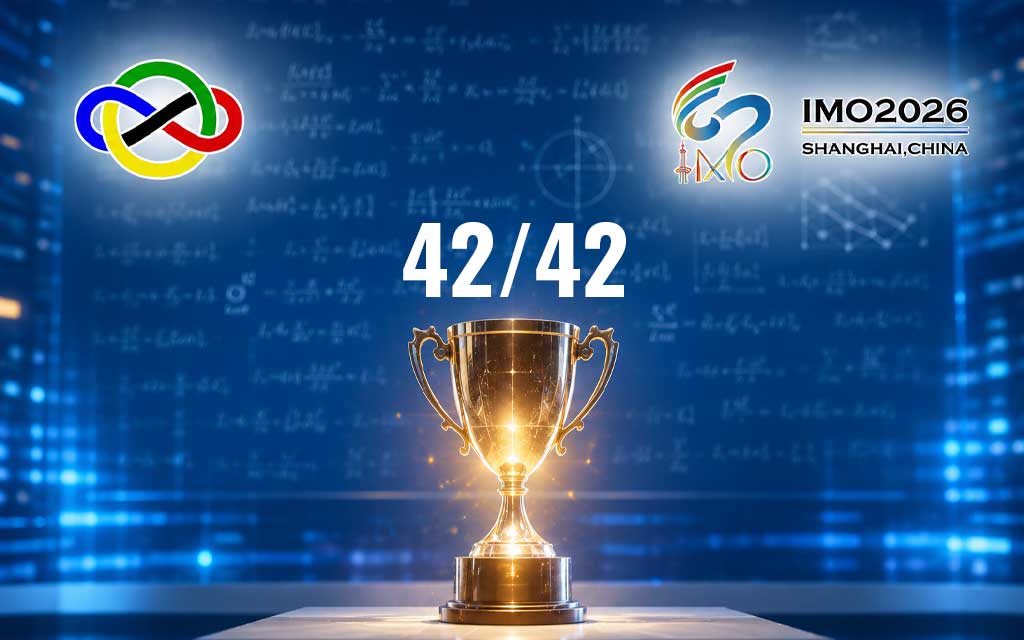
Huawei’s Celia and Xiaohongshu’s dots-note-3.0 both scored a perfect 42/42 at the 2026 International Mathematical Olympiad in Shanghai — the first time AI systems have matched the top human contestants under official judging conditions.
In a landmark achievement for artificial intelligence, two Chinese AI systems have scored a perfect 100% at the 2026 International Mathematical Olympiad (IMO), the world’s most prestigious mathematics competition for pre-university students. Huawei’s AI system “Celia” and Xiaohongshu’s (RedNote) model “dots-note-3.0” each earned a full 42 out of 42 points under the official IMO judging process, matching the performance of the very best human contestants.
This marks the first time AI systems have recorded a flawless score at the IMO under the competition’s rigorous official evaluation standards.
The 2026 IMO Context
The 67th International Mathematical Olympiad was held in Shanghai in mid-July 2026. A total of 666 human contestants from around the world participated. Only seven human students achieved a perfect score of 42/42. The competition consists of six extremely challenging problems across algebra, combinatorics, geometry, and number theory, each scored out of 7 points, for a maximum of 42.
Both AI systems solved the same set of problems given to the human participants and submitted complete solutions that were reviewed under the official process without human assistance during problem-solving.
The AI Systems Involved
Huawei’s Celia Huawei reported that its Celia system demonstrated strong capabilities across multiple mathematical domains and delivered fully correct solutions to all six problems.
Xiaohongshu’s dots-note-3.0 Xiaohongshu (also known as RedNote), primarily known as a social and lifestyle platform, has rapidly expanded into AI research. Its dots-note-3.0 (an internal version of the smallest model in the upcoming dots3 family) achieved full marks of 7 on every problem. The team noted that the model could process raw LaTeX problem statements directly and produced solutions that received official certification. One of its solutions (particularly to Problem 3) was highlighted for its elegance. Xiaohongshu has indicated plans to open-source elements of the dots3 series in the future.
Why This Matters
The IMO has long served as a rigorous benchmark for advanced mathematical reasoning. Previous AI systems, including models from leading Western labs, had achieved strong but imperfect results in earlier years. Reaching a perfect score under official conditions represents a qualitative leap in formal mathematical problem-solving, multi-step reasoning, and the ability to generate rigorous, human-readable proofs.
Key implications include:
- Progress in mathematical reasoning: AI is moving beyond pattern matching and statistical prediction toward more reliable multi-step logical deduction.
- Competition landscape: Chinese technology companies are demonstrating frontier capabilities in specialized high-reasoning domains.
- Broader AI capabilities: Success on IMO-level problems suggests stronger potential for AI in scientific discovery, formal verification, education, and complex engineering tasks that require precise reasoning.
- Benchmarking: Perfect scores raise the bar for future evaluations and may accelerate the development of even more challenging mathematical tests.
Limitations and Caveats
While historic, the achievement should be viewed in context:
- The systems operated under competition conditions but were not “contestants” in the same human sense.
- Success on IMO problems does not automatically translate to open-ended research-level mathematics or general intelligence.
- Details on compute resources, training data, specialized fine-tuning, or agentic scaffolding used by the systems have not been fully disclosed in public announcements.
- Human contestants work under strict time limits and without external tools; AI evaluation protocols can differ in setup.
Nevertheless, official certification of perfect scores by the IMO process makes this a more credible milestone than many previous unofficial AI math benchmarks.
Looking Ahead
This result arrives amid rapid advances in large language models, specialized mathematical reasoning systems, and hybrid neuro-symbolic approaches. It underscores how quickly the frontier of AI mathematical capability is advancing and intensifies both excitement about AI’s potential as a scientific collaborator and questions about the future role of human mathematical talent.
For students, educators, and researchers, the appearance of perfect-scoring AI systems may eventually influence how mathematical talent is trained and assessed. For the AI research community, it raises the competitive bar and highlights the value of rigorous, independently judged evaluations.
The 2026 IMO will be remembered as the year artificial intelligence first matched the absolute top tier of young human mathematical performance under official conditions. Whether this becomes a regular occurrence or remains a rare peak will depend on the next generation of models and evaluation standards.
Stay tuned to vfuturemedia.com for deeper analysis of the solutions, comparisons with prior AI math results, and the broader implications for scientific AI.



Leave a Comment