

Published: February 12, 2026 By VFuture Media Team – Your guide to emerging tech trends, AI disruptions, and career strategies for the digital future.
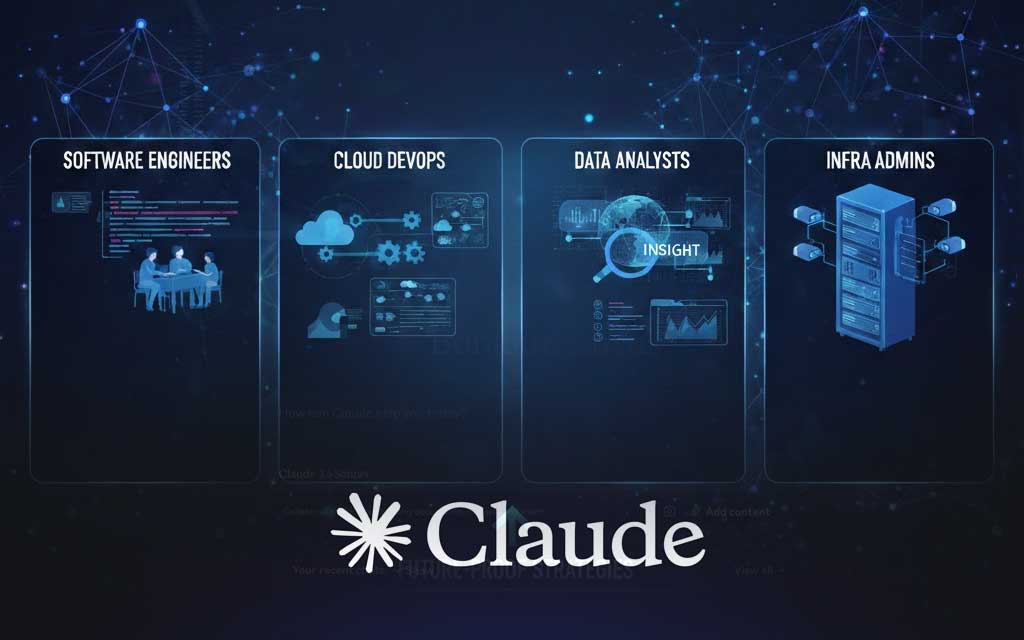
In the rapidly evolving landscape of artificial intelligence, Anthropic’s Claude AI models—particularly the latest Opus series—are not just tools; they’re game-changers reshaping entire professions. As Claude excels in coding, data analysis, workflow automation, and infrastructure management, questions arise: How does this impact key tech roles like software engineers, cloud DevOps specialists, data analysts, and infrastructure admins? More importantly, how can professionals adapt to thrive rather than survive?
Drawing from recent studies, industry reports, and expert insights, this comprehensive analysis explores Claude’s effects on these jobs. We’ll also provide actionable career guidance as a virtual analyst, focusing on skills to enhance and strategies to make your career AI-resilient. Whether you’re in Hyderabad building cloud solutions or anywhere else navigating tech’s future, this post equips you with the knowledge to stay ahead.
The Rise of Claude AI: A Brief Overview
Anthropic’s Claude, backed by massive investments from Amazon, has advanced to handle complex tasks like financial research, code generation, and agentic workflows. With features like Claude Code and Cowork plugins, it’s automating routine work across sectors, boosting productivity by up to 50% in some cases. However, this comes with trade-offs: studies show AI use can reduce skill mastery by 17%, particularly in debugging and core competencies. Anthropic’s own CEO predicts AI could automate most software engineering tasks in 6-12 months, shifting roles from creators to editors.
Now, let’s break down the impacts role by role.
Impact on Software Engineers: From Coders to AI Orchestrators
Software engineering is ground zero for Claude’s disruption. At Anthropic itself, engineers report using Claude for 60% of their work, with 100% of code now AI-generated in some teams. Key effects include:
- Productivity Surge but Skill Atrophy: Claude excels at debugging, code understanding, and feature implementation, speeding tasks by 50-80%. However, reliance on AI leads to lower quiz scores on core concepts (50% vs. 67% for manual coders), especially in debugging.
- Junior Roles at Risk: Entry-level positions, focused on basic coding, are vulnerable. Teams of 2-3 seniors with AI can replace 10-person groups, reducing demand for bootcamp grads.
- Shift to Higher-Level Work: Engineers become “managers of AI agents,” focusing on architecture, business alignment, and oversight. Full-stack skills broaden, but deep expertise in legacy systems remains human-centric.
- Backend/Frontend/Infrastructure Overlaps: Claude generates services in minutes, scaffolding UIs and scripts, compressing 20% of IT jobs in these areas.
Overall, while AI won’t fully replace engineers soon (due to complexities like legacy code and security), the field evolves: more output, smaller teams, and a premium on strategic thinking.
Impact on Cloud DevOps Jobs: Automation Meets Strategy
DevOps roles, bridging development and operations, face transformation as Claude automates CI/CD pipelines, monitoring, and incident response.
- Automation of Routine Tasks: Claude handles Git operations, testing, and infrastructure scripting, reducing manual errors and deployment times. This shrinks roles heavy on tool syntax (e.g., Jenkins, Kubernetes).
- Productivity Gains with Limits: Engineers report 50% boosts, but AI’s imperfections (e.g., in complex environments) require human oversight.
- Role Evolution: DevOps shifts to governance, strategy, and AI orchestration. Smaller teams manage more, but jobs in legacy or high-stakes systems persist.
- Job Compression: Up to 20% reduction in roles, especially mid-level, as AI enables one person to supervise multiple agents.
DevOps pros who embrace AI as a collaborator will become indispensable, focusing on business outcomes over tactical execution.
Impact on Data Analyst Jobs: From Crunching to Insight
Data analysts benefit from Claude’s speed in interpreting data and financial tasks, but face automation of routine work.
- Time Savings on Core Tasks: Claude saves 80% on analysis, generating reports and dashboards faster. Cowork plugins automate sales, marketing, and data workflows.
- Entry-Level Disruption: Half of white-collar starters at risk, as AI handles basic querying and visualization.
- Shift to Judgment-Focused Roles: Analysts move to ethical implications, complex problem-solving, and human-centric insights AI lacks.
- Broader Effects: In fields like finance and consulting, AI’s “cognitive breadth” hits multiple industries simultaneously.
Data roles fragment: AI takes the grunt work, leaving humans for strategy and nuance.
Impact on Infrastructure Admin Jobs: Streamlining the Backbone
Infrastructure admins manage servers, networks, and systems—areas Claude is automating via scripts and maintenance.
- Scripting and Maintenance Automation: Claude generates infra code, resolves conflicts, and summarizes architectures, reducing routine admin needs.
- Job Shrinkage: Roles shrink by 20%, especially in backend/infra, as AI handles deployments and scaling.
- Resilience in Complexity: Human admins remain for legacy systems, security, and critical infrastructure defense.
- Economic Shifts: Anthropic’s investments create some jobs (e.g., 800 permanent in AI infra), but overall contraction in traditional admin.
Infra admins evolve into strategic overseers, with AI handling the day-to-day.
Career Guidance: How to Future-Proof Your Tech Career Against AI
As a career guidance analyst, here’s my tailored advice: AI like Claude isn’t eliminating jobs—it’s redefining them. Focus on becoming irreplaceable by blending human strengths with AI proficiency.
Step 1: Assess and Adapt Your Role
- Self-Audit: Identify automatable tasks (e.g., basic coding for engineers, querying for analysts). Pivot to high-value areas like system design or ethical AI governance.
- Embrace AI Tools: Master Claude, Cursor, or similar—use them to amplify output. For DevOps, integrate AI into CI/CD; for analysts, leverage for faster insights.
Step 2: Enhance Key Skills
- Critical Thinking & Judgment: AI excels at data but struggles with ethics and ambiguity. Enhance via courses on decision-making.
- Emotional Intelligence & Leadership: Build teams, resolve conflicts—skills AI can’t replicate.
- Creative Problem-Solving: Connect ideas innovatively; focus on “why” over “how.”
- AI Literacy: Learn prompt engineering, ML basics—Refonte Learning offers relevant programs.
- Domain Expertise: Deepen business knowledge; e.g., engineers learn product management.
- Systems Thinking: Understand holistic impacts, crucial for DevOps/infra.
- Resilience & Adaptability: Commit to lifelong learning—one hour weekly on adjacent skills.
Step 3: Strategic Career Moves
- Upskill Proactively: Certifications in AI architecture, cybersecurity, or cloud (e.g., AWS, Azure) are resilient.
- Network & Diversify: Join AI communities; consider roles like AI ethicist or solutions architect.
- Build a Portfolio: Showcase AI-augmented projects to demonstrate value.
- Monitor Trends: Follow Anthropic reports; prepare for volatility—unemployment could spike 10-20% short-term.
In summary, future-proofing means evolving from executor to strategist. AI like Claude creates opportunities for those who adapt—potentially leading to higher-impact roles and better work-life balance.
Stay informed on AI’s job impacts and career tips at vfuturemedia.com. What skills are you enhancing? Share in the comments!
Analysis based on authoritative sources including Anthropic studies, Reddit insights, and career reports for accuracy and relevance.
#AIJobImpact #ClaudeAI #TechCareers2026 #FutureProofSkills


Leave a Comment