

Recent EV Sales Trends in 2026
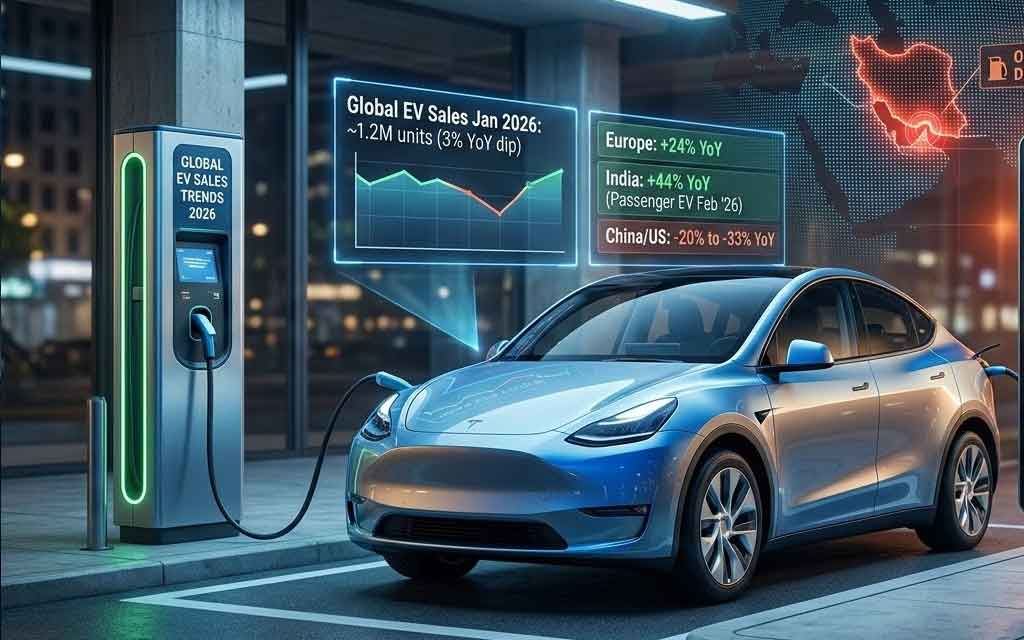
Global electric vehicle (EV) sales, encompassing battery-electric vehicles (BEVs) and plug-in hybrids (PHEVs), began 2026 with a modest dip but maintain strong underlying momentum. January 2026 registrations reached approximately 1.2 million units, reflecting a 3% year-over-year (YoY) decline according to Benchmark Mineral Intelligence and CleanTechnica data. This softening stemmed primarily from policy shifts: China saw a 20% YoY drop to around 600,000 units due to reduced subsidies and new taxes, while the U.S. experienced a sharper 26–33% decline to roughly 85,000–100,000 units following the end of certain federal incentives. Europe provided a counterbalance, surging 24% YoY to over 320,000 units, driven by supportive regulations and growing consumer interest.
Excluding China and the U.S., global EV sales outside these markets jumped 36–92% YoY in some aggregates, highlighting acceleration in emerging regions. Broader projections remain optimistic: after an estimated 23.7 million EV sales in 2025 (25.5% global light-vehicle share), 2026 is forecasted to reach 27.5% share, with long-term targets climbing to 43.2% by 2030 and over 83% by 2040. Emerging markets, including Southeast Asia and India, are increasingly pivotal.
In India—relevant for Hyderabad and Telangana residents—EV adoption continues its robust climb, especially in two-wheelers (2W) and three-wheelers (3W), with four-wheelers (4W) gaining ground. February 2026 saw 193,849 total EV registrations (down slightly month-over-month from January’s stronger figures but up significantly YoY in segments). Electric 2W captured 6.6% market share (up from 5.7% a year earlier), while 3W (L5M category) hit 34.8%. For passenger EVs, Vahan data indicates around 13,669 electric cars sold in February, a 44% YoY increase despite a 28% MoM dip from January’s 18,993 units—Tata Motors led with ~5,558–5,560 units (41% share), followed by MG Motor (~3,305–3,312) and Mahindra.
Tata Motors reported strong overall passenger vehicle performance, with EV sales up 57% YoY in February to 8,385 units (domestic + international). Cumulative FY26 EV sales (Q2 data) neared 580,000–600,000 units, approaching 10% penetration in key segments. India’s 2025 full-year EV sales grew 77% to ~176,000 units (4W focus), with 2026 expected to build on schemes like PM e-Drive subsidies and domestic manufacturing pushes from Tata, Ola Electric, and others.
- January 2026
- Global EV Sales: ~1.2 million (down 3% YoY)
- India EV Sales: Strong electric car growth (~55% YoY in early data)
- Key Notes: Slowdown in China and the US, but growth in Europe and emerging markets helped balance the market.
- February 2026
- Global EV Sales: Data not fully available (early/partial estimates)
- India EV Sales: ~193,849 total EVs sold; 13,669 electric cars (+44% YoY)
- Key Notes: Tata Motors leads the 4-wheeler EV market; EVs hold about 6.6% share in the 2-wheeler segment. Month-on-month dip but strong year-on-year growth.
- Full Year 2025
- Global EV Sales: ~23.7 million units (25.5% market share)
- India EV Sales: ~176,000 units (+77% YoY growth)
- Key Notes: Rapid expansion in emerging markets contributed significantly to global EV adoption.
- 2026 Projection
- Global EV Share: Expected to reach ~27.5% of total vehicle sales
- India EV Outlook: Continued growth, especially in 2-wheelers and 3-wheelers; government targeting 30% EV penetration by 2030.
- Key Notes: Domestic manufacturing and policy support in India help mitigate global market risks.
These trends underscore EVs’ resilience despite short-term headwinds, with India’s affordable segments (2W/3W) leading penetration.
Should You Buy an EV or a Traditional Gas/Diesel (ICE) Vehicle Amid the Iran War?
The escalating U.S.-Israel-Iran conflict, starting late February 2026, has severely disrupted oil flows via the Strait of Hormuz (20% of global seaborne crude). Brent crude surged from pre-conflict levels (~$70–75/barrel) to highs around $81–85 by early March, with settlements up 5–10% in volatile sessions and analysts warning of $100+ if disruptions persist. In India, petrol and diesel prices held largely flat through March 6 (e.g., Hyderabad petrol ~₹107.46/litre, diesel ~₹95.70; Delhi ₹94.77/₹87.67), but ripple effects from global crude could push 5–10% hikes soon, especially if tanker traffic remains halted.
This oil shock tilts the balance toward EVs for many buyers, particularly in urban India like Hyderabad, but consider nuances.
Pros of Buying an EV Now
- Fuel Cost Immunity & Savings: EVs dodge oil volatility entirely. With potential diesel/petrol rises amplifying running costs (already ₹5–7/kWh electricity vs. ₹90–100+/litre fuel), EVs deliver 30–50%+ lower operating expenses over time—especially for high-mileage users (>15,000 km/year). Past spikes historically boosted EV inquiries.
- Adoption Momentum: The conflict could spur behavioral shifts toward cost-stable options, accelerating demand. In India, subsidies (e.g., PM e-Drive up to ₹50,000 for e-2W/e-3W) and domestic production (Tata, Mahindra) provide buffers against global supply risks.
- Long-Term Alignment: Supports India’s 30% EV goal by 2030, lower maintenance, and environmental gains.
Cons of Buying an EV Now
- Upfront & Infrastructure Hurdles: EVs cost more initially (e.g., Tata Punch EV ~₹10–14 lakh vs. ICE equivalents). Hyderabad’s charging network grows (thousands nationwide), but gaps remain for long trips or apartments.
- Indirect Disruptions: Prolonged war risks petrochemical/shipping delays (tires, plastics, battery imports), potentially raising EV prices short-term. Broader economic slowdown from high energy could curb overall auto demand.
- Uncertainty: If conflict resolves quickly, oil stabilizes—ICE remains practical for budget or highway needs.
Recommendation
Buy an EV if… You’re in urban Hyderabad with home/work charging, drive shorter distances (e.g., Ather 450X for 2W or Tata Nexon/Punch EV for 4W), and plan 5+ years ownership. The oil surge strengthens EVs’ economic edge—act soon to lock in current incentives before potential demand spikes.
Stick with ICE (or consider hybrid) if… You need long-haul/diesel capability (e.g., SUVs for family highways), face tight upfront budget, or lack reliable charging. Hybrids offer efficiency bridge without full commitment.
Monitor global developments: $100 oil could boost EV interest 10–20%. Use VAHAN portal for India data, PlugShare for chargers, and track local fuel/electricity rates. For Hyderabad specifics, factor in Telangana incentives and traffic patterns favoring EVs.
About the Author Ethan Brooks is a seasoned automotive and tech journalist with 10+ years covering electrification, market trends, and geopolitical impacts on mobility. Drawing from sources like Benchmark Mineral Intelligence, CleanTechnica, FADA, and real-time trackers for accurate, up-to-date insights.
Share this post on VFutureMedia or comment your thoughts on EV buying amid the oil surge below.




Leave a Comment