

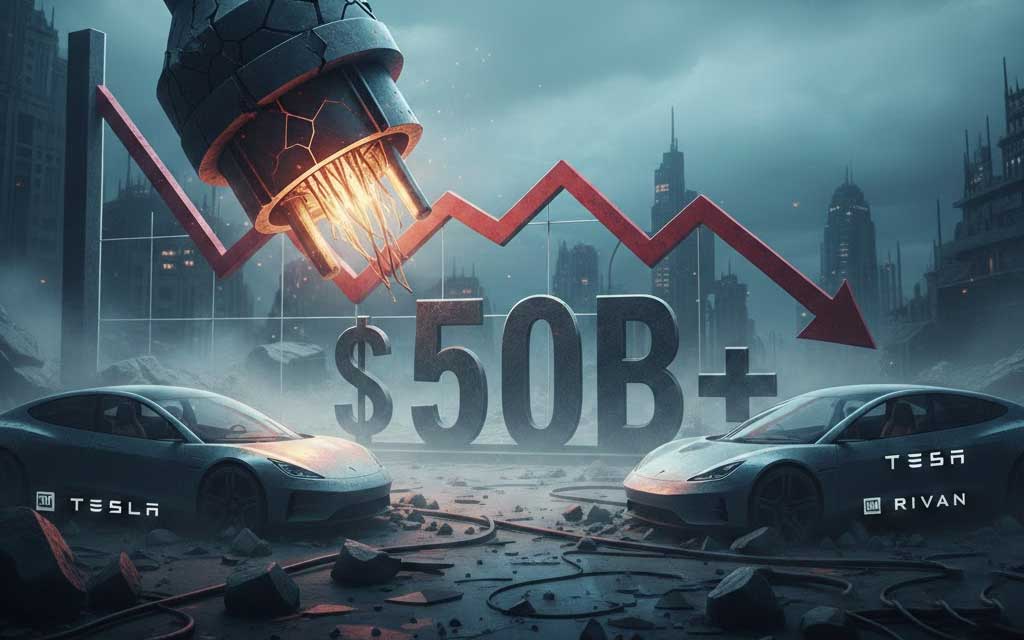
In the fast-moving world of electric vehicles, 2025 and early 2026 have delivered a harsh reality check to some of America’s biggest automakers. Ford, General Motors (GM), and Stellantis—the parent company of brands like Jeep, Ram, Chrysler, Dodge, and Fiat—have collectively taken massive financial hits, with write-offs and charges totaling over $50 billion related to their EV strategies. Stellantis alone announced a staggering $26 billion (approximately €22 billion) charge in February 2026, marking one of the largest single impairments in automotive history. Ford followed with $19.5 billion in December 2025, and GM added around $6-7.6 billion in charges, with more potentially on the horizon into 2026.
These aren’t just accounting adjustments—they signal a profound shift in the US EV landscape. What started as an aggressive push toward electrification, fueled by government incentives, ambitious climate goals, and predictions of rapid consumer adoption, has collided with slower-than-expected demand, policy reversals, and economic realities. As someone who’s followed the auto industry for years, watching trends from Detroit to Silicon Valley, I’ve seen hype cycles come and go. This one feels different because the stakes are so high: billions in shareholder value erased, production plans scrapped, and thousands of jobs potentially affected.
Let’s break it down step by step—what caused this massive reckoning, how the big players are responding, the broader implications for the US EV market, and what might come next in this evolving green tech story.
The Numbers: A $50 Billion+ Reality Check
The headlines tell a stark story. In early February 2026, Stellantis revealed it would take €22.2 billion (about $26 billion) in charges for the second half of 2025 alone. This wiped out more than 20% of the company’s market value in a single day, pushing shares to six-year lows. The charges covered canceled EV programs, supplier contract settlements, and the costs of pivoting back toward internal combustion engines (ICE) and hybrids.
Ford’s situation was similar but announced earlier. In December 2025, the company disclosed $19.5 billion in write-downs tied directly to its Model e EV division. This included scrapping plans for large electric vehicles like a next-generation electric pickup, a three-row EV SUV, and an electric commercial van. Ford’s fourth-quarter 2025 loss hit $11.1 billion—the worst since the 2008 financial crisis—contributing to an $8.2 billion full-year net loss. The EV unit bled $4.8 billion in 2025, with projections for another $4-4.5 billion in losses in 2026.
GM took a relatively “modest” $6-7.6 billion hit in early 2026 announcements, on top of earlier charges like $1.6 billion in Q3 2025. This stemmed from reduced EV investments, supplier settlements (including $4.2 billion in cash costs), and delays in models like the Chevy Bolt EV production ramp-up. GM has warned of additional charges possible in 2026.
Together, these three Detroit giants (often called the “Big Three”) have vaporized roughly $52-55 billion in EV-related value. Industry analysts, including those from Haig Partners, have called this potentially “the single biggest capital allocation mistake in automotive history,” with some estimating total global write-downs could reach $100 billion or more as other players like Volkswagen adjust.
These figures aren’t abstract. They represent real money poured into factories, battery partnerships (like Ford’s now-dissolved BlueOval SK venture with SK On), R&D, and marketing for EVs that simply aren’t selling at the pace expected.
What Went Wrong? The Perfect Storm of Challenges
Several factors converged to create this perfect storm for US automakers’ EV ambitions.
First, demand didn’t match the hype. Early 2020s projections assumed EVs would dominate quickly, driven by falling battery costs and environmental awareness. But in the US, high upfront prices (EVs often $10,000+ more than comparable gas models), range anxiety, limited charging infrastructure in rural areas, and preference for trucks/SUVs slowed adoption. Even with the $7,500 federal tax credit under the Inflation Reduction Act, many buyers hesitated.
Then came the policy whiplash. The Trump administration, starting in 2025, rolled back key supports. The federal EV tax credit expired on September 30, 2025, sparking a Q3 sales surge (EVs hit 11-12% market share in September) followed by a sharp drop—down 50% in October and continuing weak into 2026. California’s EV mandates were revoked, EPA emissions rules rewritten, and CAFE penalties eliminated. Tariffs on imports added costs, while domestic supply chain localization efforts complicated things further.
Global context matters too. While China’s BYD and others surged with affordable models, US legacy automakers faced higher costs from union labor, legacy pension obligations, and rushed investments. Overestimating the “pace of the energy transition,” as Stellantis put it, led to overbuilt capacity and canceled programs like the Ram 1500 REV electric pickup, Dodge Charger Daytona EV variants, and Jeep/Chrysler plug-in hybrids for 2026.
Consumer behavior sealed it. Many Americans still prioritize affordability, towing capability, and familiarity with gas engines over zero-emissions promises.
How the Big Three Are Responding: Pivots and Pain
The responses show pragmatism amid the pain.
- Stellantis is essentially hitting reset in North America, slashing EV plans and reviving Hemi V8 engines while focusing on hybrids. CEO Antonio Filosa emphasized meeting “customer preferences” for profitable growth. The company expects a 2025 net loss and suspended dividends, but forecasts low single-digit margins in 2026.
- Ford is centering future EV efforts on affordable models via a new universal architecture. CEO Jim Farley noted “the customer has spoken,” shifting investments to gas/hybrids while aiming for Model e break-even by 2029. Stock rose post-announcement as investors bet on the pivot.
- GM is delaying production ramps (e.g., at Spring Hill and Fairfax plants) and leaning into trucks/SUVs. Layoffs hit some shifts, but the company highlights stronger ICE/hybrid sales.
All three face supplier fallout—billions in settlements—and potential job impacts, though hybrids offer a bridge.
Broader Implications for the US EV Market and Green Tech
This isn’t the end of EVs in America—far from it. Tesla still dominates (though facing its own challenges), and startups like Rivian push forward. Global EV sales grew in 2025 despite US slowdowns, with Europe surging and China leading.
But the US risks falling behind. Flat or declining EV share (down to ~7-8% in late 2025/early 2026) means slower battery tech improvements, higher long-term costs, and lost competitiveness against China. Taxpayers funded billions in subsidies for factories now pivoting to ICE/hybrids—a bitter pill.
On the positive side, this forces realism. Hybrids reduce emissions without full infrastructure overhauls, and cheaper batteries could revive pure EVs later.
Looking Ahead: Predictions for 2026 and Beyond
2026 will likely see continued EV headwinds in the US—flat sales, more adjustments—but hybrids booming. Automakers may accelerate affordable models or partnerships.
Long-term? EVs aren’t dead; they’re maturing. As costs drop and infrastructure grows, demand could rebound. The $50B+ hit is a painful lesson in balancing ambition with market realities.
For investors, consumers, and policymakers, it’s a wake-up call: sustainable transitions need realistic timelines, incentives that work, and consumer buy-in.
The road to electrification just got bumpier, but the destination remains in sight—if approached wisely.


Leave a Comment