
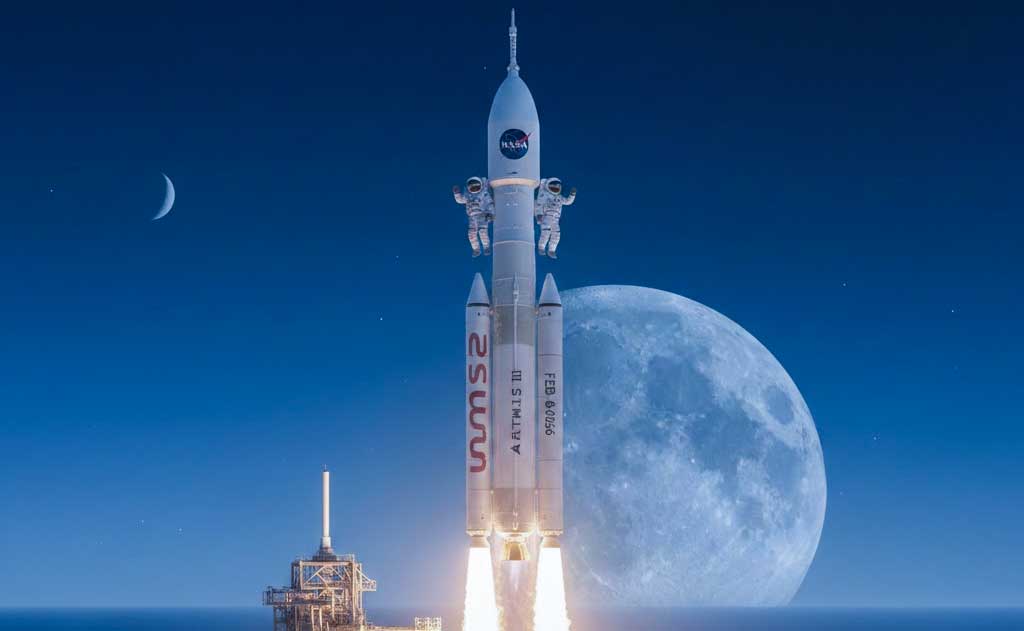
On January 20, 2026, as the world watches with bated breath, NASA dropped a bombshell that reignited the flame of human space exploration: “We’re heading to the Moon. The launch window opens as early as Feb. 6 for our crewed @NASAArtemis mission.”
This isn’t just another launch—it’s the moment we’ve waited over 53 years for. Artemis II will be the first crewed mission beyond low Earth orbit since Apollo 17 in 1972, sending four brave astronauts on a heart-pounding 10-day journey around the far side of the Moon and back. For the first time in generations, humans will venture into deep space aboard the mighty Space Launch System (SLS) and the cutting-edge Orion spacecraft.
In this exclusive deep-dive for vfuturemedia, we bring you the full technological spectacle: the groundbreaking hardware, the history-making crew, the nail-biting timeline, the revolutionary systems that make it possible, and why Artemis II isn’t just a flyby—it’s the gateway to permanent human presence on the Moon, Mars, and beyond.
Buckle up. The future starts now.
The Countdown Has Begun: Rollout Complete, Pad 39B Awaits Glory
Just days ago, on January 17, 2026, the colossal SLS rocket—standing taller than the Statue of Liberty at 322 feet (98 meters)—embarked on its majestic crawl from the Vehicle Assembly Building (VAB) at Kennedy Space Center. Carried by the legendary Crawler-Transporter 2 (the same beast that hauled Apollo Saturn Vs), the 11-million-pound stack inched along at 0.8 mph for nearly 12 hours, arriving at the iconic Launch Complex 39B under floodlights like a scene from a sci-fi epic.
This is the very pad where Apollo 10 lifted off in 1969 and where Artemis I roared to life in 2022. Now, it’s primed for humanity’s next giant leap.
Next up: The critical Wet Dress Rehearsal targeted no later than February 2, 2026. Engineers will flood the rocket with over 700,000 gallons of super-cold liquid hydrogen and oxygen, run a full countdown simulation (stopping just short of ignition), and drain the propellants. This test is make-or-break—if flawless, we’re go for February 6.
NASA Administrator Jared Isaacman (yes, the same billionaire astronaut who flew Inspiration4 and Polaris Dawn) has made crew safety absolute priority #1. “We’re pursuing every efficiency to launch as early as possible,” he stated, while confirming fallback windows extend into March and April if needed.
Meet the Heroes: The Artemis II Crew – Firsts That Will Echo Through History
This isn’t just any crew—it’s a lineup of trailblazers:
- Commander Reid Wiseman (NASA): Veteran astronaut, former ISS Expedition commander, cool under pressure.
- Pilot Victor Glover (NASA): First Black astronaut to venture to the Moon; flew on SpaceX Crew-1 and spent 6 months on the ISS.
- Mission Specialist Christina Koch (NASA): Holds the record for longest single spaceflight by a woman (328 days); first woman to travel beyond low Earth orbit.
- Mission Specialist Jeremy Hansen (Canadian Space Agency): First non-American to fly around the Moon; fighter pilot turned astronaut, representing international partnership.
Together, they’ll become the farthest-traveling humans in history, surpassing even Apollo 13’s record distance from Earth.
Glover will be the first person of color to the Moon. Koch the first woman. Hansen the first international astronaut in deep space under Artemis. This crew embodies diversity, excellence, and the spirit of global collaboration.
The Technological Marvels Powering Artemis II
1. Space Launch System (SLS) Block 1 – The Most Powerful Rocket Ever Built
- Thrust: 8.8 million pounds at liftoff—15% more powerful than the Saturn V.
- Core stage: Four RS-25 engines (shuttle heritage, upgraded) + two solid rocket boosters.
- Height: 322 ft (98 m) – tallest rocket ever stacked.
- Capable of sending 95,000 lbs to the Moon in one shot.
This beast will hurl Orion out of Earth’s gravity well in minutes, reaching speeds no human has experienced since 1972.
2. Orion Spacecraft – Humanity’s Deep-Space Chariot
- Crew module built by Lockheed Martin; European Service Module (ESM) by ESA (provides propulsion, power, life support).
- Advanced life support: Recycles water and air for weeks.
- Radiation protection: Storm shelter in the lower deck for solar flares.
- Heat shield: Upgraded after Artemis I lessons—will face 5,000°F (2,760°C) on re-entry at 25,000 mph (Mach 32)—faster than any human-rated spacecraft ever.
- 21st-century cockpit: Giant touchscreens, automated docking, call-sign “Artemis” for the crew.
3. Free-Return Trajectory – Genius Safety Built In
- The mission uses a hybrid free-return path: If anything goes wrong after trans-lunar injection, the Moon’s gravity slingshots Orion safely back to Earth—no engine burn needed.
- They’ll loop around the far side, emerging to breathtaking Earthrise views just like Apollo 8.
4. Ground-Breaking Science & Tech Demos
- Radiation sensors on mannequins (Commander Moonikin Campos returns!).
- Biological experiments studying human physiology in deep space.
- Callisto: Alexa-like AI assistant (Lockheed/Amazon/Cisco collaboration) for voice commands.
- Your name on board: Millions have already signed up—names stored on an SD card flying to the Moon!
Mission Profile: A 10-Day Odyssey Step by Step
- Launch from KSC Pad 39B – February 6 or later.
- Earth Orbit Checkout – Two orbits to verify systems.
- Trans-Lunar Injection (TLI) – SLS upper stage fires, sending Orion toward the Moon.
- Outbound Journey – 4 days coasting, crew conducts experiments.
- Lunar Flyby – Closest approach ~6,400 miles from surface; far-side pass (no comms for ~35 minutes).
- Return Trajectory – Gravity assist slingshot.
- Re-Entry & Splashdown – Pacific Ocean off California; Navy recovery.
Total distance: Over 1.3 million miles traveled—farther than any human mission.
Why Artemis II Changes Everything
This isn’t Apollo 2.0. It’s the foundation for:
- Artemis III (mid-2027): First woman and person of color on the lunar surface via SpaceX Starship HLS.
- Lunar Gateway: Orbiting Moon station for sustained presence.
- Sustainable Exploration: Reusable landers, lunar bases, resource utilization (water ice for fuel).
- Mars by 2030s: Technologies proven here will get us to the Red Planet.
Artemis II proves we can live and work in deep space again. It reignites global inspiration—kids watching today will be the Mars generation.
How to Watch the Historic Launch Live
NASA+ (plus.nasa.gov) will provide wall-to-wall coverage: rollout recaps, wet dress, daily updates, and full launch broadcast with multiple camera angles, including onboard Orion views.
As NASA says: Live coverage throughout the journey on NASA+.
Final Thoughts: We Are Going
Fifty-three years after Gene Cernan promised “we shall return,” we’re keeping that promise.
On February 6, 2026—or soon after—four astronauts will light the torch passed from Apollo, igniting a new era of exploration that belongs not just to America, but to all humanity.
The Moon is calling again.
And this time, we’re answering—for good.
Stay locked to vfuturemedia for real-time updates, exclusive breakdowns, and behind-the-scenes tech insights as we count down to launch.
The future is lunar. The future is now.
I’m Ethan, and I write about the tech that’s actually going to change how we live — not the stuff that just sounds impressive in a press release. I cover AI, EVs, robotics, and future tech for VFuture Media. I was on the ground at CES 2026 in Las Vegas, walking the show floor so I could give you a real read on what matters and what’s just noise. Follow me on X for daily takes.



Leave a Comment