
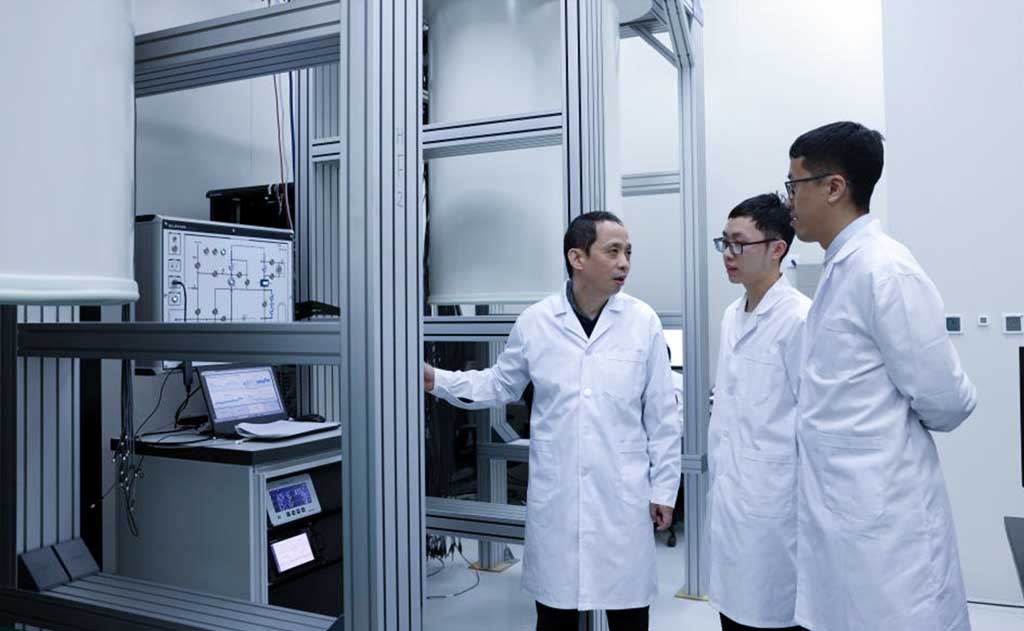
China’s Zuchongzhi 3.2 achieves fault-tolerant error correction with superior efficiency over Google, while global room-temperature advances signal practical quantum era ahead
In a stunning close to 2025, China’s quantum researchers have delivered a game-changing milestone: the Zuchongzhi 3.2 superconducting quantum processor has crossed the fault-tolerant threshold—the critical point where error correction actually improves stability rather than degrading it. Led by pioneering physicist Pan Jianwei at the University of Science and Technology of China (USTC), this breakthrough makes China only the second nation (after the US with Google’s Willow) to achieve this on a superconducting system—and potentially with a more scalable, efficient path forward.
Published in Physical Review Letters, the team’s innovative all-microwave control method suppresses leakage errors without the heavy hardware overhead Google required. This not only matches Google’s distance-7 surface code logical qubit but promises easier scaling to millions of qubits, reducing wiring complexity in cryogenic setups.
As one analyst noted, this “could offer a more efficient route than Google’s” to practical, large-scale quantum machines. For a field long plagued by fragile qubits, this is the stability breakthrough we’ve been waiting for.
Crossing the Fault-Tolerant Threshold: What It Really Means
Quantum bits (qubits) are incredibly sensitive—vibrations, heat, or electromagnetic noise can cause errors that cascade through calculations. Traditional error correction often added more problems than it solved.
The fault-tolerant threshold changes everything: Below it, adding correction layers worsens errors. Above it (or rather, operating below the threshold rate), each layer exponentially improves reliability, enabling indefinite computations.
Zuchongzhi 3.2’s feats:
- 107 physical qubits forming a distance-7 logical qubit
- Error-suppression factor of 1.4 as code distance increased
- Logical error rates dropping markedly with scaling
This confirms the system operates below the threshold, proving error correction works effectively. It’s the first non-US demonstration and uses multiplexed microwaves for cleaner, simpler control—potentially revolutionizing chip design.
Beating Google on Efficiency: The Microwave Advantage
Google’s Willow relied on direct-current pulses and extra hardware to suppress leakage (qubits escaping computational states). Effective, but constraining for scaling.
China’s all-microwave approach:
- Multiplexes signals over shared lines
- Reduces wiring density and hardware constraints
- Eases thermal/mechanical challenges in dilution refrigerators
As Pan’s team stated, this opens “a new, more efficient pathway” for fault-tolerant quantum computing. Experts call it an “impressive feat” that narrows—and in efficiency, arguably surpasses—the gap with US leaders.
Room-Temperature Breakthroughs: Closing the Cryogenic Gap
While superconducting systems like Zuchongzhi still need near-absolute zero, 2025 saw explosive progress in room-temperature quantum technologies:
- Neutral-atom systems (e.g., China’s Hanyuan No. 1): Operate at room temp, compact (three racks), commercial orders pouring in.
- Photonic quantum computers: Light-based qubits inherently stable at room temp; China’s Jiuzhang series and global modular systems (e.g., Xanadu’s Aurora) advance scalability.
- Hybrid integrations: New chips combine quantum dots with lithium niobate for dense, tunable emitters.
- Global highlights: Stanford’s nanoscale device entangles photons/electrons at room temp; polymer materials maintain coherence without cooling.
These designs bypass cryogenic barriers, slashing costs and enabling practical deployment—from data centers to portable sensors.
Why This Matters: From Lab Curiosity to Real-World Power
Fault-tolerance + room-temp progress = the holy grail of usable quantum computing:
- Drug discovery: Simulate molecules impossible classically
- Materials science: Design room-temp superconductors
- Optimization/AI: Solve logistics, finance problems exponentially faster
- Cryptography: Break current codes—or build unbreakable ones
China’s microwave efficiency edge accelerates the race toward million-qubit systems. Combined with photonic/neutral-atom room-temp paths, practical quantum advantage feels closer than ever.
As 2025 ends, the quantum future isn’t distant—it’s arriving, led by bold innovations like Zuchongzhi 3.2.
What quantum breakthrough excites you most for 2026? Fault-tolerance scaling or room-temp reality? Comment below!
Published on www.vfuturemedia.com | December 29, 2025




Leave a Comment