

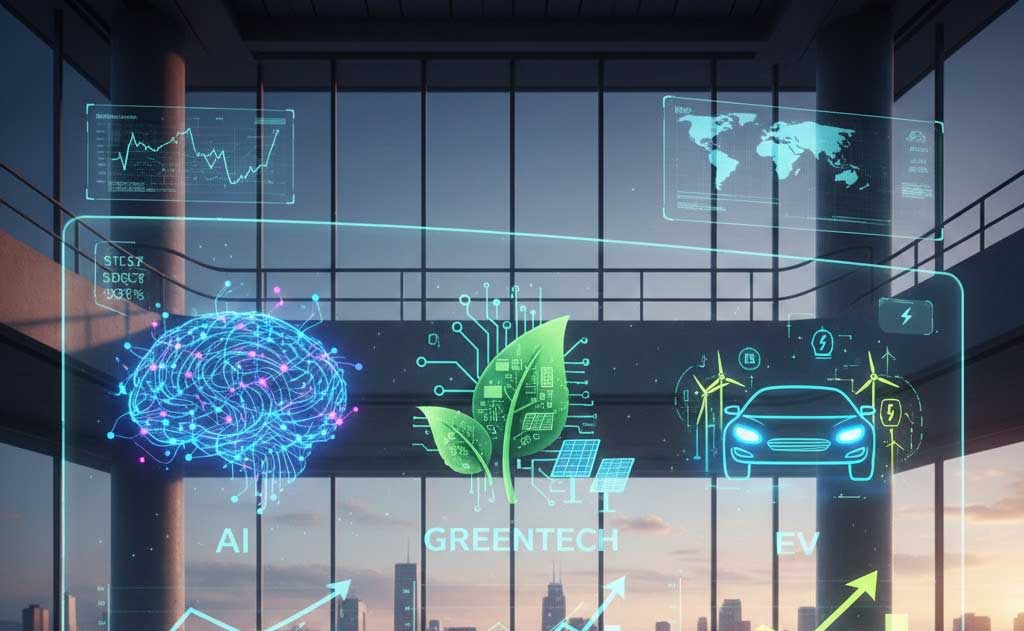
The startup funding landscape in February 2026 continues to show remarkable strength, particularly in AI, greentech, and technologies addressing the energy demands of the AI boom. Investors are doubling down on deeptech solutions that power intelligent systems while solving sustainability and efficiency challenges. From AI inference platforms raising at unicorn valuations to AI-enhanced wind energy operations in India and innovative data-center cooling inspired by rocket technology, this month’s notable rounds highlight the tight linkage between artificial intelligence and the global energy transition.
For more context on capital flows in this environment, explore our detailed guide: vfuturemedia.com: Tech Investments in the AI Era – Strategies for 2026 and Beyond.
Standout Funding Rounds This Month
GreenTech (India) closed its first institutional round, raising ₹30 crore (~$3.5 million) entirely from climate-focused Transition VC through a combination of equity and debt. Founded in 2018 by Daniel Raj and previously bootstrapped, the Coimbatore-based deeptech company specializes in AI-driven wind turbine operations and maintenance (O&M). Its platform uses predictive analytics, SCADA integration, and asset optimization to improve uptime, reduce downtime, and lower operating costs for wind farm operators.
The fresh capital will accelerate global expansion, infrastructure development, and further enhancement of its AI capabilities—well timed as India continues to rapidly scale its renewable energy capacity.
Baseten announced a blockbuster $300 million Series E at a $5 billion valuation. The round was led by IVP and CapitalG (both increasing their stakes), with participation from NVIDIA, Altimeter, Battery Ventures, and other strategic investors. Baseten provides high-performance, reliable inference infrastructure that powers production-grade AI applications, especially those running complex, multi-model workloads. This funding comes amid exploding demand for efficient AI deployment at scale.
Humans&, a newly formed “human-centric” AI lab founded by alumni from Anthropic, xAI, Google, and Stanford (including Andi Peng, Georges Harik, Eric Zelikman, Yuchen He, and Noah Goodman), raised an extraordinary $480 million seed round at a $4.48 billion valuation. The round included NVIDIA, Jeff Bezos, SV Angel, GV (Google Ventures), Emerson Collective, and others. Despite being only months old, the company is building AI systems designed to augment human workers rather than replace them, with a strong emphasis on ethical design and real-world productivity gains.
Neurophos, the Austin-based photonic AI hardware startup, secured $110 million in Series A funding (oversubscribed, bringing total raised to $118 million). The round was led by Gates Frontier (Bill Gates’ venture arm), with participation from M12 (Microsoft’s corporate venture fund), Carbon Direct Capital, Aramco Ventures, Bosch Ventures, and additional investors. Neurophos develops energy-efficient photonic processors using metamaterial modulators, targeting exaflop-scale inference workloads and directly addressing the massive power consumption challenges of modern AI data centers.
Karman Industries (Los Angeles) raised $20 million as part of a larger round totaling over $30 million, backed by Riot Ventures, Sunflower Capital, Space VC, Wonder Ventures, and former Intel/VMware CEO Pat Gelsinger. The founders—SpaceX alumni David Tearse and Chiranjeev Kalra—are applying rocket-engine-derived thermal management technology to create water-free, low-power data center cooling systems. Their modular 10MW Heat Processing Units (HPUs) use liquid CO2 refrigerant to deliver >25% energy savings and up to 80% smaller footprint compared to traditional cooling. First customer deliveries are scheduled for summer 2026.
Key Trends Shaping Greentech & AI Investments in 2026
Several clear patterns are emerging:
- AI-Driven Energy Demand Fuels Climate Tech The explosive growth of AI infrastructure is creating massive new demand for sustainable power and cooling solutions. Startups like Karman (advanced cooling), Neurophos (photonic efficiency), and GreenTech (AI-optimized renewables) are capitalizing on this tailwind.
- Regional Momentum India continues to attract climate-focused capital for AI-enhanced renewable technologies, while the U.S. dominates deep hardware and infrastructure plays backed by corporate giants (NVIDIA, Microsoft, Gates Frontier, Aramco).
- Investor Priorities Climate specialists (Transition VC) target scalable, high-impact efficiency solutions. Big tech and strategic investors are placing large bets on hardware and infrastructure that can tame AI’s power footprint.
- Larger Checks, Fewer Deals While overall deal volume may moderate, average check sizes in high-conviction categories continue to grow significantly.
These trends confirm that the AI supercycle and the energy transition are now deeply intertwined—creating outsized opportunities for founders solving real constraints at scale.
For practical advice on positioning startups in this environment, see: vfuturemedia.com: Startup Strategies for AI Disruption in Software.
Founder Highlights
- Daniel Raj (GreenTech) — Successfully bootstrapped for years before securing climate VC backing; now positioned to globalize AI-powered wind O&M services.
- Neurophos team — Translating cutting-edge metamaterials research into commercially viable photonic AI hardware with elite strategic support.
- Karman Industries founders (David Tearse & Chiranjeev Kalra) — Repurposing SpaceX-derived thermal expertise to solve one of AI’s most pressing infrastructure bottlenecks.
These founders exemplify deep domain knowledge combined with timely market insight—qualities attracting the highest-conviction capital.
Looking Ahead
February 2026 funding activity reinforces that momentum in AI infrastructure and climate-resilient technologies will persist. Expect continued interest in edge efficiency, next-generation geothermal, fusion-adjacent innovations, and AI-optimized renewable operations.
Call for Submissions
Building something exciting in AI, greentech, EV, deeptech, or cleantech? We’d love to hear from you.
Submit your funding announcement, product launch, milestone, or founder story for potential featuring on vfuturemedia.com — reaching investors, operators, and tech leaders worldwide.
→ Submit here: vfuturemedia.com/startup-submissions
In summary, February 2026 proves once again that the intelligence supercycle and the energy transition are not separate stories—they are the same story, creating fertile ground for bold, technically deep


Leave a Comment