
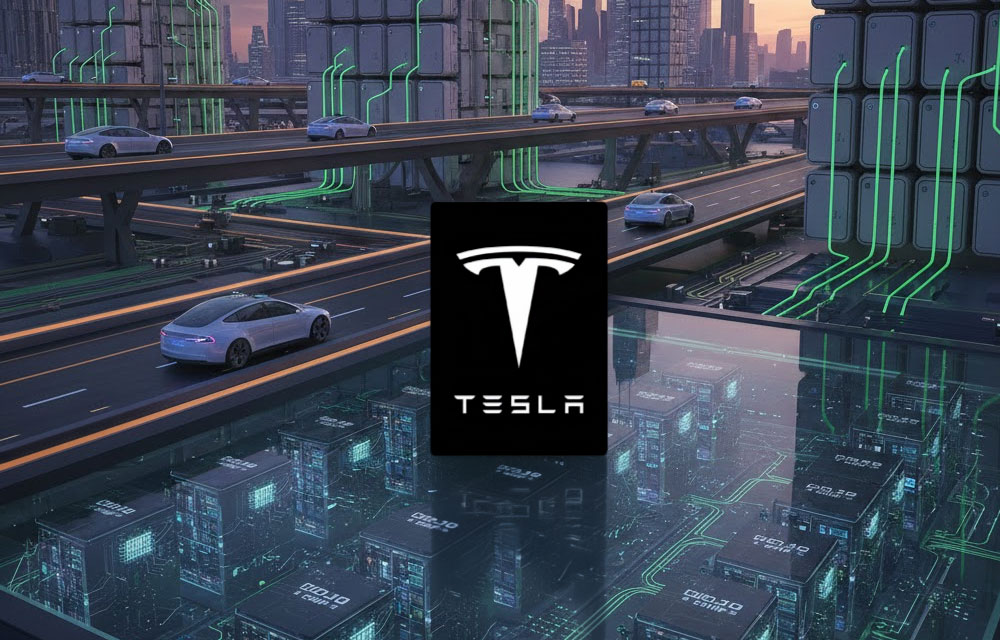
How Tesla Could Unlock 100 GW of AI Compute While Greening the Planet
Imagine waking up in 2026. You open an app, tap once, and a sleek two-seat Cybercab with no steering wheel glides silently to your door. It whisks you across town for pennies while its onboard AI chips quietly earn money for you by solving complex problems when the car is parked. In factories nearby, thousands of Optimus humanoid robots assemble the next wave of vehicles with superhuman speed and precision. And holding it all together: continent-scale grids of Megapacks that turn millions of idle Tesla batteries into the backbone of renewable energy.
This isn’t science fiction. It’s Tesla’s converging master plan, and 2026 is the year everything clicks.
1. Cybercab – The Global Robotaxi Rollout
Production of the purpose-built Cybercab (code-named “Redwood” internally) is scheduled to begin in April 2026 at Giga Texas. Built using Tesla’s revolutionary unboxed manufacturing process, the vehicle has no steering wheel, no pedals, and is designed from the ground up for full autonomy.
- First unsupervised FSD fleets expand rapidly in Austin, San Francisco, and Los Angeles in early 2026
- Cybercab volume ramps from 5,000 units in Q2 to potentially 100,000+ by year-end
- Pricing targeted below $25,000, with operating costs of 20–30 cents per mile – cheaper than buses in many cities
- Global launches prioritized in high-demand, labor-short markets (Japan, South Korea, Europe)
Every Cybercab becomes a node in the world’s largest distributed supercomputer. With over one million quarterly vehicle deliveries by 2026, the fleet’s collective idle compute could exceed 100 GW – more than the world’s current top supercomputers combined.
2. Dojo Chips + Optimus – From Factory Floor to Household Helper
Tesla’s AI5 inference chip (250 W, 2,250 TOPS) ships in volume in 2026, followed quickly by AI6 and AI7. These chips don’t just power cars – they give Optimus its brain.
- Optimus Gen 3 begins low-rate production in Fremont and Texas in Q1 2026
- Thousands of units deployed inside Tesla factories by mid-year, handling repetitive or dangerous tasks
- End-to-end neural control means the same software that drives a Cybercab also walks, grasps, and learns
- Late 2026: first external customer shipments (warehouses, logistics partners)
Because the robot and the car train on the exact same massive video dataset, progress in one accelerates the other at lightning speed.
3. Megapack Grids – The Hidden Superpower
While robotaxis grab headlines, Tesla’s energy division is quietly becoming the largest battery maker on Earth.
- New Megafactory in Houston begins production in 2026, joining the record-breaking Shanghai and California plants
- Grid-forming inverters allow Megapacks to stabilize networks and absorb massive amounts of solar/wind without blackouts
- Virtual Power Plants (VPPs) turn every parked Tesla into a revenue-generating grid asset
- By tying millions of vehicles and home Powerwalls together, Tesla creates the world’s most resilient, decentralized energy system
The Ultimate Flywheel
These three businesses aren’t separate – they’re symbiotic:
Robotaxis → massive fleet → petabytes of real-world training data Data → better AI → safer autonomy + smarter robots Robots → cheaper cars + higher factory output Cheaper cars → bigger fleet → more distributed compute Megapacks + VPPs → cheap, green electricity to charge everything 24/7
The result? A self-reinforcing loop that no competitor can match.
What 2026 Actually Looks Like
- Q1: First unsupervised Robotaxi service goes live for employees, then early access owners
- Q2: Cybercab production starts; Optimus walks unaided out of the factory for the first time
- Q3: Megapack deployments cross 100 GWh cumulative storage
- Q4: Tesla’s market cap reflects not just car sales, but the explosive optionality of autonomy, robotics, and energy
By the end of 2026, Tesla stops being “just” a car company. It becomes the central nervous system of the autonomous, electric, AI-powered future.
The trifecta is complete. The age of abundance begins.
What will you do with your first driverless ride? The future isn’t coming – it’s already being built in Texas, Shanghai, and every charging station around the world.
VFuturMedia – Where Tomorrow Meets Today
You made it to the end, which means you actually care about this stuff. So do we. Check out our AI and EV sections for more stories worth your time.


Leave a Comment