

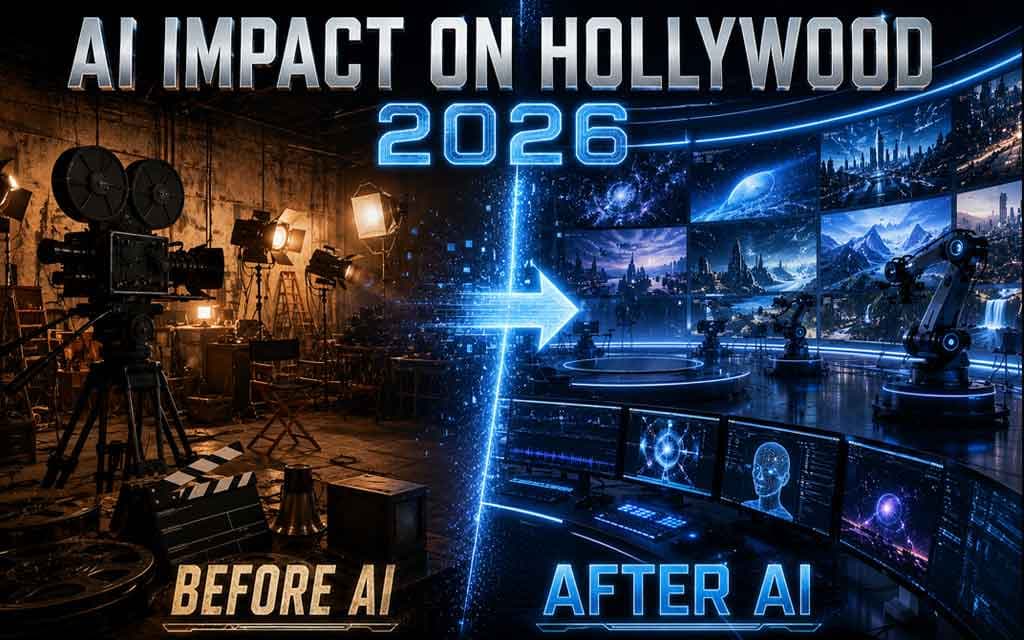
AI Impact on Hollywood 2026: Before AI vs After AI – The Complete Transformation
NEXT_PUBLIC_GOOGLE_ADSENSE_ID to enableExplore the AI revolution in Hollywood 2026. Before vs after AI: job losses, new tools like Runway & Sora, SAG-AFTRA deals, indie opportunities, and what it means for actors, writers, and the future of cinema. (148 characters)
Introduction
Hollywood in 2026 stands at a historic crossroads. Artificial Intelligence is no longer a futuristic concept or a strike flashpoint — it’s deeply embedded in every stage of filmmaking, from script generation to final VFX. What was once a labor-intensive, multimillion-dollar industry dominated by large studio crews and physical sets has rapidly evolved into a hybrid ecosystem where AI tools dramatically cut costs, accelerate timelines, and democratize creation.
This article provides a detailed before AI vs after AI comparison focused on 2026 realities. We’ll examine job impacts, creative shifts, union responses, emerging tools, and the broader implications for the entertainment industry. For anyone tracking AI in Hollywood 2026, Hollywood job losses AI, or the future of film, this serves as a comprehensive guide.
The transition hasn’t been smooth. The 2023 WGA and SAG-AFTRA strikes highlighted deep fears over AI replacing human creativity and livelihoods. By mid-2026, cautious acceptance is emerging alongside ongoing tensions, with studios embracing productivity gains while unions secure new protections.
Hollywood Before AI: The Traditional Model
Prior to the widespread adoption of generative AI (roughly pre-2023–2024), Hollywood operated on a well-established, high-cost model:
- Pre-Production: Manual scriptwriting, storyboarding by artists, location scouting, and casting calls. Tools were digital but human-driven — Final Draft for scripts, Photoshop for concepts.
- Production: Large crews (often 100–500+ people per shoot), physical sets, practical effects, and on-location filming. Principal photography for a blockbuster could take months and cost tens to hundreds of millions.
- Post-Production: Labor-intensive VFX by teams at companies like ILM or Weta Digital, manual editing, sound design, and color grading. A single VFX-heavy scene might require weeks of human effort.
- Workforce: High employment in entry-level and mid-tier roles — concept artists, junior editors, background actors, voice talent, and VFX artists. Studios relied on big budgets and theatrical releases for revenue.
This system produced iconic cinema but suffered from inefficiencies: skyrocketing budgets (e.g., Marvel films exceeding $200–300M), long timelines, and barriers for independent creators. Creativity was human-centric, but scalability was limited by talent availability and costs.
Hollywood After AI in 2026: The New Reality
By 2026, AI has permeated the pipeline, delivering 5–10%+ productivity gains in many workflows and enabling entirely new possibilities. McKinsey and industry reports highlight a shift toward hybrid human-AI collaboration, with generative tools handling repetitive tasks and augmenting creativity.
Pre-Production Revolution
- Scripting & Development: Tools like ScriptBook, Storyflow, and AI-assisted platforms analyze market trends, generate drafts, and suggest plot twists. Writers use AI for ideation but refine for originality.
- Storyboarding & Concept Art: Midjourney, Runway, and FLUX models (used by directors like Martin Scorsese) create rapid visualizations. Scorsese’s partnership with Black Forest Labs for storyboarding exemplifies how AI frees directors to communicate visions faster.
- Casting & Planning: AI scheduling tools like Filmustage automate breakdowns, budgets, and call sheets.
Production & Virtual Worlds
- Virtual production with LED walls (e.g., The Mandalorian style) combined with AI generative elements reduces the need for massive physical sets.
- Tools like Luma AI, Runway, and Higgsfield generate scenes, backgrounds, or even short clips from text prompts. Indie filmmakers now produce competitive content with tiny crews.
Post-Production Transformation
- VFX & Editing: Runway ML, Adobe Sensei, and Descript handle complex effects, upscaling, and automated cuts. What once took teams weeks now happens in days.
- Voice & Dubbing: ElevenLabs and similar tools for realistic voice synthesis and multilingual dubbing.
- Full Generative Content: Short films and even features increasingly incorporate AI-generated footage, with human oversight for coherence.
Studios report significant cost savings and faster release cycles, enabling more content for streaming platforms.
Before vs After AI: Side-by-Side Comparison (2026 Lens)
| Aspect | Before AI (Traditional) | After AI (2026 Hybrid) | Key Impact |
|---|---|---|---|
| Production Cost | High ($100M+ for blockbusters) | Significantly reduced (micro-studios viable) | Democratization for indies |
| Timeline | Months/years for full pipeline | Weeks/months with AI acceleration | Faster content output |
| Crew Size | Large (hundreds) | Smaller hybrid teams + AI tools | Job consolidation |
| VFX/Effects | Manual, expensive teams | Generative AI + human polish | 204K+ potential job shifts by 2026 |
| Creativity | Purely human-driven | Human-AI collaboration | New tools but "soul" debates |
| Accessibility | Gatekept by studios/budgets | Open to independent creators | Rise of micro-studios |
Data draws from McKinsey, Animation Guild, and industry reports projecting major disruption.
Job Impacts: Losses, Shifts, and New Opportunities
One of the most contentious areas is employment. Predictions from 2025 suggested up to 204,000 film and TV jobs could disappear by 2026, particularly in animation, VFX, background acting, and entry-level roles.
- Winners: AI specialists, prompt engineers, hybrid technicians (blending real + generated footage), and top-tier talent. Companies like Runway are hiring filmmakers for tool development.
- Losers: Junior VFX artists, concept illustrators, and background performers. AI-generated crowds and synthetic actors reduce demand.
- Overall: A structural shift rather than total collapse. Demand grows for AI-literate creatives, but entry barriers rise for traditional paths.
Union Responses and SAG-AFTRA 2026 Deals
SAG-AFTRA’s 2026 TV/Theatrical Agreement ratification (June 2026) marks a key milestone. It strengthens protections for digital replicas and synthetics, requiring consent, compensation, and limits on AI use (e.g., “significant additional value” clause for synthetic performers). A pension merger and residual increases were also secured.
These deals reflect a move from outright resistance to regulated integration, though critics argue loopholes remain. Ongoing 2026 negotiations will refine these further.
Success Stories and Challenges in 2026
- Embracing AI: Directors like Scorsese and Gareth Edwards experiment with tools for efficiency. Indie productions thrive with lower barriers.
- Concerns: Deepfakes, loss of authenticity, and “uncanny valley” issues persist. Viral AI clips (e.g., Tom Cruise/Brad Pitt mashups) spark debates on creativity.
- Box Office & Revenue: AI helps studios produce more content amid streaming wars, but theatrical experiences emphasize human storytelling for premium appeal.
The Future Outlook: 2026 and Beyond
AI won’t “kill” Hollywood but is reshaping it into a more efficient, accessible industry. McKinsey envisions new profit pools, micro-studios, and creator-driven content. Long-term, the winners will be those mastering human-AI symbiosis — preserving storytelling soul while leveraging technology.
Challenges remain: ethical guidelines, training displaced workers, and ensuring AI augments rather than replaces human ingenuity. Cannes 2026 highlighted this shift from fear to acceptance.
Conclusion
The AI impact on Hollywood in 2026 represents one of the fastest industry transformations ever. Before AI, filmmaking was an elite, costly endeavor; after AI, it’s becoming more dynamic, affordable, and collaborative — albeit with real human costs and creative questions.
For professionals, the message is clear: Adapt by learning AI tools, upskilling in hybrid workflows, and focusing on irreplaceable human elements like emotional depth and originality. Studios that balance innovation with ethical practices will lead.
Stay tuned to vfuturemedia.com for the latest on AI news, tech in entertainment, gadgets, and future trends. How do you see AI shaping movies in the coming years? Share your thoughts in the comments below.
NEXT_PUBLIC_GOOGLE_ADSENSE_ID to enable

