
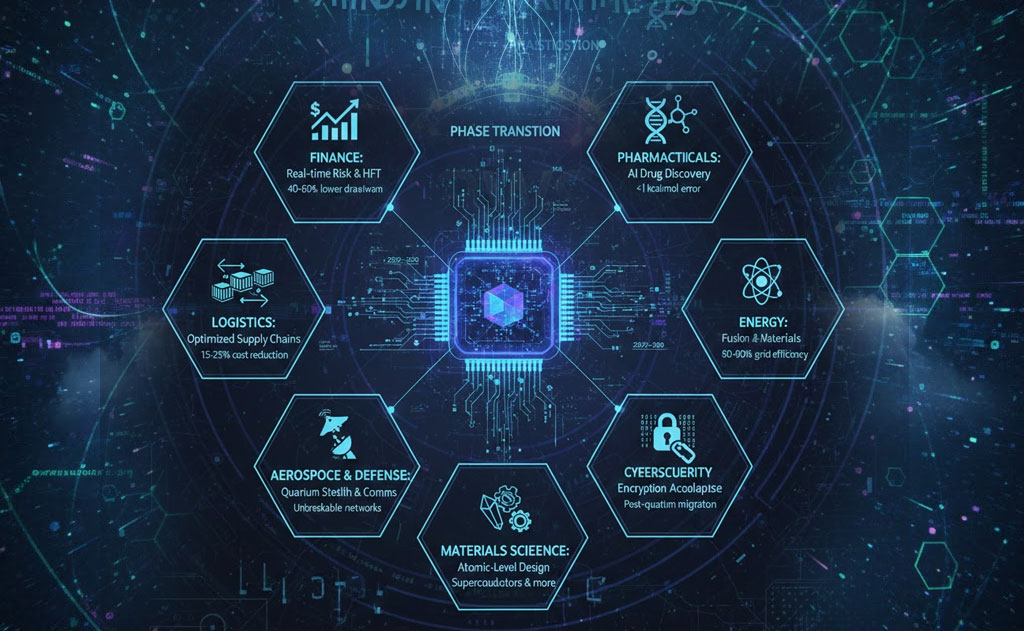
By 2030, quantum computing will no longer be a laboratory curiosity or a PowerPoint slide for venture capitalists. It will be live, scalable, and mercilessly rewriting the rules of seven multi-trillion-dollar industries. While classical computers grind through problems one step at a time, quantum machines will exploit superposition, entanglement, and tunneling to solve in minutes what would take today’s supercomputers longer than the age of the universe.
Here’s the deep dive you’ve been waiting for — no hype, just the cold, hard physics and economics of what’s coming.
1. Finance: The End of “Acceptable” Risk Models
Wall Street runs on risk. Value-at-Risk (VaR), derivatives pricing, portfolio optimization — every model depends on sampling millions of possible futures. Classical Monte Carlo simulations take hours or days. A 300+ qubit fault-tolerant quantum computer will run those same simulations in seconds with perfect accuracy.
By 2028–2030:
- Black-Scholes will look like an abacus. Quantum amplitude estimation will price complex options in real time, even those with path-dependent, early-exercise, or basket features.
- High-frequency trading firms using quantum-enhanced machine learning will predict micro-movements 50–200 milliseconds before classical algorithms.
- Quantum portfolio optimization (using QAAP — Quantum Approximate Optimization Algorithm and improved versions) will routinely manage $100 billion+ funds with 40–60% lower drawdown reduction.
- Central banks and hedge funds will quietly run quantum-accelerated stress tests that expose systemic risks no classical model ever saw.
Result? The first funds to cross the “quantum advantage” threshold will generate returns so obscene that regulators will be forced to ask whether markets are still fair.
2. Pharmaceuticals: From 12 Years and $2.6 Billion to Months and Millions
90% of drug candidates fail in clinical trials because we’re terrible at predicting how molecules fold, bind, and interact inside the chaotic environment of a human cell.
Quantum computers are built for exactly this problem. They simulate quantum mechanics natively.
By 2030:
- Companies like Google Quantum AI, IBM, PsiQuantum, and Xanadu will offer cloud-based quantum chemistry platforms capable of exact simulation of molecules with ~200 atoms (think kinase inhibitors, G-protein-coupled receptors, antibodies).
- Room-temperature stable nitrogen-vacancy diamond sensors + logical qubits will model protein-ligand binding affinities with <1 kcal/mol error — good enough to skip most Phase I failures.
- Generative quantum AI will design de-novo small molecules and macrocycles that are synthesizable, patentable, and already pre-optimized for ADMET properties.
- Personalized oncology will explode: a patient’s tumor genome + quantum simulation = bespoke drug in weeks instead of decades.
The first quantum-discovered drug to reach market (expected 2027–2029) will instantly make every big pharma CEO lose sleep.
3. Logistics & Supply Chain: The Death of “Good Enough” Planning
Global supply chains are optimized with heuristics because exact solutions for 100,000+ variables are NP-hard.
Quantum annealing and universal gate-based systems destroy that excuse.
By 2030:
- D-Wave, Fujitsu, and new players will deploy million-qubit-class annealers for real-time fleet routing, warehouse slotting, and multimodal transport.
- Gate-based quantum algorithms (improved Grover + QAOA hybrids) will solve the quadratic assignment problem exactly for entire port operations.
- Maersk, Amazon, and Walmart will shave 15–25% off global logistics costs — trillions of dollars — while cutting CO₂ emissions by similar margins.
- Dynamic re-routing during disruptions (strikes, Suez 2.0, hurricanes) will happen in under 60 seconds instead of days.
The ripple effect? Empty shelves and $150 iPhones become historical curiosities.
4. Energy: Fusion Ignition Was Just the Opening Act
The holy grail of energy isn’t only better magnets or lasers — it’s perfect materials and real-time plasma control.
Quantum computers deliver both.
By 2030:
- Exact simulation of high-temperature superconductors will let us design room-temperature variants, slashing grid transmission losses by 80–90%.
- Quantum machine learning will control tokamak and stellarator plasmas with millisecond precision, pushing Q > 30 commercially viable fusion by 2032–2034.
- Oil & gas giants will use quantum-enhanced seismic imaging and reservoir modeling to squeeze the last economically recoverable barrels with near-zero dry wells.
- Battery chemistry leaps: solid-state cells with 1000+ Wh/kg become routine once we can simulate lithium-sulfur and lithium-air systems without approximation.
Cheap, abundant, clean energy flips geopolitics on its head.
5. Aerospace & Defense: Hypersonics, Stealth, and Space Become Unfair
Quantum radar renders stealth aircraft visible. Quantum sensors detect submarines through thermal noise. Quantum navigation without GPS becomes reality.
But the offense is even scarier.
By 2030:
- Quantum optimization designs airframes and turbine blades that no human or classical supercomputer could dream up — 30–40% more efficient, lighter, heat-resistant.
- Satellite constellation scheduling for thousands of LEO birds solved exactly in minutes.
- Quantum key distribution (QKD) networks + post-quantum cryptography hybrids make battlefield comms mathematically unbreakable.
- DARPA and Chinese equivalents will deploy drone swarms coordinated by quantum routing algorithms that cannot be jammed or predicted.
The nation that achieves scalable fault-tolerant quantum computing first gains a decade-long military advantage.
6. Cybersecurity: The Encryption Apocalypse
RSA-2048, ECC, Diffie-Hellman — all die the moment Shor’s algorithm runs on a logical-qubit machine with ~4000 high-fidelity qubits.
Timeline:
- 2027–2029: First cryptographically relevant quantum computer (CRQC) demonstrated.
- 2029–2030: Nation-state actors and elite hacking groups gain access.
- Every HTTPS certificate, blockchain private key, and military encryption scheme created before 2025 becomes retroactively readable.
The migration to post-quantum cryptography (NIST standards Kyber, Dilithium, Falcon) is already underway, but 60–70% of global systems will still be vulnerable in 2030.
Harvest-now-decrypt-later attacks mean your banking records, medical history, and state secrets recorded today could be an open book tomorrow.
7. Materials Science: Programming Reality at the Atomic Level
Want a metal stronger than steel but lighter than aluminum? A plastic that conducts electricity like copper? A window that turns into a solar panel on command?
Quantum simulation makes it trivial.
By 2030:
- Photonic and ion-trap quantum computers will routinely simulate periodic systems with thousands of atoms — enough to design metamaterials, topological insulators, and high-entropy alloys from first principles.
- Carbon capture membranes with 10× higher selectivity, room-temperature superconductors for MRI machines the size of a briefcase, self-healing concrete, aerospace-grade ceramics that don’t crack at Mach 8.
- The entire periodic table becomes Lego bricks. We stop guessing — we calculate.
This isn’t incremental improvement. It’s the difference between alchemy and chemistry.
The Bottom Line: A Phase Transition, Not Evolution
Most people think technological progress is linear or even exponential. Quantum computing is a phase transition — like going from ice to water. The rules suddenly change everywhere at once.
By 2030, the world will split into two categories:
- Organizations that have integrated quantum workflows.
- Organizations that are trying to survive against those that have.
The seven industries above won’t be “improved.” They will be rebuilt from the ground up, and the economic value created (and destroyed) will be measured in tens of trillions of dollars.
The quantum age isn’t coming. It’s already here — we’re just waiting for the qubits to finish booting up.
Welcome to the new reality.
© 2025 VFutureMedia – All Rights Reserved
I’m Ethan, and I write about the tech that’s actually going to change how we live — not the stuff that just sounds impressive in a press release. I cover AI, EVs, robotics, and future tech for VFuture Media. I was on the ground at CES 2026 in Las Vegas, walking the show floor so I could give you a real read on what matters and what’s just noise. Follow me on X for daily takes.
If you found this useful, the best thing you can do is share it with someone who’d actually appreciate it. And if you want more like it, we’re here every week.


Leave a Comment