
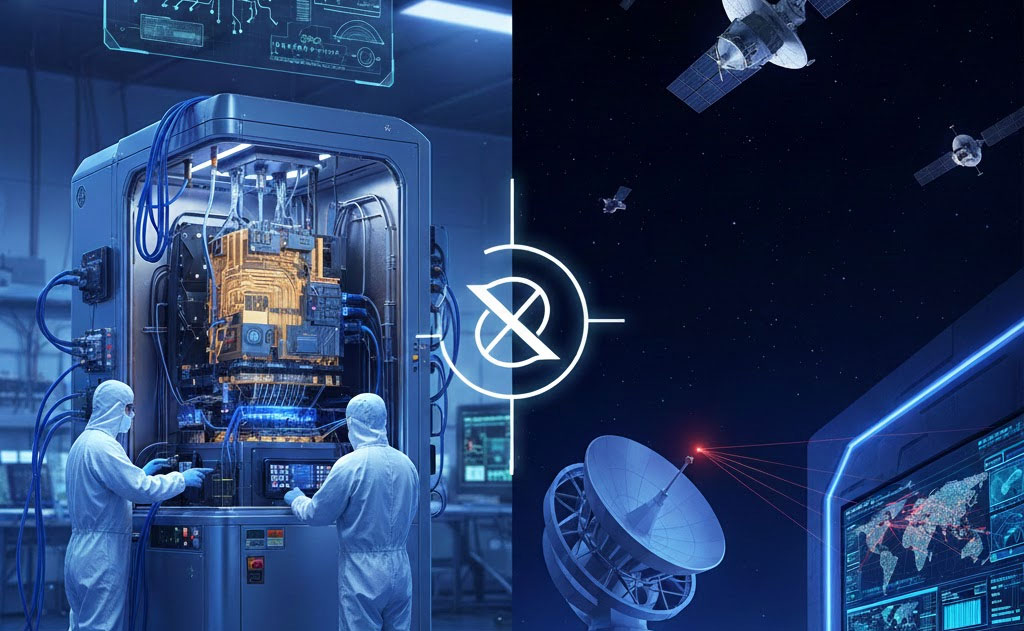
As 2025 draws to a close—the United Nations’ International Year of Quantum Science and Technology—the quantum computing race 2025 has reached new heights. Major breakthroughs from Google and IBM highlight U.S. dominance in powerful quantum processors, while China continues to lead in deploying practical China quantum satellite networks for ultra-secure communications. This creates a clear split: The U.S. excels in US vs China quantum hardware for raw computing power, while China prioritizes quantum communications that could reshape global encryption and military technology.
In simple terms, quantum computing uses strange rules of physics to solve problems impossibly hard for regular computers. But the field splits into two main paths: building powerful “brains” (hardware-focused quantum computers) and creating unbreakable “nerves” (quantum communications). The U.S. is ahead on the brains, China on the nerves—with profound future implications for encryption, cybersecurity, and military advantage.
The US Leads in Quantum Hardware: Google’s Willow and IBM’s Bold Roadmap
2025 has been a banner year for U.S. quantum hardware breakthroughs.
Google’s Willow chip, unveiled late 2024 and advancing through 2025, marked a milestone by demonstrating “below-threshold” error correction—meaning errors decrease as the system scales up, solving a 30-year challenge. Willow’s 105 qubits performed benchmarks in minutes that would take supercomputers billions of years, and in October 2025, Google achieved the first verifiable quantum advantage with the “Quantum Echoes” algorithm, running 13,000 times faster than classical systems.
IBM pushed boundaries with announcements in November 2025: the experimental Loon processor showcasing components for fault-tolerant computing, and the Nighthawk chip designed for quantum advantage by 2026. IBM’s roadmap targets large-scale fault-tolerant systems by 2029, with processors like Kookaburra aiming for over 1,000 qubits.
These US vs China quantum hardware advances focus on superconducting qubits, enabling simulations for drug discovery, materials science, and optimization—areas with massive military potential, like designing stealth materials or optimizing logistics.
In essence: U.S. companies like Google and IBM are building the most powerful quantum “engines” capable of tackling complex calculations exponentially faster.
China’s Edge: The World’s Leading Quantum Satellite Network
While the U.S. chases computing power, China has prioritized quantum communications, deploying the most advanced China quantum satellite infrastructure.
Building on the pioneering Micius (Mozi) satellite from 2016, China expanded its network dramatically in 2025. Milestones include record-breaking quantum key distribution (QKD) links: a microsatellite enabled secure transmission over 12,900 km to South Africa, and integrations with ground networks spanning thousands of kilometers.
China’s system uses satellites to distribute encryption keys via quantum entanglement—keys that are theoretically unhackable because any eavesdropping disrupts the quantum state and alerts users. In 2025, this network supported intercontinental links, including with BRICS nations, and plans for high-orbit satellites by 2027 aim for global coverage.
Simply put: China is building an “unbreakable internet” for secure data transmission, especially valuable for military and government communications.
The Split Explained: Hardware vs. Communications
The quantum computing race 2025 shows a strategic divide:
- U.S. Focus (Hardware/Computing): Google, IBM, and others invest in scalable quantum processors to run algorithms like Shor’s, which could one day break current encryption. This offers offensive potential—cracking codes—and defensive breakthroughs in simulations.
- China Focus (Communications): Prioritizing QKD via satellites and fiber networks for “unbreakable” encryption keys. This defends against future quantum attacks without needing full-scale quantum computers soon.
Neither side has “won” yet—useful large-scale quantum computing remains years away—but the paths complement different goals.
Future Implications: Encryption at Risk and Military Shifts
The most immediate concern is encryption. Today’s public-key systems (like RSA) rely on math problems hard for classical computers but potentially easy for quantum ones using Shor’s algorithm.
A cryptanalytically relevant quantum computer (CRQC) could trigger “Q-Day,” decrypting stored data—including “harvest now, decrypt later” stockpiles. Military implications: Exposed troop movements, nuclear protocols, or intelligence.
China’s QKD network provides quantum-secure communications now, potentially giving an edge in unbreakable military links. U.S. strategy favors post-quantum cryptography (PQC)—new math-based algorithms resistant to quantum attacks—with NIST standards rolling out.
Militarily:
- Quantum sensors could detect stealth vehicles or submarines.
- Quantum-accelerated AI for faster battlefield decisions.
- Whoever integrates first gains advantages in intelligence, targeting, and secure command.
Reports warn of eroding U.S. edges if China scales communications globally, while U.S. hardware leads could enable superior simulations.
The Path Ahead in the Quantum Race
As 2025 ends, the quantum computing race 2025 is balanced but intensifying. U.S. private innovation drives hardware leaps, while China’s state investments yield operational networks. Both pursue hybrid approaches, but the split persists.
Future security hinges on transitioning to PQC, international norms, and sustained investment. Quantum isn’t just futuristic—it’s reshaping encryption and military tech today.
Stay tuned to the evolving US vs China quantum hardware and China quantum satellite developments.
For more on emerging quantum breakthroughs and their global impact, visit vfuturemedia



Leave a Comment