
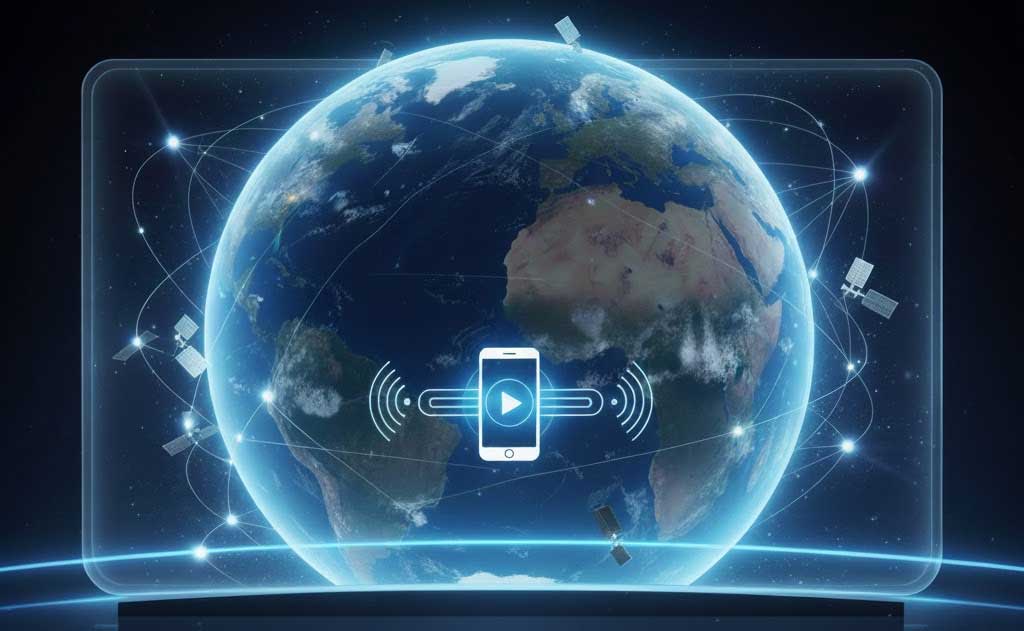
In a recent interview, SpaceX CEO Elon Musk dropped exciting details on the future of Starlink’s direct-to-cell satellite technology, promising a revolutionary leap in global mobile connectivity. “Your phone will eventually connect directly to Starlink satellites,” Musk stated, envisioning a world where users can stream high-definition videos anywhere on the planet – no cell towers required.
The key quote that’s sparking massive interest among tech enthusiasts: “High broadband connectivity from the satellite to the phones, but there are hardware changes that need to happen to the phone. The chip-set has to be modified to add these frequencies, so the phones that are able to use this would probably start shipping in about 2 years. And then we also need to build the satellites that are going to communicate all those frequencies. So we’re building the satellites and working with the hand-set makers to add these frequencies to the phones. The net effect is that you should be able to watch videos anywhere on your phone.”
This announcement builds on Starlink’s rapid progress in satellite-to-phone connectivity, shifting from basic texting in dead zones to full high-bandwidth data capable of supporting video streaming, gaming, and more.
Current State of Starlink Direct-to-Cell: Eliminating Dead Zones Today
As of late 2025, Starlink’s direct-to-cell service is already operational in several countries, primarily for texting and emergency communications. Powered by over 650 specialized satellites in low Earth orbit (LEO), the system acts like “cell towers in space.” These satellites use advanced phased-array antennas and laser inter-satellite links to beam signals directly to unmodified LTE-compatible smartphones.
- In the US: Through a partnership with T-Mobile (branded as T-Satellite), users in remote areas – covering over 500,000 square miles of uncovered land – can send texts, access select apps, and even connect during disasters. Beta testing has expanded to include voice and limited data, with full rollout progressing.
- Global Partners: Services are live or testing in countries like Canada (Rogers), Australia (Optus/Telstra), New Zealand (One NZ), Japan (KDDI), and others. Recent deals, such as with VEON for Ukraine and Kazakhstan, and Airtel Africa for 14 markets, signal aggressive expansion into 2026.
- Performance So Far: Current beams offer around 10 Mbps, sufficient for messaging and basic browsing in off-grid areas, but not yet optimized for high-speed video.
This Phase 1 relies on existing phone frequencies (e.g., PCS bands around 1.9-2.0 GHz), allowing compatibility with most modern smartphones without hardware changes.
The Next Leap: High-Bandwidth Direct-to-Cell with New Frequencies
Musk’s comments point to an ambitious Phase 2, enabled by SpaceX’s massive spectrum acquisitions, including a multi-billion-dollar deal with EchoStar for AWS-4 and H-block bands in the S-band range.
Technical Deep Dive: Why Hardware Changes Are Needed
To achieve high broadband – think 100+ Mbps for seamless 4K video streaming – Starlink needs mid-band spectrum with better propagation characteristics for handheld devices. These new frequencies (not supported in current chipsets) offer:
- Improved signal penetration through obstacles.
- Higher capacity per beam for data-intensive applications.
- Better handover between satellites moving at 17,000+ mph.
Challenges and Solutions:
- Chipset Modifications: Phone manufacturers (e.g., Qualcomm, Apple, Samsung) must integrate new RF front-ends and modems to support these bands. This involves redesigning the radio chipset – a process Musk estimates at ~2 years from now (targeting 2027-2028 device launches).
- Satellite Upgrades: SpaceX is developing next-gen direct-to-cell satellites (potentially deployed via Starship) with enhanced payloads for these frequencies. Plans include thousands more satellites for denser coverage and higher throughput.
- Physics Limitations Overcome: Early direct-to-cell used low-power phone transmitters challenging for distant LEO satellites. Advanced beamforming, custom silicon, and software algorithms now enable reliable links, with future iterations boosting bandwidth dramatically.
The result? A unified account for home Starlink dish (high-speed fixed broadband) and mobile direct-to-cell, potentially bypassing traditional carriers for global roaming.
Timeline and Global Rollout Outlook
- 2025-2026: Expansion of current service (text, voice, basic data) to more countries via partnerships. IoT connectivity for remote devices.
- 2027+: First phones with modified chipsets ship, unlocking high-bandwidth video and data worldwide.
- Long-Term Vision: Ubiquitous coverage over land, oceans, and polar regions, with potential for Starlink to act as a global MVNO (mobile virtual network operator).
Why This Matters for the Future of Connectivity
Starlink direct-to-cell isn’t just about filling gaps – it’s poised to disrupt the telecom industry. In remote areas, oceans, or during outages, it provides lifesaving access. For everyday users, it promises true global freedom: stream Netflix in the Himalayas or video call from the Sahara.
Competitors like AST SpaceMobile (backed by AT&T/Verizon) are racing, but Starlink’s massive constellation (over 7,000 satellites total) and rapid launch cadence give it a clear lead.
Stay tuned to VFutureMedia for the latest on Starlink, SpaceX, and emerging tech transforming our connected world. Will this finally kill mobile dead zones forever? The stars are aligning – literally
I’m Ethan, and I write about the tech that’s actually going to change how we live — not the stuff that just sounds impressive in a press release. I cover AI, EVs, robotics, and future tech for VFuture Media. I was on the ground at CES 2026 in Las Vegas, walking the show floor so I could give you a real read on what matters and what’s just noise. Follow me on X for daily takes.



Leave a Comment