
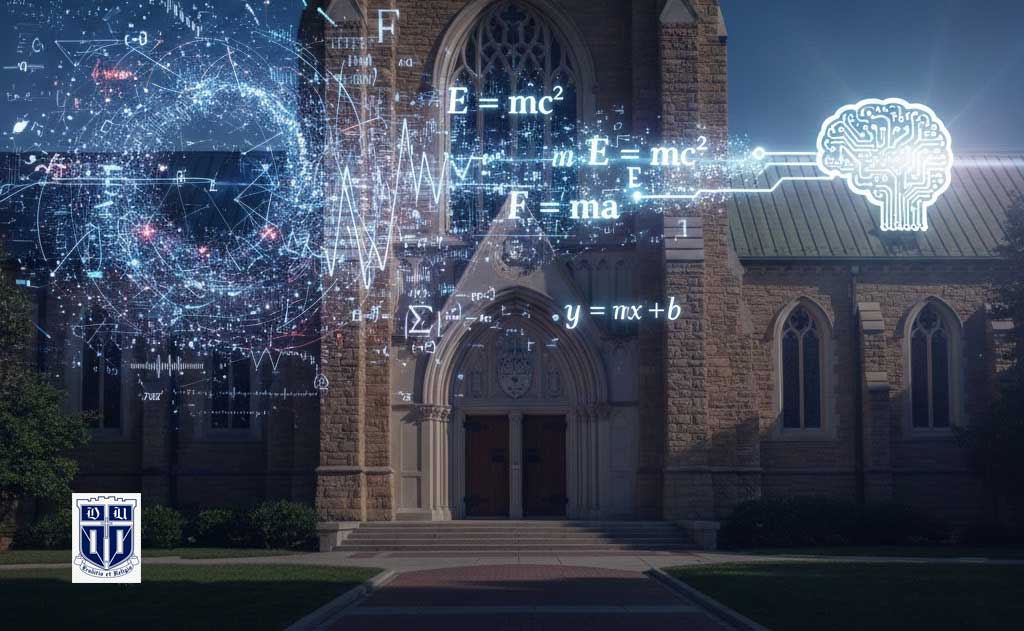
Researchers at Duke University have unveiled a revolutionary AI framework that automatically derives simple, human-readable mathematical equations from complex and chaotic systems. Published in npj Complexity, the new method analyzes time-series data from real-world experiments and distills high-dimensional chaos into compact, low-dimensional linear models that accurately predict long-term behavior.
This breakthrough addresses a long-standing challenge in science: making sense of nonlinear, unpredictable dynamics in systems like turbulent fluids, weather patterns, biological networks, and engineering processes.
How the AI Framework Works: Technical Breakdown
Traditional modeling techniques often fail when faced with strong nonlinearity and chaos, either relying on crude approximations or requiring extensive human expertise to define potential equations. Duke’s automated approach overcomes these limitations through:
- Advanced Dimensionality Reduction: The system embeds complex, high-dimensional time-series data into lower-dimensional latent spaces where underlying linear dynamics naturally emerge.
- Global Linear Operators: Using deep learning guided by physics-inspired constraints, it identifies global governing equations across the entire dataset rather than piecemeal local approximations.
- Robust Long-Term Prediction: The resulting equations enable accurate forecasting of system evolution, including stability analysis and identification of multi-stable attractors.
The framework was rigorously tested on classic chaotic benchmarks, including the double pendulum, Lorenz-96 model (used to study atmospheric predictability), and the iconic Lorenz attractor—widely known as the mathematical origin of the “butterfly effect.” In many cases, it recovered exact or near-exact governing equations, even uncovering subtle dynamics that traditional methods miss.
Why This Breakthrough Matters
Chaotic systems are notoriously difficult to model because tiny changes in initial conditions can lead to vastly different outcomes. This new AI tool bridges the gap between opaque “black-box” machine learning and interpretable scientific discovery by producing compact, verifiable equations that researchers can understand and build upon.
Key advantages include:
- Enhanced Interpretability: Delivers transparent mathematical insights instead of incomprehensible neural network weights.
- Broad Applicability: Proven effective across physics (pendulum dynamics), fluid mechanics (turbulence), biology (gene regulatory networks), neuroscience (neural activity), and climate modeling.
- Accelerated Discovery: Automates the search for hidden laws in data-rich experiments, complementing human intuition.
As lead researcher Boyuan Chen explains, this tool empowers “machine-assisted scientific discovery” in domains long considered too complex for systematic equation-finding.
Real-World Impact and Future Potential
In an era of increasing regulatory focus on explainable AI (XAI), this development arrives at a critical time. Beyond fundamental science, potential applications include:
- Improved predictive maintenance for renewable energy infrastructure
- Better optimization of smart grids under variable conditions
- Enhanced modeling of complex biological processes for drug discovery
- More accurate long-term climate and weather forecasting
As data from sensors and simulations grows exponentially, tools like this could transform how we extract fundamental knowledge from complexity.
Stay tuned to VFutureMedia for ongoing coverage of explainable AI advancements, chaos theory applications, and the latest in automated scientific discovery.
I’m Ethan, and I write about the tech that’s actually going to change how we live — not the stuff that just sounds impressive in a press release. I cover AI, EVs, robotics, and future tech for VFuture Media. I was on the ground at CES 2026 in Las Vegas, walking the show floor so I could give you a real read on what matters and what’s just noise. Follow me on X for daily takes.
If you found this useful, the best thing you can do is share it with someone who’d actually appreciate it. And if you want more like it, we’re here every week.
Discover more emerging technologies and AI innovations at VFutureMedia. Subscribe for daily updates on the future of tech.




Leave a Comment