
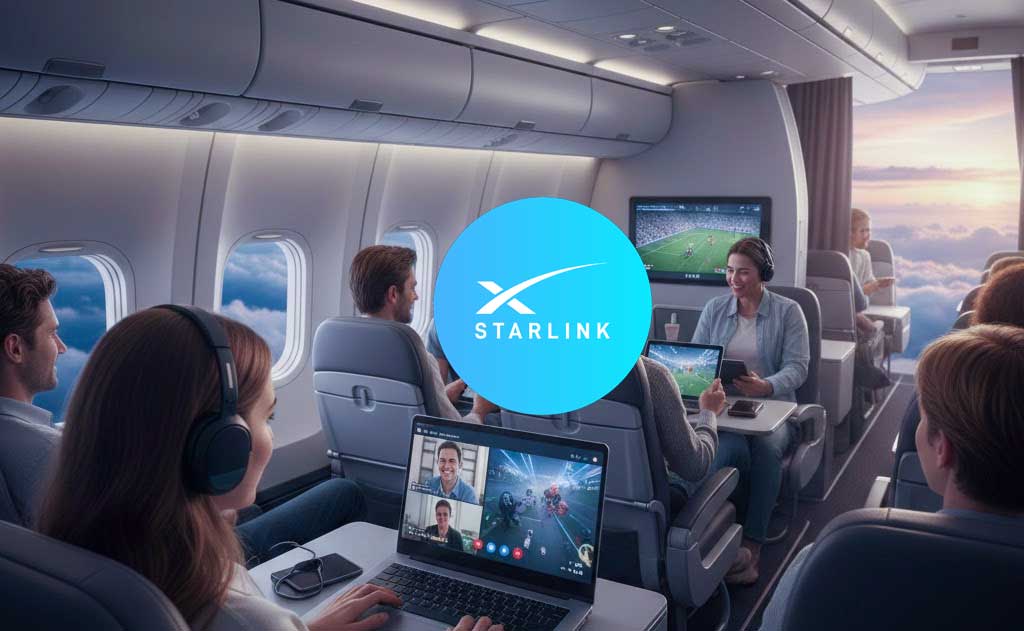
As of December 25, 2025, the experience of flying has undergone one of the most dramatic transformations in commercial aviation history. What was once universally despised — slow, unreliable, expensive in-flight Wi-Fi that barely allowed you to check email — has become something genuinely remarkable. Starlink, the satellite internet constellation developed by SpaceX under the leadership of Elon Musk, has delivered on its promise of high-speed, low-latency broadband connectivity not just on the ground, but at 35,000 feet and beyond. This is no minor upgrade. It represents a fundamental shift in how passengers, crew, and even airlines themselves interact with the digital world while airborne.
In this comprehensive deep-dive, we’ll explore every major aspect of Starlink Aviation: the historical failures of legacy in-flight connectivity, the revolutionary physics and engineering behind low Earth orbit (LEO) satellite internet, the hardware and software that make it work on commercial aircraft, the real-world performance numbers airlines are achieving in late 2025, the aggressive rollout across global carriers, the economic and operational implications for the airline industry, passenger testimonials and changing behaviors, regulatory and certification hurdles overcome, and what the future holds for connected skies. By the end, you’ll understand why Starlink is widely regarded as the single biggest quality-of-life improvement in modern air travel.
The Dark Ages of In-Flight Connectivity (Pre-2023)
For decades, passengers endured what could only be described as a digital torture chamber. Traditional in-flight entertainment and connectivity systems fell into two main categories, both deeply flawed.
First were the geostationary (GEO) satellite systems operated by providers such as Gogo (formerly Aircell), Panasonic Avionics, Viasat, and Intelsat. These satellites orbit at approximately 35,786 kilometers (22,236 miles) above the equator, remaining fixed relative to Earth’s surface. The enormous distance creates unavoidable problems:
- Round-trip latency typically ranged from 600 to 800 milliseconds, making real-time applications (video calls, online gaming, stock trading) practically impossible.
- Bandwidth per aircraft was severely limited — often 10–50 Mbps shared among dozens or hundreds of passengers.
- Coverage gaps existed over oceans, polar regions, and remote landmasses because GEO satellites cannot provide reliable beams to high-latitude areas or moving targets far from the equator.
- Expensive pricing — airlines frequently charged $10–30 for short sessions or $30–50 for full-flight access, yet delivered speeds slower than early 2000s home dial-up in many cases.
The second category, air-to-ground (ATG) systems, used cellular-like towers on the ground to beam signals to aircraft. Providers like Gogo 2Ku and various regional ATG networks offered slightly better latency (around 100–200 ms), but coverage was limited to continental United States, parts of Europe, and select other landmasses. Once an aircraft crossed an ocean or flew over sparsely populated regions, connectivity vanished entirely.
Passenger frustration reached legendary status. Social media was filled with memes about “loading screens at 35,000 feet,” complaints about dropped Zoom calls during critical business meetings, and entire flights where not a single passenger could successfully stream a single episode of a show. Airlines knew the system was broken, but the economics of GEO satellites and the regulatory complexity of installing new hardware kept meaningful change at bay for years.
Enter Starlink: The LEO Revolution
Starlink’s core innovation lies in its use of low Earth orbit satellites. Instead of parking satellites 22,000 miles away, SpaceX deploys thousands of small satellites at altitudes between 340 and 1,200 kilometers (most commonly around 550 km). This dramatically shorter distance is the single most important factor in Starlink’s performance.
Physics tells the story clearly:
- Light travels at approximately 300,000 km/s. A round-trip signal to a GEO satellite requires traveling roughly 70,000 km (up and down), resulting in a minimum theoretical latency of about 233 ms — before accounting for processing delays, atmospheric interference, and routing.
- A round-trip to a Starlink satellite at 550 km altitude requires traveling only about 1,100 km, yielding a theoretical minimum latency of roughly 3.7 ms. Even with real-world processing, routing through inter-satellite laser links, and ground station handoffs, operational latency consistently measures between 20–70 ms on aircraft — often comparable to or better than many terrestrial fiber connections.
The second major advantage is constellation density. As of late December 2025, Starlink operates more than 9,800 active satellites, with launches occurring multiple times per week. This massive number creates overlapping coverage beams that follow aircraft as they move at 900+ km/h. No more waiting for a single satellite to drift out of view.
Third, Starlink satellites communicate with each other via optical inter-satellite laser links (ISLs). These space lasers transmit data at speeds up to 100 Gbps per link, allowing data to hop across the constellation without always needing to travel down to a ground station immediately. This mesh network enables true global coverage, including over the middle of the Pacific Ocean, the Arctic, and Antarctica — areas where legacy systems simply disappeared.
The Starlink Aviation Hardware Stack
To bring this space-based internet into a commercial airliner, SpaceX engineered a specialized product line called Starlink Aviation.
The centerpiece is the aero terminal — a low-profile, electronically steered phased-array antenna roughly the size of a large suitcase. Unlike older mechanically steered dishes that protruded from the fuselage and created significant drag, the Starlink Aviation antenna is flat, aerodynamic, and certified for continuous high-speed flight. It weighs approximately 100–120 pounds including radome and mounting hardware, a fraction of legacy systems.
Key features of the terminal:
- Electronically steered beams that track satellites in milliseconds without moving parts
- Dual redundant power and data feeds for FAA/EASA certification
- Automatic failover between satellites and beams
- Support for multiple simultaneous high-bandwidth connections
- Built-in encryption and cybersecurity features compliant with aviation security standards
Inside the aircraft, connectivity is distributed via Wi-Fi access points (typically 4–8 units depending on cabin size) that create a high-capacity internal network. Airlines can choose to offer free service to all passengers, tiered paid access, or crew-only priority channels. The system supports hundreds of simultaneous users without the congestion collapse seen in older generations.
Installation time is remarkably fast. On narrowbody aircraft like the Boeing 737 or Airbus A320 family, a full Starlink retrofit can be completed in under 48 hours of downtime. Widebody installations (A330, 777, 787) typically require 3–5 days. This speed has been a major factor in the rapid adoption seen throughout 2024 and 2025.
Real-World Performance Data (December 2025)
Independent tests and airline-reported metrics paint a consistent picture:
- Download speeds: 150–350 Mbps per aircraft (peak reported speeds exceeding 500 Mbps on lightly loaded flights)
- Upload speeds: 25–80 Mbps
- Latency: 35–80 ms average (occasional spikes to 120 ms during satellite handoffs, but rarely noticeable)
- Reliability: 99.95%+ uptime across oceanic and polar routes
- Capacity: Enough bandwidth to support 4K streaming on dozens of devices simultaneously
Passengers regularly report experiences that would have been science fiction just five years ago:
- Conducting full-resolution Zoom board meetings
- Playing competitive online games (Fortnite, Call of Duty, Valorant) with minimal lag
- Uploading and downloading large files for work
- Streaming live sports events without buffering
- Using cloud-based productivity tools (Google Workspace, Microsoft 365, Figma, Adobe Creative Cloud) as if in an office
Airline Adoption Timeline (2023–2025)
The rollout has been nothing short of aggressive:
- Hawaiian Airlines became the launch customer in early 2023, completing installation across its entire fleet by mid-2024. All flights offer free gate-to-gate Starlink service — a bold move that helped the carrier differentiate itself on long-haul transpacific routes.
- United Airlines announced the largest commitment: more than 1,000 aircraft. By December 2025, roughly 60% of United’s mainline fleet and nearly all regional jets are equipped, with free service for MileagePlus members.
- Alaska Airlines completed its narrowbody fleet in 2025, offering free Wi-Fi on most domestic routes.
- International carriers including Qatar Airways, Emirates, airBaltic, SAS, JSX, Air France-KLM (select aircraft), and LATAM have either completed or are in active deployment phases.
- Regional and business aviation providers (Charter operators, private jet companies) have moved even faster, with many fleets fully converted by Q3 2025.
Economic and Operational Impacts
For airlines, Starlink represents both a cost and a revenue opportunity. Hardware and installation costs are substantial (estimated $300,000–$500,000 per aircraft), but monthly service fees are dramatically lower than legacy GEO contracts. Many carriers have decided to offer the service for free, betting that improved passenger satisfaction, increased ancillary revenue (premium cabins, loyalty program perks), and competitive differentiation will more than offset the expense.
Operationally, the always-on connection enables new possibilities: real-time predictive maintenance data uploads, dynamic route optimization based on live weather and air traffic data, and enhanced crew communication during long-haul flights.
Passenger Behavior Shift
The psychological impact cannot be overstated. Passengers who once dreaded long flights now look forward to them as productive time. Business travelers report completing entire workdays in the air. Families stay connected with loved ones on the ground. Students finish assignments. Content creators edit and upload videos mid-flight.
Social media is filled with posts showing speed test screenshots from 35,000 feet, video calls with crystal-clear quality over the Atlantic, and even live-streamed gaming sessions from inside the cabin.
Regulatory, Safety, and Future Challenges
Getting Starlink Aviation certified required extensive testing by the FAA, EASA, and other authorities. Electromagnetic interference tests, structural integrity analysis, and emergency procedures validation all had to be completed. SpaceX and its airline partners passed every hurdle, demonstrating the system’s safety and reliability.
Looking ahead, the next frontiers include:
- Even lower latency through next-generation satellite designs
- Higher capacity beams with next-gen phased-array technology
- Integration with 5G/6G hybrid networks for seamless gate-to-gate transitions
- Potential for augmented reality experiences and immersive in-flight entertainment powered by always-on connectivity
Conclusion: The New Era of Flying
Starlink Aviation has not merely improved in-flight Wi-Fi; it has eliminated the concept of “bad” in-flight internet. What began as a moonshot project to bring broadband to rural Earth has inadvertently revolutionized the aviation experience for hundreds of millions of passengers annually.
Flights are no longer dead zones. They are extensions of our digital lives — places where work gets done, entertainment flows freely, and human connection persists regardless of location.
As 2025 draws to a close, one thing is clear: the skies are connected, and they will never go dark again.
Ethan Brooks covers the tech that’s reshaping how we move, work, and think — for VFuture Media. He was at CES 2026 in Las Vegas when the world got its first real look at humanoid robots, AI-powered vehicles, and Samsung’s tri-fold phone. He writes about AI, EVs, gadgets, and green tech every week. No hype. No filler. X · Facebook
We started VFuture Media because we wanted tech news written by people who actually follow this industry — not content farms chasing keywords. If that resonates, we’d love to have you as a regular reader. Pull up a chair.



Leave a Comment