
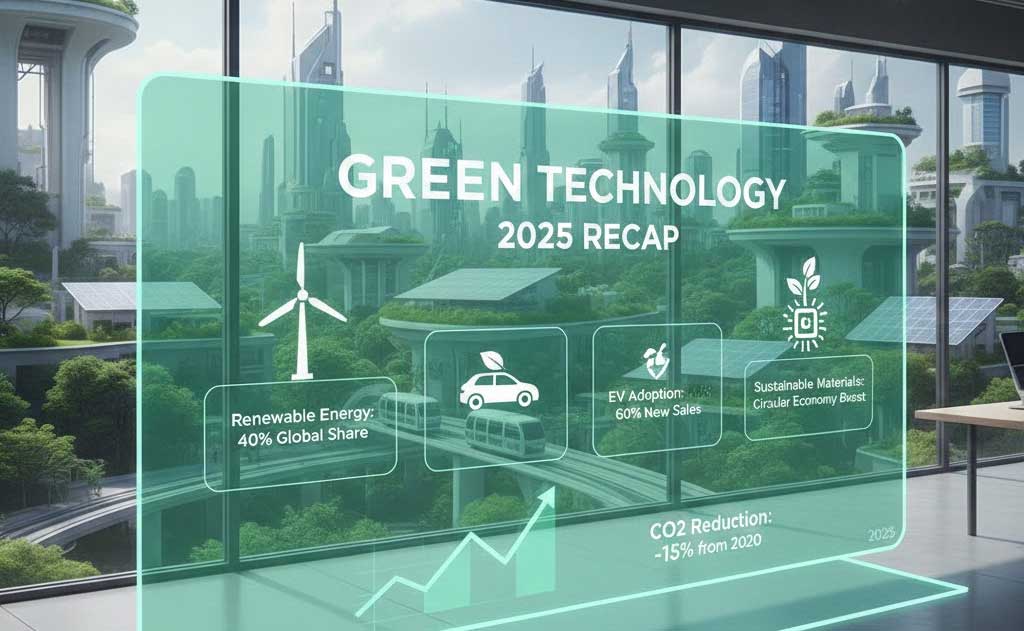
Green technology 2025 breakthroughs: Solar-storage costs collapse to $65/MWh LCOS, carbon capture mainstreams, AI climate models outperform physics, hydrogen scales amid policy shifts
It’s December 27, 2025, and amid geopolitical shifts and policy recalibrations, green tech delivered tangible wins this year. Just weeks ago, Ember reported utility-scale battery LCOS hitting $65/MWh globally (outside China/US), enabling dispatchable solar at costs rivaling fossil fuels. Carbon capture entered mainstream with projects like STRATOS DAC nearing operation and investments topping $100M in geoengineering startups. AI weather models from NOAA and Microsoft Aurora outperformed traditional systems, while climate tech funding held resilient despite macro slowdowns.
Here’s what most people get wrong: They see policy backlash stalling progress. The number that actually matters is acceleration—renewables investment hit records, battery prices plunged 40%+, and biobased innovations bridged climate-nature goals. What this means in plain English: We’re not just racing to net-zero; tech is making sustainability cheaper, smarter, and more resilient than ever.
In this countdown, we rank the seven pivotal green technology 2025 shifts driving the sustainable energy future.
#7: ESG Backlash & Reboot
From Hype to Hard-Nosed Realism
ESG faced intense scrutiny in 2025—U.S. mentions in reports declined, funds saw outflows, and political backlash labeled it “woke.” Europe delayed parts of CSRD amid business complaints.
Surprising fact: Despite noise, climate tech became a top-three VC category; private finance scaled EVs/heat pumps (WRI 2025).
Contrarian take: Backlash forced reboot—firms refocused on material risks, blending sustainability with profitability.
Rhetorical question: If ESG rebrands as “resilience investing,” does it emerge stronger?
#6: Hydrogen Energy Progress
Scaling Amid Mixed Signals
Low-emissions hydrogen hit ~1 Mt production; projects with FID reached 4+ Mtpa by 2030 potential (IEA Global Hydrogen Review 2025).
Surprising stat: China dominated electrolyzer additions; costs fell sharply.
Balanced view: Delays/cancellations tempered hype, but blue/green pilots advanced (e.g., Europe industrial plants online 2025).
By 2026 expect: Utility in hard-to-abate sectors like steel/shipping.
#5: Smart Grids & Energy Decentralization
Microgrids, VPPs, and AI Optimization
Decentralized systems boomed—VPP market eyed $39B by 2034; blockchain enabled P2P trading.
Surprising fact: AI transformed grids—predictive maintenance, demand response; hybrid microgrids enhanced resilience.
Examples: Tesla Australia VPP; Germany 46%+ decentralized renewables.
Projection: 2026 sees IoE, digital twins standardizing decentralized management.
#4: Climate AI Prediction Systems
From Supercomputers to GPUs
AI models revolutionized forecasting—NOAA’s AIGFS faster/efficient; Microsoft Aurora accurate 10-day predictions.
Surprising stat: Hybrid AI-physics ensembles extended skill 18-24 hours.
What this means: Better extremes prediction, grid optimization; AI cut emissions via efficient routing/energy use.
Rhetorical question: If AI simulates 1000 climate years in a day, how fast until policy-grade projections?
#3: Solar + Storage Cost Collapse
Dispatchable Renewables Go Mainstream
Battery LCOS $65/MWh; pack prices ~$108/kWh; solar $43/MWh average.
Surprising fact: All-in BESS capex $125/kWh—40% drop 2024 continued (Ember December 2025).
Examples: Saudi auctions $73-75/kWh equipment; paired solar-storage ~$76/MWh total.
By 2026: Sub-$50/MWh LCOS; hyperscaler demand accelerates.
#2: Carbon Capture Reality vs Hype
Mainstream Traction Emerges
CCS capacity grew; DAC like STRATOS world’s largest; investments mainstreamed innovative startups.
Surprising stat: Over $115M into geoengineering firms; CCUS pipeline 430 Mtpa by 2030 (IEA).
Yes, but… Costs/energy challenges persist; breakthroughs like low-heat regeneration promising.
Contrarian: Hype cooled, but commercial pilots (e.g., cement Norway) proved viability.
#1: Climate Startups Attracting Real Capital
Resilience Amid Macro Shifts
Climate tech funding ~$13-20B H1; AI-climate convergence (e.g., geothermal, DAC); records in defense-linked tech.
Surprising fact: Top-three VC category; $300M funds, billions private despite slowdowns.
Examples: Fervo geothermal $462M; bioeconomy/biobased surges.
What this means: Problem-solvers thrived—unit economics, scalability key.
Global Impact: Developed vs Developing World Adoption Gap
Developed nations led deployment—US/Europe CCS, AI grids; China renewables dominance.
Surprising fact: Developing readiness low (UNCTAD index); exports gap widened.
Balanced view: Leapfrogging potential—affordable solar/storage, bioeconomy in LAC/Africa.
Climate policy meets tech acceleration: IRA/REPowerEU legacies; COP30 looms—private finance, tech transfer critical to close gaps.
Future Outlook: Acceleration into 2026
By 2026: Biobased mainstream; AI-climate hybrids; decentralized grids dominant.
Actionable takeaways:
- Investors: AI-climate, bioeconomy, storage.
- Policymakers: Tech transfer, incentives for developing leapfrog.
- Businesses: Integrate AI grids, circular biobased.
- Startups: Focus scalability, real-world pilots.
- Everyone: Backlash temporary—economics favor green.
2025 proved green tech’s resilience. Innovations race ahead—planet needs them to win.
FAQ
Top green technology 2025 trends? Solar-storage costs collapse, AI prediction advances, carbon capture mainstream, hydrogen scaling.
Solar battery storage costs 2025? LCOS $65/MWh; capex ~$125/kWh utility-scale.
Carbon capture progress 2025? Mainstream investments; largest DAC operational; pipeline quadruples by 2030.
Hydrogen energy status 2025? Low-emissions ~1 Mt; strong growth to 4% global by 2030.
Climate AI advancements 2025? NOAA/Microsoft models outperform physics; faster, accurate forecasts.
Smart grids decentralization 2025? VPPs boom; AI optimization; microgrids resilience.
ESG in climate tech 2025? Backlash but reboot—focus material risks, resilience.
Climate startup funding 2025? Resilient ~$13-20B; top VC category.
Developed vs developing green tech gap? Widening exports/readiness; leapfrog potential bio/solar.
Climate policy impact 2025? Shifts but tech acceleration via private finance.
I’m Ethan, and I write about the tech that’s actually going to change how we live — not the stuff that just sounds impressive in a press release. I cover AI, EVs, robotics, and future tech for VFuture Media. I was on the ground at CES 2026 in Las Vegas, walking the show floor so I could give you a real read on what matters and what’s just noise. Follow me on X for daily takes.
The future doesn’t wait — and neither should your feed. If this got you thinking, there’s plenty more where that came from. Browse our latest at VFutureMedia and stick around.




Leave a Comment