
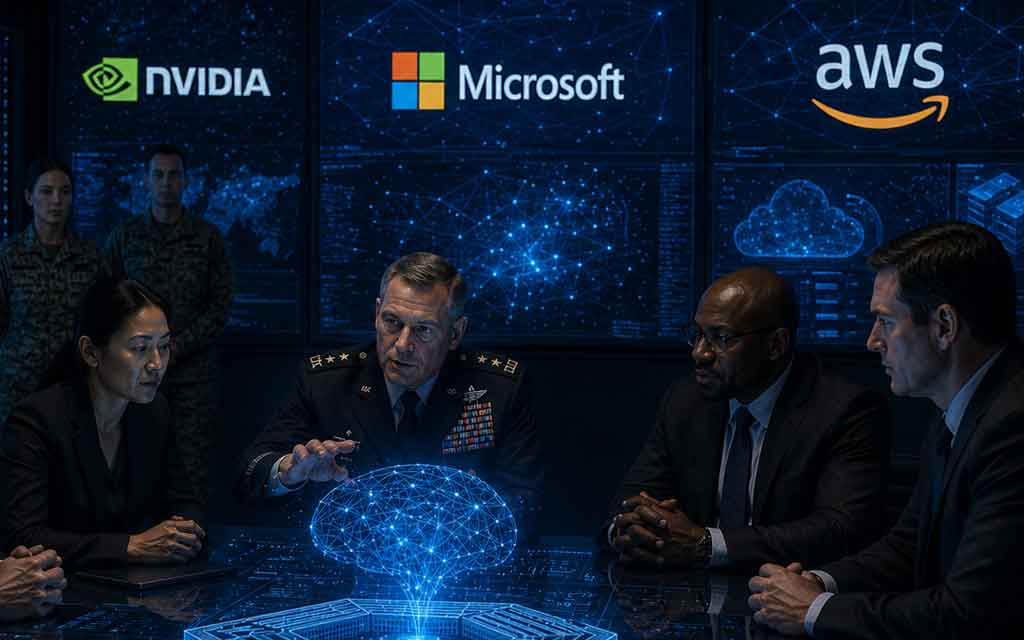
In a landmark announcement on May 1, 2026, the U.S. Department of Defense (Pentagon) has signed new agreements with Nvidia, Microsoft, Amazon Web Services (AWS), and Reflection AI to deploy cutting-edge artificial intelligence tools directly on its most secure classified military networks. This expands the Pentagon’s rapidly growing AI arsenal to seven major partners—including prior deals with SpaceX, OpenAI, and Google—marking a decisive step toward an “AI-first” military posture.
For American defense strategists, tech investors, and national security watchers, today’s deals signal Washington’s determination to harness frontier AI for real-world operational superiority—while diversifying away from any single vendor. At vFutureMedia.com, we unpack the full story, its strategic implications, and what it means for U.S. tech leadership in 2026 and beyond.
The Announcement: Four New Partners Join the Classified AI Fold
According to a Defense Department statement and officials briefed on the matter, Nvidia, Microsoft, Reflection AI, and AWS have all entered formal agreements “for lawful operational use” of their AI capabilities on classified networks.
These new pacts build on earlier arrangements with SpaceX, OpenAI, and Google, bringing the total roster to seven of the world’s most advanced AI providers. The technology will be integrated into the Pentagon’s high-security Impact Levels 6 and 7 environments—secure clouds designed for SECRET-level (and potentially higher) classified data.
- Nvidia: Supplies its open-source Nemotron models and AI infrastructure. The world’s leading chipmaker will enable powerful on-premise and agentic AI capabilities tailored for defense workloads.
- Microsoft: Leverages its deep existing cloud relationship with the Pentagon plus its own AI tools (including Copilot and Azure AI services).
- AWS: Amazon’s cloud giant brings scalable infrastructure and will help sell and deploy OpenAI models across government customers, further embedding AWS in classified operations.
- Reflection AI: A Nvidia-backed startup founded by former Google DeepMind researchers, offering open-weight models that allow greater customization—aligning with the Pentagon’s push for transparent, developer-friendly AI.
Pentagon officials emphasized that these integrations will “streamline data synthesis, elevate situational understanding, and augment warfighter decision-making in complex operational environments.”
Why Now? Context Behind the Classified AI Expansion
The deals arrive amid heightened global tensions and after months of negotiations. Earlier this year, the Pentagon faced a high-profile standoff with Anthropic, ultimately designating it a supply-chain risk after the company resisted broad access over concerns about mass surveillance and autonomous weapons. That opened the door for faster deals with more compliant partners.
OpenAI, Google, and SpaceX secured their classified access in recent months. Today’s additions complete a broad, multi-vendor strategy deliberately designed to avoid over-reliance on any one company—exactly the kind of resilient approach U.S. defense leaders have long advocated.
Impact Levels 6 and 7 represent the gold standard for classified cloud computing:
- IL6: Handles SECRET-level data in dedicated, physically or virtually isolated environments with direct SIPRNet connectivity.
- IL7: Extends even higher protections for the most sensitive intelligence and operational planning.
By clearing these AI models for IL6/7, the Pentagon gains the ability to run advanced reasoning, predictive analytics, and autonomous agents on the same networks used for mission-critical decisions—without compromising security.
Strategic Implications for U.S. National Security and Tech
- Accelerated Battlefield AI: Real-time intelligence fusion, predictive maintenance for weapons systems, cyber defense, and logistics optimization become dramatically faster and more accurate.
- Open-Source Momentum: Nvidia and Reflection AI’s involvement highlights a Pentagon preference for open models that can be audited, customized, and deployed without black-box limitations.
- Cloud Dominance: Microsoft and AWS—already entrenched in DoD infrastructure—now become even more central to America’s classified AI backbone.
- Economic Ripple Effects: These contracts boost U.S. tech giants at a time when global AI competition with China is intensifying. Nvidia’s hardware leadership, Microsoft’s enterprise AI, and AWS’s scale all get a major national-security validation.
For American taxpayers and defense contractors, the message is clear: the Pentagon is all-in on commercial AI rather than building everything in-house. This “commercial-first” approach promises faster innovation and lower costs while maintaining strict oversight.
Broader Context: America’s AI-First Military Strategy
This announcement aligns perfectly with the Department of Defense’s 2026 Artificial Intelligence Strategy, which calls for enterprise-wide agentic AI, rapid experimentation, and market-driven competition. By partnering with the private sector’s best, the Pentagon aims to outpace adversaries in the race for AI superiority.
Critics and ethicists have raised familiar questions about guardrails—particularly around surveillance and lethal autonomy—but Pentagon statements consistently frame usage as “lawful” and subject to existing U.S. law and oversight protocols. The multi-vendor approach also provides built-in checks against any single company’s models dominating sensitive operations.
What This Means for Tech Investors and Everyday Americans
- Investors: Nvidia, Microsoft, and Amazon shares are likely to see positive sentiment. The deals underscore these companies’ strategic importance to national security.
- Tech Workers: More defense-related AI projects could create high-paying opportunities in secure environments.
- National Security: Everyday Americans benefit from a military that makes faster, better-informed decisions—potentially saving lives and deterring conflict.
At a time when AI is reshaping everything from consumer gadgets to global power balances, today’s Pentagon moves reinforce the United States’ commitment to staying ahead.
Looking Ahead: The Classified AI Race Is Just Beginning
With these seven powerhouse agreements now in place, expect rapid pilot deployments, followed by broader operational rollout throughout 2026. Future phases may include even tighter integration of multimodal AI, real-time agent swarms, and hardened edge computing for forward-deployed forces.
The Pentagon has sent an unmistakable signal: America’s defense establishment is no longer experimenting with AI—it is operationalizing it at classified scale, with the best commercial partners in the world.
Stay ahead of the curve with vFutureMedia.com. We’ll continue tracking these deployments, analyzing the next wave of defense-tech deals, and delivering unbiased insights on how AI is transforming U.S. national security. Subscribe for exclusive updates and in-depth analysis as this story develops


Leave a Comment