
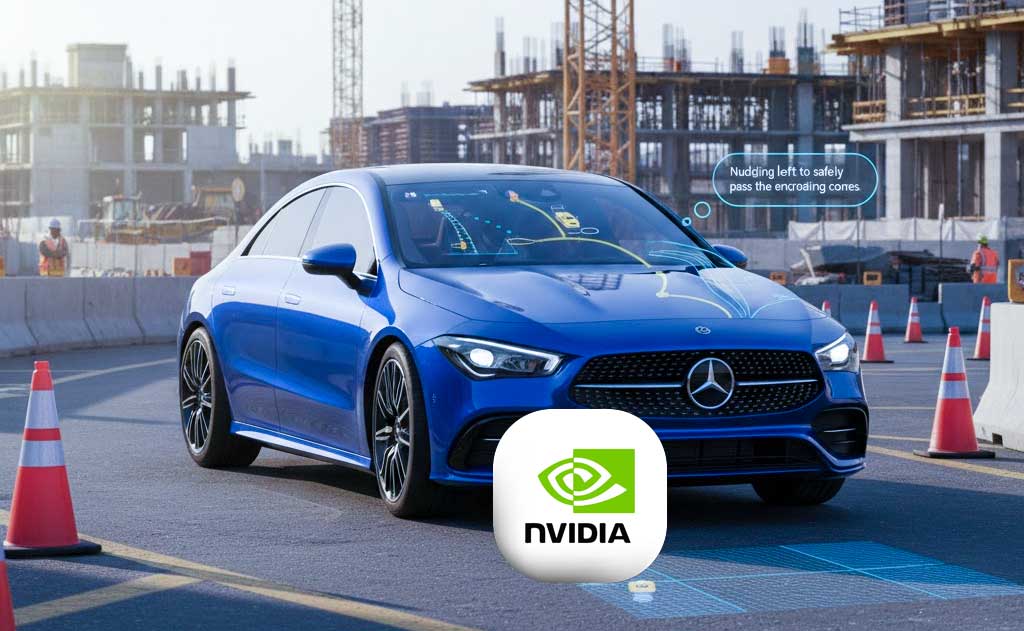
Imagine a car that doesn’t just react to the road—it truly thinks about it. One that sees a chaotic construction zone, weighs the options, explains its decision (“Nudging left to safely pass the encroaching cones”), and executes the maneuver smoothly. No rigid rules, no brittle programming—just fluid, human-like reasoning powered by cutting-edge AI.
This isn’t science fiction anymore. At CES 2026 in Las Vegas, NVIDIA CEO Jensen Huang took the stage and declared: “The ChatGPT moment for physical AI is here.” With that, he introduced Alpamayo—the world’s first thinking, reasoning autonomous vehicle AI.
What Makes Alpamayo Revolutionary?
Traditional self-driving systems rely on hand-crafted rules and massive mapping data, but they often falter on rare “long-tail” scenarios—sudden roadwork, erratic pedestrians, or faded lane markings in a storm.
Alpamayo changes the game with Vision-Language-Action (VLA) models—end-to-end AI trained directly from camera inputs to vehicle controls. At its core is Alpamayo 1, a massive 10-billion-parameter model that doesn’t just drive; it reasons step-by-step using chain-of-thought logic.
- It perceives the world through video and sensors.
- It generates natural language explanations for every decision.
- It outputs precise trajectories for steering, braking, and acceleration.
This transparency is essential for safety, trust, and regulatory approval. Engineers can audit the AI’s “thought process,” making it far more robust than black-box systems.
NVIDIA is accelerating adoption by going fully open-source:
- Model weights and inference scripts available on Hugging Face.
- Over 1,700 hours of diverse real-world driving data in open datasets.
- AlpaSim, an open simulation framework for testing edge cases in virtual worlds.
Developers can distill the large “teacher” model into efficient on-vehicle versions or build tools like auto-labelers and safety evaluators on top.
Hitting the Roads: Starting with the All-New Mercedes-Benz CLA
The future arrives fast. The first production vehicle powered by NVIDIA’s full DRIVE AV stack—including Alpamayo reasoning—will be the sleek, all-new Mercedes-Benz CLA.
Mercedes plans to roll out enhanced Level 2++ point-to-point assistance (hands-off, eyes-on driving with advanced navigation) in the U.S. by Q1 2026, followed by Europe and Asia. Built on the new MB.OS platform, it already boasts a five-star Euro NCAP safety rating.
This marks a major milestone in the long-standing collaboration between NVIDIA and Mercedes, delivering a complete AI-defined driving experience.
Why This Matters: The Path to True Autonomy
Huang envisions a world where “everything that moves will ultimately be autonomous.” Alpamayo is a major step toward Level 4 (fully driverless in defined areas) and beyond, tackling the toughest challenges: rare events, explainability, and scalability.
By open-sourcing the platform, NVIDIA is building an ecosystem, much like Android revolutionized mobile. Early adopters include Lucid, JLR, Uber, and research groups, all racing to integrate reasoning into their stacks.
This announcement signals the era of Physical AI—where machines don’t just compute; they understand the real world, reason like humans, and act safely. From robotaxis to everyday commuters, the roads ahead look smarter, safer, and infinitely more exciting.
I’m Ethan, and I write about the tech that’s actually going to change how we live — not the stuff that just sounds impressive in a press release. I cover AI, EVs, robotics, and future tech for VFuture Media. I was on the ground at CES 2026 in Las Vegas, walking the show floor so I could give you a real read on what matters and what’s just noise. Follow me on X for daily takes.
Stay tuned as we track Alpamayo’s rollout and the next wave of AI-driven mobility. The thinking car has arrived—and it’s just getting started.




Leave a Comment