
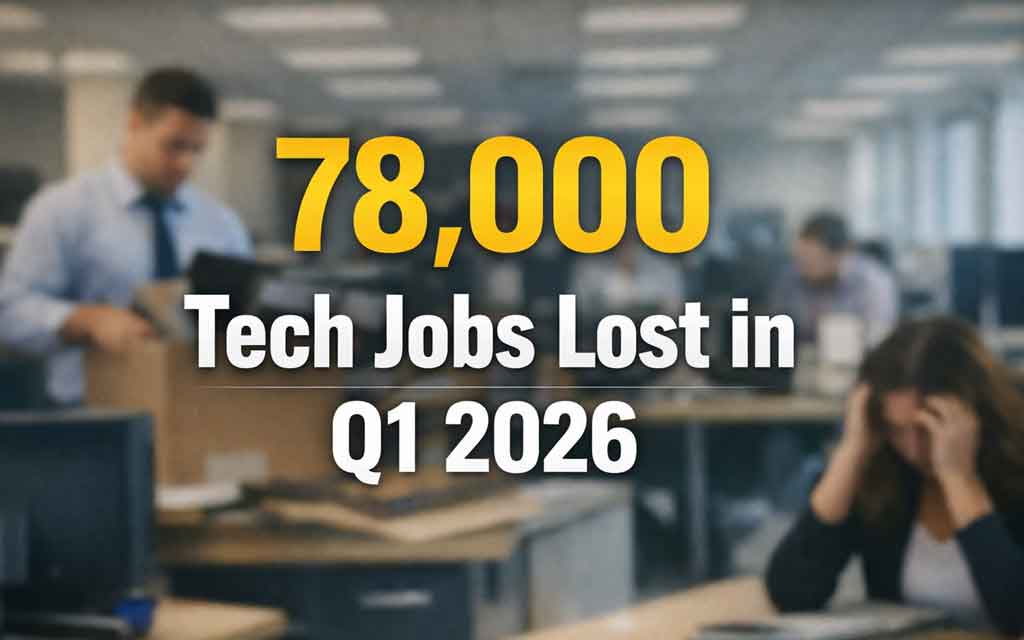
Over 78,000 tech jobs cut in Q1 2026 with nearly half tied to AI automation. Oracle slashes up to 30,000, Meta trims hundreds more. Ethan Brooks on the human cost, AI shift, and survival strategies for 2026.
By Ethan Brooks
USA Tech Journalist | April 12, 2026
After more than a decade reporting on Silicon Valley’s boom-and-bust cycles — from the dot-com crash echoes to the post-pandemic hiring frenzy and now the AI restructuring wave — I’ve rarely seen a quarter as sobering as Q1 2026. Companies are openly redirecting billions from payrolls into AI infrastructure, and the human impact is hitting hard.
This week’s layoff announcements, combined with Challenger, Gray & Christmas data, paint a clear picture: the tech sector announced roughly 78,000 job cuts in the first three months of 2026, with AI automation cited as a driving factor in nearly 47-50% of those reductions.
It’s not just trimming fat. It’s a fundamental reallocation: fewer people writing code, managing routine operations, or handling mid-level support roles — replaced or augmented by faster, cheaper AI tools. Yet the same companies pouring money into large language models and data centers are also creating demand for specialized AI talent.
Here’s my grounded breakdown of what happened this week, why it’s happening, the companies involved, and — most importantly — what it means for the thousands of professionals now updating résumés.
The Scale of Q1 2026 Tech Layoffs: The Numbers Don’t Lie
According to outplacement firm Challenger, Gray & Christmas, the technology sector recorded 52,050 job cuts in the first quarter of 2026 — a 40% increase over the same period in 2025. March alone saw 18,720 tech layoffs, making it the highest Q1 total for the sector since 2023.
Broader estimates that include smaller firms and unreported cuts push the tech-specific total closer to 78,557 positions eliminated between January and early April, with AI cited in roughly 37,638 of those (about 47%).
AI wasn’t the only driver — cost optimization, post-hiring bloat correction, and shifting priorities played roles — but it has become the leading stated reason in many cases. In March, AI accounted for 15,341 cuts across industries, or 25% of all announced reductions, the highest share since Challenger began tracking the category.
This isn’t abstract. These are real people — engineers, recruiters, sales reps, and operations staff — receiving early-morning emails or terse manager meetings that upend careers overnight.
Why AI Is Accelerating the Cuts
The narrative from executives is consistent: AI tools now handle repetitive coding, data analysis, customer support triage, and even aspects of recruiting and content creation. The savings free up cash for massive AI infrastructure bets — data centers, GPUs, and specialized talent.
Critics, including Salesforce CEO Marc Benioff, argue AI is sometimes used as a convenient scapegoat for broader cost-cutting and structural realignment. Yet the correlation is hard to ignore. Companies reporting record profits or strong cloud growth are simultaneously shrinking headcount to fund AI ambitions.
As one laid-off Oracle engineer shared anonymously this week: “They told us it was about ‘organizational change,’ but everyone knows the money is going straight to data centers.”
Goldman Sachs put it bluntly in a recent note: Workers displaced by technology (especially AI) face tougher transitions — taking about one month longer to find new roles and suffering real earnings losses of more than 3% upon reemployment. Many end up in “occupational downgrading,” moving into roles requiring fewer analytical skills.
Major Companies Cutting Jobs This Quarter
Here are the most significant tech-related moves reported in Q1 2026, with a focus on recent April developments:
- Oracle: The largest single event. The company laid off an estimated 20,000 to 30,000 employees globally starting March 31–April 1, delivered via abrupt early-morning emails. This represents roughly 18% of its workforce. The cuts span multiple divisions and geographies, including significant numbers in California (over 700 in Santa Monica, Redwood City, Pleasanton, and Santa Clara). Leadership cited “current business needs” while analysts link it directly to freeing $8–10 billion in cash flow for a massive AI data center push, including potential involvement in large-scale projects with partners like OpenAI.
- Meta Platforms: Multiple rounds. Roughly 1,500 jobs cut earlier in Reality Labs (about 10% of that division), followed by several hundred more in late March across Facebook teams, global operations, recruiting, sales, and additional Reality Labs roles. The company continues redirecting resources toward AI features and infrastructure, with capital expenditures projected at $115–135 billion for 2026.
- Amazon: Over 16,000 roles trimmed in the first quarter as part of ongoing efficiency drives and AI restructuring.
- Salesforce: Nearly 1,000 positions across functions, though CEO Marc Benioff has pushed back against framing all cuts as purely AI-driven, calling it sometimes a “lazy” explanation for necessary realignment. The company has since grown headcount to record levels in other areas.
- Other notable cuts: Block (nearly 40–50% of workforce in earlier waves), Dell (significant share of March tech cuts), Atlassian (10%), Pendo, Tailwind (small but symbolic engineer cuts), plus smaller reductions at Angi, Crypto.com, Ericsson, and others.
In California alone this week, Oracle, Meta, and Qualcomm disclosed hundreds of additional layoffs tied to AI investments and cost measures.
The Human Side: Anxiety, Anger, and Adaptation
I’ve spoken with engineers in Hyderabad, product managers in Austin, and recruiters in the Bay Area this month. The common thread is shock at the speed and lack of warning. Many mid-level roles in software engineering, QA, data entry, and routine support are being automated or consolidated.
Yet it’s not all doom. Demand remains strong for AI engineers, prompt specialists, machine learning ops roles, ethical AI governance experts, and professionals who can integrate AI into domain-specific workflows (including automotive software for the EV space I also cover).
Jamie Dimon at JPMorgan and others have noted that while short-term disruption is real, AI could ultimately expand economic opportunity if societies invest in reskilling.
Practical Advice for Tech Workers Navigating 2026
If you’re affected — or worried you might be — here’s straightforward guidance from someone who’s watched multiple tech cycles:
- Audit Your Skills Ruthlessly — Identify tasks AI can already do better or faster in your role. Double down on uniquely human strengths: complex problem-solving, stakeholder management, domain expertise, and AI oversight.
- Upskill Aggressively but Smartly — Focus on high-demand areas: agentic AI systems, cybersecurity applications of AI, multimodal model deployment, and industry-specific integration (e.g., AI for EV battery optimization or autonomous features).
- Build a Portfolio of AI-Augmented Work — Show how you’ve used tools like Cursor, Claude, or Gemini to boost productivity. Employers want proof you can leverage AI, not fear it.
- Network and Diversify — The job search may take longer. Tap alumni groups, LinkedIn communities, and defense/tech crossover events. Consider adjacent sectors like automotive software, where AI + EVs create hybrid opportunities.
- Financial Buffer and Mindset — Expect potential earnings pressure. Build runway and treat this as a pivot, not a failure.
Companies, for their part, owe transparent communication. Abrupt 6 AM emails erode trust and talent pipelines long-term.
Balanced Outlook: Pain Today, Transformation Tomorrow
The Q1 2026 layoff wave is painful and real. Nearly 80,000 tech professionals are rethinking their next move. At the same time, the billions flowing into AI infrastructure signal massive future investment — new data centers need operators, new models need trainers and evaluators, and new applications need integrators.
As a journalist who’s interviewed both laid-off coders and AI lab leaders, my view is pragmatic: AI isn’t replacing all human work, but it is reshaping it rapidly. The winners will be those who adapt fastest — learning to direct AI rather than compete directly against it.
This week’s news is a loud wake-up call. For individuals: treat AI as your co-pilot, not your replacement. For companies: balance efficiency gains with humanity and clear reskilling paths. For policymakers: the transition needs support through education and workforce programs.
What’s your experience with this wave — have you been impacted, or are you hiring in AI roles? Share in the comments. Subscribe to VFuture Media for weekly tech roundups, career insights, and EV-AI crossover stories.
Ethan Brooks is a veteran USA tech journalist with over 12 years covering Silicon Valley, workforce trends, and the intersection of AI with mobility and enterprise software. He has reported from major conferences and spoken with executives and engineers across the industry.



Leave a Comment