
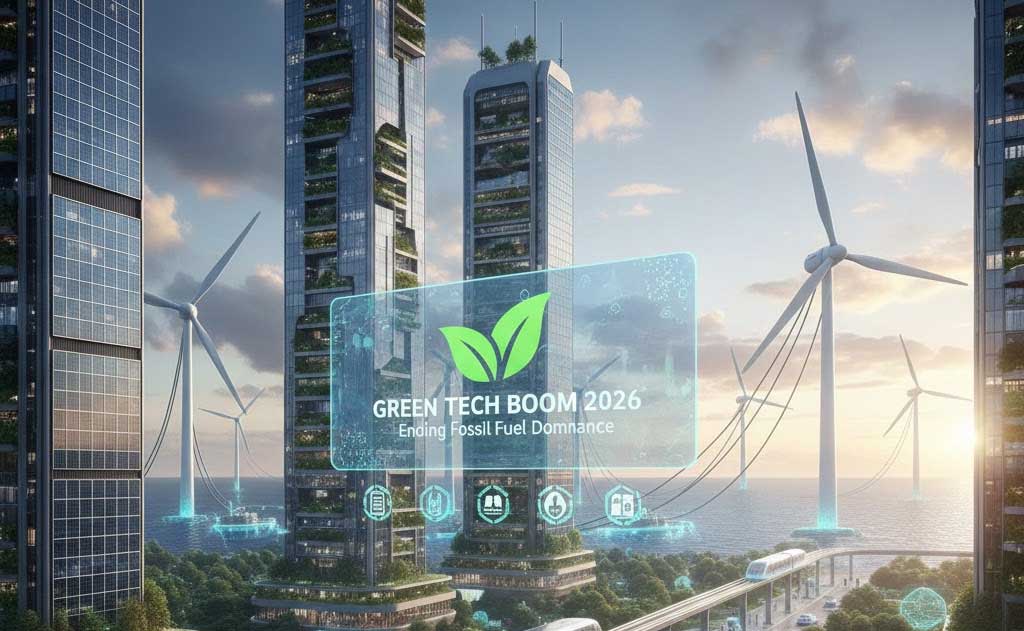
Introduction: The Beginning of the End for Fossil Fuels
What if 2026 is remembered as the year fossil fuels finally lost their dominance—not because they ran out, but because better technologies won?
According to multiple global energy outlooks entering 2026, renewables, storage, electrification, and AI-driven efficiency are scaling faster than coal, oil, and gas ever did at comparable stages. The result: a historic inflection point now referred to by analysts as the Green Tech Boom 2026.
As a tech journalist covering AI, EVs, and green innovation at VFutureMedia.com, I’ve rarely seen this level of convergence—where cost curves, policy, technology, and consumer demand align at once.
This article breaks down the core technologies poised to replace fossil fuels, why 2026 is the tipping year, and what it means for energy, industry, transportation, and the global economy.
Why 2026 Is the Global Green Tech Tipping Point
Three forces collide in 2026:
- Cost parity: Clean energy becomes cheaper than fossil fuels without subsidies
- AI acceleration: Machine learning optimizes energy generation, storage, and grids
- Electrification at scale: Transport, heating, and industry shift rapidly
Fossil fuels aren’t disappearing overnight—but their economic advantage is collapsing.
1. Next-Generation Solar Power Surpasses Fossil Fuel Economics
Solar energy is no longer “alternative”—it’s dominant.
What’s New in 2026
- Perovskite-silicon tandem solar cells exceed 33% efficiency
- AI-driven solar farms dynamically adjust angles and output
- Ultra-low-cost manufacturing slashes panel prices
Why It Replaces Fossil Fuels
- Zero fuel cost
- Minimal maintenance
- Rapid scalability
Pros
- Cheapest energy source globally
- Distributed generation reduces grid risk
Cons
- Intermittency (solved by storage—see below)
2026 Impact:
Solar becomes the default energy choice for new capacity worldwide
2. Grid-Scale Battery Storage Unlocks 24/7 Clean Energy
Energy storage is the missing puzzle piece—and it’s finally clicking into place.
Breakthroughs Powering the Boom
- Solid-state batteries
- Iron-air and sodium-ion storage
- AI-optimized charge/discharge cycles
What This Replaces
- Natural gas “peaker plants”
- Fossil-fuel backup generation
Pros
- Enables round-the-clock renewable power
- Stabilizes grids during demand spikes
Cons
- Raw material supply chains still scaling
2026 Prediction:
Storage deployments grow 3× year-over-year
3. Green Hydrogen Becomes Industrial Fuel of Choice
Some sectors can’t easily electrify—and that’s where green hydrogen steps in.
Industries Transformed
- Steel and cement
- Shipping and aviation
- Chemical manufacturing
What Changed
- Electrolyzer costs drop sharply
- Renewable-powered hydrogen beats gray hydrogen on price
- Government mandates accelerate adoption
Pros
- Zero-carbon fuel
- Long-term energy storage
Cons
- Infrastructure build-out required
2026 Outlook:
Green hydrogen replaces fossil fuels in heavy industry
4. Electric Vehicles Permanently Displace Oil Demand
By 2026, the EV debate is over.
What’s Driving the Shift
- Sub-$25,000 EVs go mainstream
- Charging networks rival gas stations
- Battery lifespans exceed vehicle lifetimes
Oil’s Decline
- Gasoline demand peaks
- Refinery margins shrink
- ICE bans expand globally
Pros
- Zero tailpipe emissions
- Lower operating costs
Cons
- Charging infrastructure still uneven in some regions
2026 Reality:
EVs become the default new vehicle choice
5. AI-Optimized Smart Grids Replace Centralized Energy Systems
AI is the invisible force accelerating green tech.
What Smart Grids Do
- Predict energy demand
- Balance renewables and storage
- Prevent blackouts before they happen
Why Fossil Grids Fail
- Rigid, centralized
- Inefficient
- Vulnerable to climate extremes
Pros
- Higher efficiency
- Lower energy waste
- Faster recovery from disruptions
Cons
- Cybersecurity risks (actively addressed)
2026 Shift:
Energy grids become AI-first systems
6. Carbon Capture Moves From Theory to Deployment
Carbon capture doesn’t save fossil fuels—but it helps clean up what remains.
Where It Works
- Cement plants
- Steel production
- Legacy industrial sites
2026 Breakthroughs
- Modular capture units
- Lower energy penalties
- CO₂ used for materials and fuels
Pros
- Reduces industrial emissions
- Buys time for full transition
Cons
- Not a replacement for renewables
Role in 2026:
Carbon capture becomes a bridge technology
7. Heat Pumps Replace Gas in Buildings Worldwide
Heating is one of the largest fossil fuel uses—and heat pumps are changing that.
Why Heat Pumps Win
- 3–5× more efficient than gas
- Work in cold climates
- Paired with solar and storage
Pros
- Lower energy bills
- Zero on-site emissions
Cons
- Upfront installation cost
2026 Trend:
Gas heating rapidly phases out in new buildings
8. Nuclear Fusion and Advanced Fission Enter the Conversation
Fusion isn’t powering cities yet—but 2026 marks real progress.
What’s Real Now
- Small Modular Reactors (SMRs)
- Fusion breakeven milestones
- Private capital investment surge
Pros
- Constant clean energy
- Massive output potential
Cons
- Long timelines
2026 Status:
Nuclear becomes a strategic clean energy pillar
9. Green Tech Economics Crush Fossil Fuel Profitability
This is the real turning point.
What’s Happening
- Fossil fuels lose cost advantage
- Capital shifts to green infrastructure
- Insurance exits coal and oil projects
Result
- Fossil fuel assets become stranded
- Green tech attracts record investment
2026 Outcome:
Markets accelerate the energy transition faster than policy ever could
10. A New Energy World Emerges
The Green Tech Boom 2026 isn’t about one technology—it’s about systems replacing systems.
Fossil fuels dominated because they were:
- Dense
- Reliable
- Scalable
Green tech now matches or beats them on all three metrics.
Conclusion: Fossil Fuels Aren’t Being Banned—They’re Being Outcompeted
The most powerful force in history isn’t regulation—it’s better technology.
In 2026, solar, storage, EVs, AI, hydrogen, and smart grids don’t just reduce emissions—they win economically.
This is how energy transitions really happen.
What green technology do you think will have the biggest impact?
Comment below, share this article, and subscribe to VFutureMedia.com for the future of energy, AI, and innovation.
FAQs: Green Tech Boom 2026
1. What is the Green Tech Boom 2026?
A global surge in clean energy technologies that economically outperform fossil fuels.
2. Will fossil fuels disappear in 2026?
No—but their dominance ends as demand peaks and alternatives scale faster.
3. Which technology replaces fossil fuels fastest?
Solar + storage combined with electrification leads the transition.
4. Is green energy reliable without fossil fuels?
Yes—AI-driven grids and storage ensure stability.
5. How does AI accelerate green tech?
AI optimizes generation, forecasting, storage, and grid efficiency.
I’m Ethan, and I write about the tech that’s actually going to change how we live — not the stuff that just sounds impressive in a press release. I cover AI, EVs, robotics, and future tech for VFuture Media. I was on the ground at CES 2026 in Las Vegas, walking the show floor so I could give you a real read on what matters and what’s just noise. Follow me on X for daily takes.
The future doesn’t wait — and neither should your feed. If this got you thinking, there’s plenty more where that came from. Browse our latest at VFutureMedia.com and stick around.

Leave a Comment