
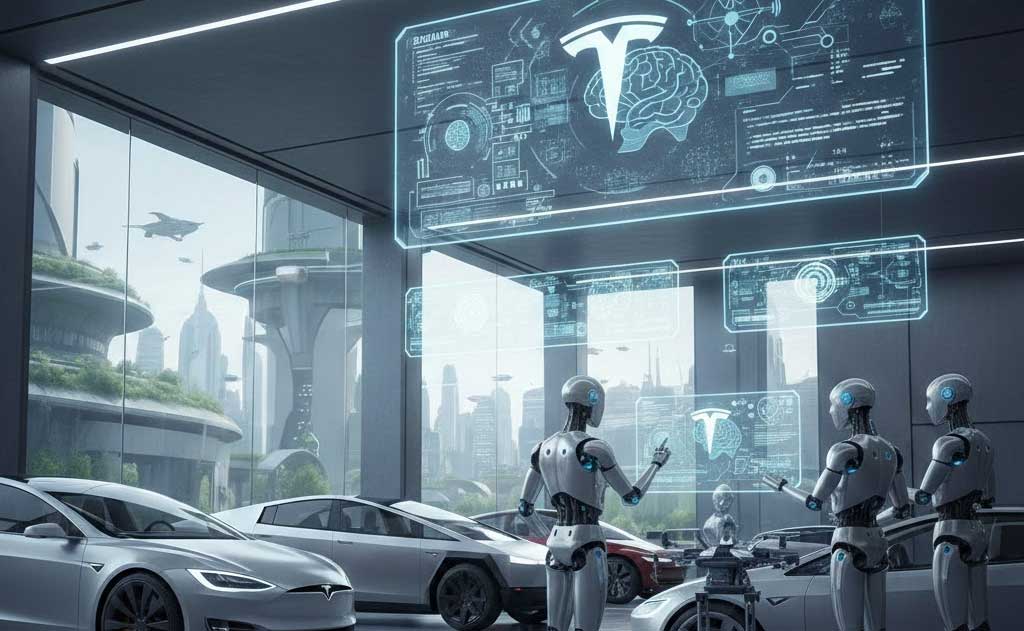
Introduction: Tesla Doesn’t Talk Like a Car Company Anymore
Listen carefully to Tesla’s earnings calls in 2026.
They’re no longer dominated by:
- Horsepower
- Range
- Vehicle trims
Instead, you hear:
- Neural networks
- Training compute
- Data advantage
- Autonomy scaling
- Humanoid robots
That raises a serious question investors, engineers, and regulators are now asking:
Is Tesla becoming an AI company first—and a car company second?
This isn’t clickbait. It’s a structural shift that’s been quietly underway for years and is now impossible to ignore.
As a tech journalist covering AI, EVs, and robotics at VFutureMedia.com, I believe 2026 is the year Tesla’s identity crisis becomes its biggest strategic advantage.
Let’s break it down.
Do you still think of Tesla primarily as a carmaker? Comment below.
1. Tesla’s Core Product Is No Longer Just the Car
Traditionally, automakers sell hardware.
Tesla sells:
- A rolling AI data collector
- A software platform
- An autonomous system in training
Every Tesla vehicle feeds:
- Vision data
- Driving behavior
- Edge-case scenarios
Into one of the largest real-world AI datasets on the planet.
Key insight:
The car is becoming Tesla’s deployment mechanism for AI—not the end product.
2. Full Self-Driving (FSD) Is an AI Product, Not a Car Feature
If Tesla were a traditional automaker, FSD would be a checkbox option.
Instead:
- It’s sold as a subscription
- It improves via over-the-air AI updates
- It’s trained on billions of miles of data
That’s software economics—not auto economics.
Why This Matters
- Margins scale like SaaS, not manufacturing
- Value compounds with data, not metal
Hard truth:
FSD is closer to a foundation model than a cruise control system.
3. Tesla’s Biggest Asset Isn’t Factories—It’s Data
In 2026, Tesla operates:
- Millions of AI-connected vehicles
- Constant real-world sensor streams
- A closed feedback loop for learning
No other AI company has this much physical-world data.
Compare That To
- OpenAI → text and images
- Google → search and video
- Tesla → reality itself
That’s not a car advantage. That’s an AI advantage.
4. Dojo: Tesla’s Most Underrated AI Bet
Dojo doesn’t get the hype of new models—but it may matter more.
Tesla built Dojo to:
- Train massive vision models
- Reduce dependence on NVIDIA
- Optimize real-time decision making
This is a move you’d expect from:
- An AI infrastructure company
- A hyperscaler
Not a traditional automaker.
2026 Signal:
Tesla talks about compute like AI labs talk about compute.
5. Optimus: The Moment Tesla Stops Pretending
If you still think Tesla is just a car company, Optimus breaks the illusion.
A humanoid robot:
- Powered by Tesla’s AI stack
- Trained using the same vision models as FSD
- Designed to work in factories—and eventually homes
That’s not automotive.
That’s:
- Robotics
- AI agents
- Physical autonomy
Key realization:
Optimus only exists because Tesla thinks like an AI company.
6. Why Traditional Automakers Can’t Copy This Easily
Legacy car companies struggle because:
- Their software teams are siloed
- Their data pipelines are fragmented
- Their culture is hardware-first
Tesla reversed the model:
- AI first
- Hardware as a delivery layer
This is why traditional automakers buy:
- AI tools
- Chips
- Software licenses
Tesla builds:
- Models
- Infrastructure
- Training loops
That gap widens in 2026.
7. Is Tesla Competing With OpenAI, Google, and xAI?
Not directly—but not accidentally either.
Tesla doesn’t build chatbots.
It builds embodied intelligence.
Tesla’s AI Focus
- Perception
- Decision-making
- Physical world interaction
This puts Tesla in a unique category:
- Not just AI software
- Not just robotics
- AI in the real world at scale
Long-term implication:
Tesla may be the most important non-chat AI company.
8. The Business Model Shift Investors Are Missing
If Tesla is valued as:
- A car company → it looks expensive
- An AI + robotics platform → it looks early
That’s why Tesla’s valuation debates never end.
Because people are valuing the wrong thing.
Future Revenue Streams
- Autonomy licensing
- Robot services
- AI software subscriptions
- Data-driven platforms
Cars become:
- The first product
- Not the final one
9. The Risks of Being an AI Company Disguised as a Carmaker
This transition isn’t without danger.
Key Risks
- Regulatory scrutiny on autonomy
- Public trust issues
- Slower-than-expected AI breakthroughs
And unlike software-only AI companies:
- Mistakes happen in the physical world
- Failure has real-world consequences
Tesla’s bet is high-reward—but high-stakes.
10. So… What Is Tesla Really in 2026?
Here’s the most accurate description:
Tesla is an AI company building cars to teach machines how to navigate reality.
The car business funds the AI mission.
The AI mission defines the company’s future.
That doesn’t mean Tesla stops being a carmaker.
It means:
- Cars are the means
- AI is the end
Does that make Tesla more exciting—or more dangerous? Comment below.
Conclusion: Tesla Isn’t Abandoning Cars—It’s Outgrowing Them
Tesla won’t stop selling vehicles.
But in 10 years, that may no longer be what defines it.
Just like:
- Amazon outgrew books
- Google outgrew search
Tesla may outgrow cars.
And when people finally accept that, the Tesla debate will make a lot more sense.
Share this article if you think Tesla is misunderstood.
Subscribe to VFutureMedia.com for deep analysis on AI, EVs, robotics, and the future of technology.
FAQs: Tesla as an AI Company (2026)
1. Is Tesla officially an AI company?
Tesla still sells cars, but its core strategy increasingly revolves around AI and autonomy.
2. Is Full Self-Driving really AI?
Yes—FSD relies on neural networks trained on massive real-world data.
3. How does Optimus fit Tesla’s strategy?
Optimus extends Tesla’s AI into humanoid robotics, far beyond vehicles.
4. Does this make Tesla more valuable?
Potentially—but only if its AI bets succeed.
5. Who are Tesla’s real competitors now?
Not just automakers—AI labs, robotics companies, and autonomy startups.
I’m Ethan, and I write about the tech that’s actually going to change how we live — not the stuff that just sounds impressive in a press release. I cover AI, EVs, robotics, and future tech for VFuture Media. I was on the ground at CES 2026 in Las Vegas, walking the show floor so I could give you a real read on what matters and what’s just noise. Follow me on X for daily takes.
This one’s going to look very different in 12 months. Agree? Disagree? We’d genuinely like to know — leave a comment below and let’s find out where the room stands.


Leave a Comment