
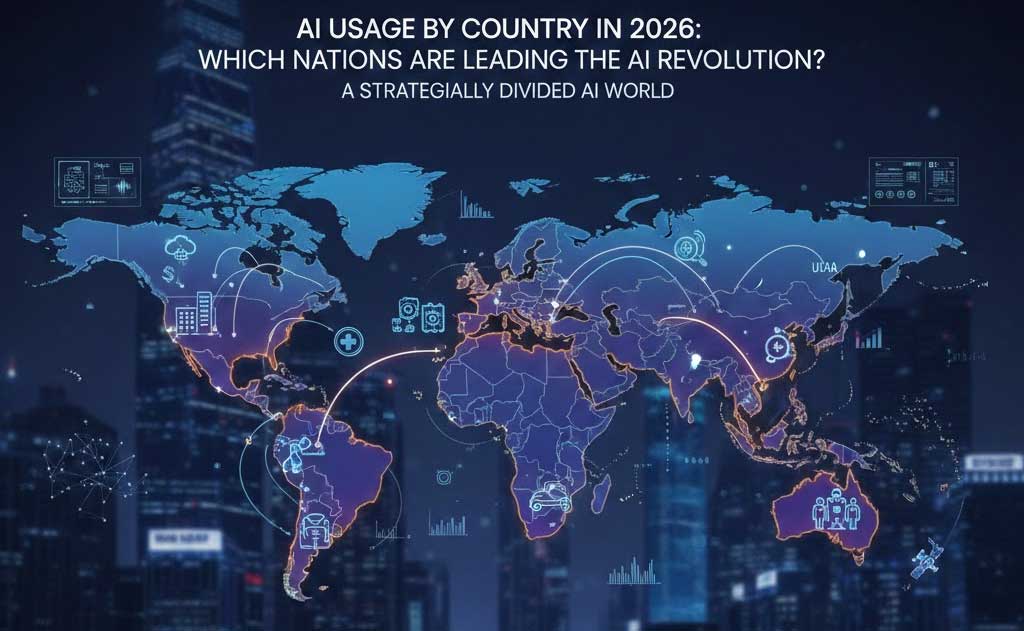
The global landscape of artificial intelligence adoption reveals a world divided not by technology access, but by strategic implementation. In 2026, AI usage patterns vary dramatically across nations, shaped by government priorities, industrial focus, and cloud infrastructure investments. Understanding these differences provides crucial insights into where AI is making the biggest impact and which countries are positioning themselves for long-term technological leadership.
The Current State of Global AI Adoption
Artificial intelligence has moved beyond experimental phases into mainstream deployment across industries worldwide. However, adoption rates tell only part of the story. The real differentiator lies in how countries integrate AI into their economic infrastructure, regulatory frameworks, and societal systems.
Some nations have embraced AI as a tool for government efficiency and surveillance. Others focus on consumer applications, healthcare breakthroughs, or industrial automation. This strategic diversity reflects different national priorities, technological capabilities, and ethical considerations surrounding AI deployment.
AI Usage Leaders: Country-by-Country Analysis
United States: The Enterprise AI Powerhouse
The United States maintains its position as a global AI leader, driven primarily by enterprise adoption and cloud infrastructure dominance. American companies leverage AI for automation, predictive analytics, and customer experience enhancement across virtually every sector.
Key Focus Areas:
- Cloud-based AI platforms (AWS, Microsoft Azure, Google Cloud)
- Enterprise automation and business intelligence
- AI-driven marketing and customer analytics
- Healthcare AI for diagnostics and drug discovery
- Financial services automation
The US AI ecosystem benefits from massive venture capital investment, world-class research institutions, and the presence of leading tech companies. Over 75% of Fortune 500 companies have deployed AI solutions in at least one business function, with cloud platforms enabling rapid scaling and deployment.
China: AI at Unprecedented Scale
China’s AI implementation operates at a scale unmatched globally, with government support driving adoption across smart cities, manufacturing, and public services. The nation’s approach combines centralized planning with rapid commercial deployment.
Key Focus Areas:
- Smart city infrastructure and traffic management
- Manufacturing automation and quality control
- Facial recognition and surveillance systems
- E-commerce personalization
- Agricultural AI for crop monitoring
Chinese tech giants Alibaba, Tencent, and Baidu have built comprehensive AI ecosystems that integrate seamlessly with government initiatives. The country’s focus on practical, large-scale implementation has created testing grounds for AI applications that other nations are still developing.
United Kingdom: Financial and Healthcare AI Innovation
The UK has carved out a leadership position in specialized AI applications, particularly in financial services and healthcare. London’s position as a global financial hub, combined with the NHS’s vast healthcare data, provides unique advantages for AI development.
Key Focus Areas:
- Algorithmic trading and risk management
- Healthcare diagnostics and treatment planning
- Natural language processing for legal services
- AI-powered fraud detection
- Academic AI research institutions
The UK government’s AI strategy emphasizes ethical AI development and regulatory frameworks that balance innovation with protection, positioning the country as a thought leader in responsible AI deployment.
Germany: Industrial AI and Automotive Excellence
Germany’s AI adoption reflects its manufacturing heritage, with particular strength in industrial applications and automotive technology. The country’s “Industrie 4.0” initiative has systematically integrated AI into production processes.
Key Focus Areas:
- Predictive maintenance in manufacturing
- Autonomous vehicle development
- Supply chain optimization
- Quality control automation
- Energy grid management
German companies excel at combining traditional engineering excellence with AI capabilities, creating hybrid solutions that enhance rather than replace existing systems.
Japan: Robotics and Automation Leadership
Japan’s AI strategy builds on its robotics expertise, addressing demographic challenges through automation. The country leads in developing AI systems that work alongside humans in manufacturing, healthcare, and service industries.
Key Focus Areas:
- Industrial robotics with AI vision systems
- Elderly care robots and assistance systems
- Precision manufacturing automation
- Disaster response AI systems
- Transportation and logistics optimization
Japanese companies prioritize reliability and safety in AI deployment, resulting in slower but more robust implementations compared to some competitors.
India: Rapid Cloud AI Growth
India represents one of the fastest-growing AI markets globally, driven by a thriving tech sector, government digitization initiatives, and widespread smartphone adoption. The country’s AI usage focuses heavily on cloud-based applications and financial technology.
Key Focus Areas:
- Fintech and digital payment AI
- Cloud-based business applications
- Agriculture AI for crop management
- Education technology platforms
- Healthcare accessibility through AI diagnostics
India’s large English-speaking population and strong software development sector position it as both an AI consumer market and a global AI services provider.
Canada: AI Research Excellence
Canada punches above its weight in AI research and development, home to leading AI research institutes and pioneering work in deep learning. The country’s AI strategy emphasizes fundamental research alongside commercial applications.
Key Focus Areas:
- Academic AI research (Montreal, Toronto, Edmonton)
- Healthcare AI applications
- Natural resources management
- Financial services AI
- AI ethics and governance frameworks
Canadian AI institutes have produced many of the researchers and technologies now powering global AI systems, creating a strong foundation for continued leadership.
United Arab Emirates: AI-Powered Governance
The UAE has aggressively adopted AI as part of its national development strategy, appointing the world’s first Minister of AI and implementing AI across government services.
Key Focus Areas:
- Smart city infrastructure (Dubai, Abu Dhabi)
- Government service automation
- Healthcare system optimization
- Education technology
- Transportation and mobility solutions
The UAE’s concentrated wealth and centralized governance enable rapid AI deployment that serves as a model for other developing nations.
The Cloud Infrastructure Foundation
Behind these national AI strategies lies a critical enabler: cloud computing infrastructure. In 2026, over 90% of AI applications worldwide run on cloud platforms, making cloud access and expertise essential for AI adoption.
Regional Cloud Dominance
North America and Europe:
- Amazon Web Services (AWS) leads in enterprise AI deployments
- Microsoft Azure dominates in hybrid cloud AI solutions
- Google Cloud Platform excels in machine learning services
- IBM Cloud serves specialized enterprise needs
Asia-Pacific:
- Alibaba Cloud powers Chinese AI applications
- Tencent Cloud supports consumer AI services
- Huawei Cloud serves government and enterprise clients
- Local providers gaining market share in Southeast Asia
Emerging Markets:
- Increasing adoption of global cloud platforms
- Regional data sovereignty concerns driving local cloud development
- Partnership models between global and local providers
The cloud’s role extends beyond infrastructure. Cloud platforms provide pre-trained AI models, development tools, and managed services that dramatically lower the barriers to AI adoption. Companies no longer need massive capital investments or specialized expertise to deploy sophisticated AI applications.
Regional AI Adoption Patterns
North America: Enterprise-Driven Innovation
North American AI adoption centers on enterprise applications designed to improve efficiency, reduce costs, and enhance customer experiences. Companies invest heavily in AI to maintain competitive advantages in fast-moving markets.
Adoption Characteristics:
- High investment in custom AI solutions
- Focus on measurable ROI and business outcomes
- Extensive use of AI in marketing and sales
- Growing deployment in HR and talent management
- Regulatory concerns around data privacy increasing
Asia: Mass-Scale Implementation
Asian countries, led by China, India, and Southeast Asian nations, deploy AI at scales that dwarf Western implementations. Population density, government support, and mobile-first technology adoption create unique AI ecosystems.
Adoption Characteristics:
- Government-led smart city initiatives
- Widespread consumer AI applications
- Integration with mobile payment systems
- Manufacturing and logistics automation
- Educational technology for mass markets
Europe: Ethical and Regulated AI
European AI adoption reflects the region’s emphasis on privacy, ethics, and regulation. The EU’s AI Act and GDPR influence not just European companies but global AI development practices.
Adoption Characteristics:
- Strong emphasis on explainable AI
- Privacy-preserving AI techniques
- Sector-specific AI regulations
- Focus on AI for sustainability and climate
- Cross-border data governance frameworks
Middle East: AI for National Development
Middle Eastern countries, particularly the Gulf states, view AI as essential to economic diversification beyond oil and gas. Massive infrastructure investments support ambitious AI deployment goals.
Adoption Characteristics:
- Top-down government-driven implementation
- Focus on smart city technology
- Healthcare and education modernization
- Tourism and hospitality AI applications
- Financial services innovation
Factors Driving AI Adoption Differences
Several key factors explain why AI usage varies so dramatically across countries:
Infrastructure Maturity: Countries with advanced digital infrastructure adopt AI more rapidly. High-speed internet, cloud computing access, and digital payment systems create foundations for AI deployment.
Government Policy: National AI strategies, funding programs, and regulatory frameworks significantly impact adoption rates. Countries with clear AI visions and supportive policies accelerate implementation.
Industry Composition: Manufacturing-heavy economies prioritize industrial AI, while service-based economies focus on customer experience and analytics applications.
Talent Availability: Access to AI researchers, data scientists, and machine learning engineers determines what AI projects countries can undertake. Brain drain or gain significantly impacts national capabilities.
Data Availability: AI systems require vast amounts of data for training. Countries with digitized records, permissive data policies, or large user bases enjoy advantages in developing AI applications.
Cultural Factors: Societal attitudes toward automation, privacy, and technology adoption influence how quickly AI spreads through different sectors.
Emerging AI Markets to Watch
While established leaders dominate current AI usage, several emerging markets show potential for rapid growth:
Brazil: Growing AI startup ecosystem, strong agriculture AI applications, expanding cloud infrastructure
South Korea: Advanced telecommunications infrastructure, government AI investment, robotics integration
Singapore: Smart nation initiative, financial services AI hub, regional tech center
Israel: Cybersecurity AI leadership, strong venture capital ecosystem, military technology spillover
Nigeria: Mobile-first AI applications, fintech innovation, largest African tech market
These countries combine growing technical capabilities with specific market needs that AI can address, positioning them for increased global AI influence.
The Future of Global AI Usage
Looking ahead, several trends will shape how AI usage evolves across countries:
Sovereign AI Initiatives: More nations will develop domestic AI capabilities to reduce dependence on foreign technology and protect national interests.
AI Localization: Global AI models will increasingly adapt to local languages, cultural contexts, and regulatory requirements.
Edge AI Growth: Processing AI workloads closer to data sources will reduce cloud dependence and address latency concerns.
AI Skills Gap: Countries investing in AI education and training will pull ahead, while others face growing talent shortages.
Ethical Frameworks: International cooperation on AI ethics and safety will influence which countries’ AI systems gain global trust and adoption.
Conclusion: A Strategically Divided AI World
AI usage in 2026 reveals a world where technology access is widespread but strategic implementation varies dramatically. The countries leading the AI revolution aren’t simply those with the most advanced technology, but those that have aligned AI adoption with clear national priorities, invested in necessary infrastructure, and created environments where AI innovation can flourish.
The United States and China maintain leadership positions through different approaches—one driven by private sector innovation and cloud platforms, the other by centralized planning and mass implementation. Europe charts a third path emphasizing ethical AI and regulatory frameworks. Meanwhile, countries like India, Canada, and the UAE demonstrate that AI leadership isn’t limited to traditional tech powers.
For businesses, policymakers, and individuals, understanding these national AI strategies provides crucial context for navigating an increasingly AI-driven global economy. The nations that successfully integrate AI into their economic and social systems while addressing ethical concerns and workforce impacts will shape the technological landscape for decades to come.
Ethan Brooks covers the tech that’s reshaping how we move, work, and think — for VFuture Media. He was at CES 2026 in Las Vegas when the world got its first real look at humanoid robots, AI-powered vehicles, and Samsung’s tri-fold phone. He writes about AI, EVs, gadgets, and green tech every week. No hype. No filler. X · Facebook
The AI revolution isn’t happening uniformly—it’s happening strategically, with each country pursuing its own vision of an AI-enabled future.




Leave a Comment