
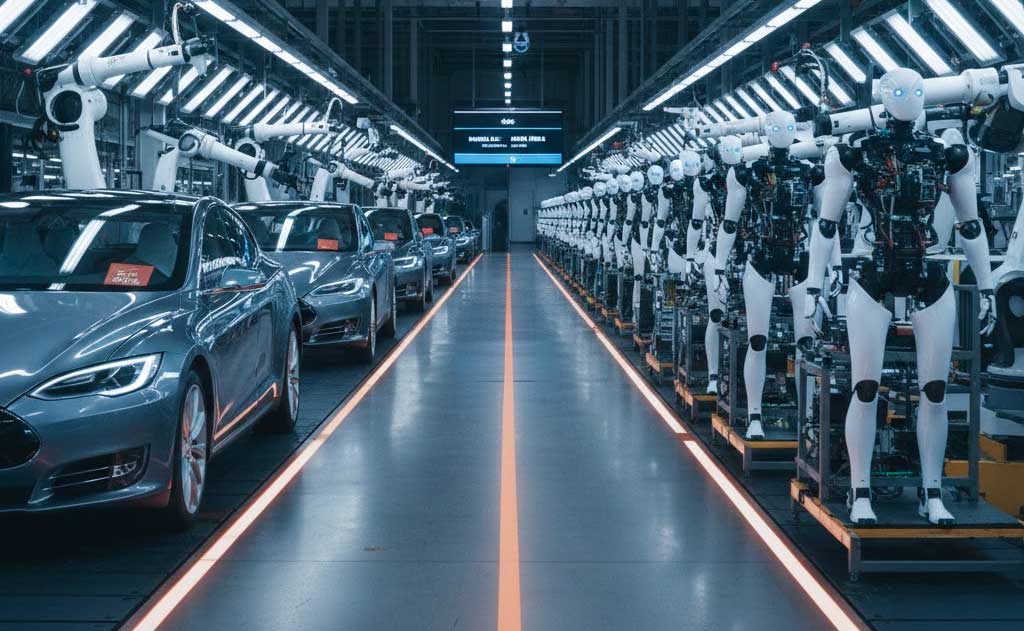
The announcement from Tesla’s Q4 2025 earnings call sent shockwaves through the automotive and tech worlds: the company plans to end production of its flagship Model S and Model X vehicles by the end of Q2 2026, reallocating those Fremont factory lines to ramp up Tesla Optimus production 2026 for its humanoid robots. This pivot underscores Elon Musk’s vision of Tesla as a leader in physical AI, autonomy, and robotics rather than purely an EV maker.
Tesla’s Q4 2025 results showed $24.9 billion in revenue—slightly down year-over-year but beating expectations—driven by record energy storage profits that offset softer auto sales. The company highlighted no Bitcoin sales, with holdings unchanged despite market fluctuations, and revealed strong progress in autonomy: over 500 unsupervised Robotaxis operating and Tesla FSD 1.1 million users paying for Full Self-Driving capabilities.
This strategic shift raises profound questions about Tesla’s future trajectory. Is the end of iconic models a sign of maturity or a bold bet on trillion-dollar opportunities in robotics? Having followed Tesla’s quarterly calls since the Model 3 ramp, I see this as the clearest signal yet that Musk is doubling down on Optimus and autonomy as the next phase.
Q4 2025 Earnings: $24.9B Revenue & Energy Record Profits
Tesla’s latest quarter delivered a mixed but ultimately resilient picture. Total revenue came in at $24.9 billion, a modest 3% decline from the prior year, yet it surpassed analyst estimates. Automotive revenue softened to around $17.7 billion (down 11% YoY), reflecting lower deliveries amid the expiration of certain incentives and competitive pressures.
The standout performer was the energy generation and storage segment, which posted record profits and deployments. Q4 energy storage hit 14.2 GWh—a new high—and contributed significantly to margin expansion, with automotive gross margins reaching 20.1%.
Here’s a snapshot of key financials from the quarter:
Q4 2025 Financial Performance — Key Metrics
- Total Revenue: $24.9B (⬇️ 3% YoY)
Beat estimates; energy segment helped offset automotive decline - Automotive Revenue: ~$17.7B (⬇️ 11% YoY)
Impacted by lower vehicle deliveries - Energy Storage Revenue: ~$3.84B (⬆️ 25% YoY)
Record deployments of 14.2 GWh - GAAP Net Income (Q4): $0.8B
Down YoY; full-year: $3.8B - Non-GAAP EPS: $0.50
Beat consensus estimate of $0.45 - Operating Margin: ~5.7%
Mixed performance; energy segment drove margin improvement
For full details, see Tesla’s official Q4 2025 earnings release.
Energy storage has emerged as a cash cow, with margins far outpacing autos. This segment’s growth highlights Tesla’s diversification beyond vehicles—a theme that ties directly into the robotics pivot.
The Fremont Pivot: Model S/X End by Q2 2026 for Optimus Ramp
The headline news: Tesla will wind down Model S and Model X production at its Fremont factory by mid-2026, converting those lines to produce Optimus humanoid robots at scale.
Musk described it as an “honorable discharge” for the programs that defined Tesla’s early luxury EV era. The Model S, launched in 2012, pioneered long-range electric sedans, while the Model X brought falcon-wing doors and family-friendly utility. Yet production volumes have dwindled, with these models representing a small fraction of output compared to Model 3/Y.
Why now? Fremont’s space is premium real estate for high-value manufacturing. By reallocating, Tesla aims to build a dedicated Optimus line targeting eventual capacity of 1 million units annually. Musk emphasized this as part of the shift to an “autonomous future,” where physical AI—embodied in robots—takes precedence.
The decision isn’t without risks: legacy fans lose flagship options, and no direct successors are announced. But operationally, it frees capital and expertise for higher-growth areas. For more on EV transitions, check our coverage at Electric-vehicles/.
Optimus at Scale: 1 Million Humanoid Robots Annually Target
Tesla Optimus production 2026 marks the company’s boldest robotics bet. The humanoid robot, now in its third generation designed for mass production, is set for meaningful ramp-up by late 2026.
Musk has long positioned Optimus as potentially more valuable than Tesla’s vehicle business—a trillion-dollar opportunity in labor augmentation for factories, homes, and services. Early prototypes focused on simple tasks; now, with AI advancements from xAI integrations (see xAI raises $20B in Series E: Elon Musk’s bold AI power play), Optimus aims for general utility.
The Fremont retooling targets 1 million units/year long-term, starting slow but scaling rapidly as manufacturing matures. This isn’t just assembly—it’s leveraging Tesla’s vertical integration in batteries, actuators, and AI compute.
Implications:
- Supply chain transformation — New parts dominate, leading to an “agonizingly slow” initial ramp before explosive growth.
- Workforce evolution — Increased headcount at Fremont for robotics expertise.
- Market entry — Potential sales to businesses first, then consumers by 2027+.
This pivot aligns with broader AI trends; explore more in AI dominance continues in explosive rounds.
Robotaxi & FSD Progress: Unsupervised Fleet at 500+, 1.1M Users
Autonomy remains core. Tesla reported over 500 unsupervised Robotaxis running—meaning no in-car safety driver—mostly in Austin, with plans for wider U.S. rollout by end-2026.
Tesla FSD 1.1 million users (active subscribers, including outright purchases) represent ~12% of cumulative vehicles, up significantly. Subscriptions doubled in 2025, highlighting recurring revenue potential.
Safety data continues to improve, with unsupervised miles accumulating rapidly. This fleet validates the vision: Robotaxi networks could generate high-margin revenue, dwarfing traditional sales.
For AI intersections, see Elon Musk reveals x’s AI future 2026.
No Bitcoin Sales & Capital Allocation Discipline
Tesla held its Bitcoin steady at ~11,509 coins—no sales in Q4 despite a $239M unrealized loss from price dips. This conservative stance preserves optionality while focusing cash on core bets: AI infrastructure, Optimus, and autonomy.
CapEx will surge in 2026 (potentially $20B+), funding robotics and compute. Energy profits provide the buffer.
Fan & Community Reactions: Roadster Delays vs. Robotics Excitement
Reactions are polarized. Long-time fans lamented the Model S/X end—jokes about perpetual Roadster delays resurfaced (“At least the Roadster outlived them!”). Yet robotics enthusiasts praised the pivot, seeing Optimus as the true moonshot.
Community forums buzz with debates: legacy disappointment vs. forward-looking optimism. Musk’s charisma sustains loyalty, but execution will decide sentiment.
Broader Tesla Ecosystem: Cybertruck, Next-Gen Delays, Energy Dominance
The pivot fits a larger strategy:
- Cybertruck ramp continues, though slower than hoped.
- Next-gen $25K vehicle delayed, prioritizing autonomy/robotics.
- Energy storage dominates as a high-margin growth engine.
Tesla’s ecosystem—vehicles, energy, AI—positions it uniquely. Read more on green tech at Green-tech/.
Competitive Landscape: Humanoids vs. Figure, Boston Dynamics; Robotaxi vs. Waymo
In humanoids, Tesla faces Figure AI, Boston Dynamics, and Agility Robotics—strong in niches but lacking Tesla’s scale/manufacturing edge.
Robotaxi competition includes Waymo (leader in miles) and Cruise. Tesla’s advantage: vast fleet data from FSD users and vertical integration.
Market Predictions 2027–2035: Optimus as Mass-Market Robot, Valuation Uplift
By 2030, Optimus could disrupt labor markets; by 2035, mass adoption in homes/factories. Robotics may drive TSLA multiples higher, with energy as stable cash flow.
Tesla’s valuation could reflect AI/robotics premiums, similar to tech giants.
Investment Angles: TSLA Stock Reaction & Multiples
Post-earnings, TSLA rose on robotics optimism despite revenue softness. Investors weigh auto decline vs. high-growth bets—robotics/energy multiples could justify premiums.
Risks include execution delays; rewards are transformative.
Conclusion: A Robotics-First Future
Tesla’s Model S/X end for Optimus signals a profound evolution. Q4 2025’s resilience—energy records, autonomy milestones, disciplined capital—supports the pivot. Musk’s vision of abundance through AI and robots may redefine industries.
This isn’t the end of EVs but a maturation toward broader impact. Tesla leads the convergence of electric, autonomous, and robotic futures.
Explore more EV trends at Electric-vehicles/ or AI insights at Ai/.
FAQ
Why is Tesla ending Model S and X production in 2026?
To reallocate Fremont lines for Tesla Optimus production 2026, targeting 1 million humanoid robots annually as part of the shift to robotics and autonomy.
What is Tesla’s Optimus robot production target?
Long-term capacity of 1 million units per year from the converted Fremont facility, with ramp-up starting late 2026.
How many unsupervised Robotaxis does Tesla have in 2026?
Over 500 running unsupervised, primarily in Austin, with expansion planned across U.S. cities.
How many FSD users does Tesla have?
1.1 million active subscribers as of end-2025, including outright purchases.
Did Tesla sell any Bitcoin in 2025 or 2026?
No—holdings remained at ~11,509 coins, with no sales despite unrealized losses.
What drove Tesla’s energy storage record profits in Q4 2025?
14.2 GWh deployments and strong demand for Megapack/Powerwall, boosting margins amid auto softness.
Will Tesla bring back Model S/X or launch successors?
No direct plans announced; focus shifts to next-gen platforms and robotics.
How does the Fremont pivot impact Tesla jobs?
Likely increased headcount for robotics expertise, transitioning from legacy vehicle lines.
What are competitors to Tesla Optimus?
Figure AI, Boston Dynamics, Agility Robotics in humanoids; Waymo/Cruise in robotaxi.
When might Optimus be available for purchase?
Potentially 2027 for broader sales, starting with business applications.
How does this affect TSLA stock long-term?
Positive for robotics/energy multiples, though short-term volatility from auto declines.
What about the Roadster—still delayed?
Yes, ongoing quips from fans, but priority remains autonomy/robotics.
Is Tesla still committed to affordable EVs?
Next-gen $25K delayed; focus on higher-margin autonomy/energy.
Why prioritize robotics over legacy models?
Musk views Optimus as trillion-dollar potential, aligning with physical AI vision.
Stay tuned for updates on these transformative trends.
I’m Ethan, and I write about the tech that’s actually going to change how we live — not the stuff that just sounds impressive in a press release. I cover AI, EVs, robotics, and future tech for VFuture Media. I was on the ground at CES 2026 in Las Vegas, walking the show floor so I could give you a real read on what matters and what’s just noise. Follow me on X for daily takes.



Leave a Comment