
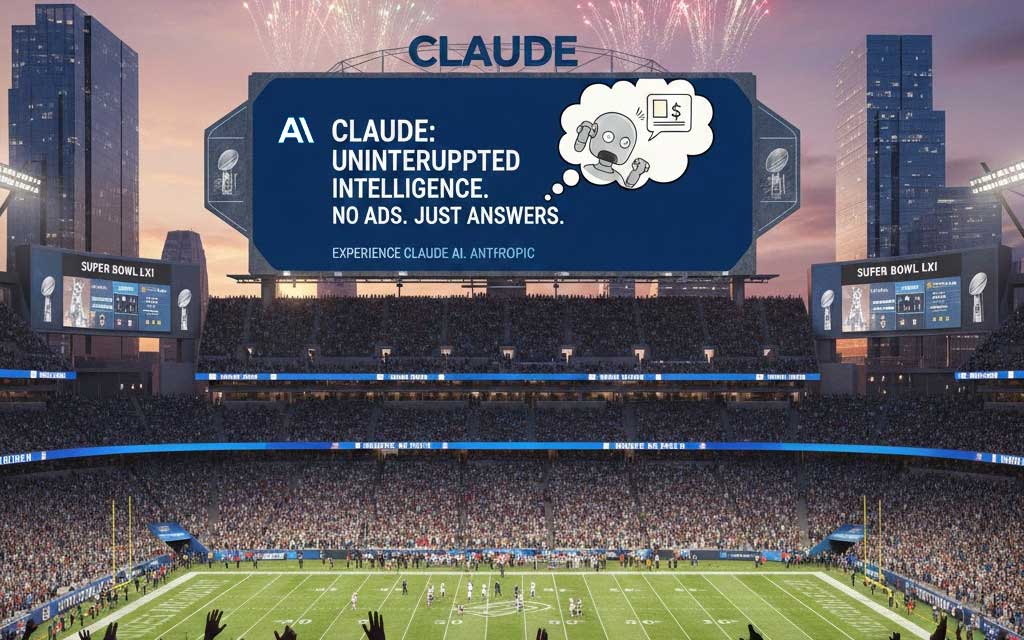
The Super Bowl on February 8, 2026 became one of the most talked-about battlegrounds in artificial intelligence—not because of the game itself, but because two leading AI labs chose the biggest advertising stage in the world to directly confront each other’s business models and philosophies.
Anthropic ran multiple high-profile spots that openly mocked the idea of advertisements appearing inside AI chat responses. One widely shared creative showed a user asking for fitness advice, only for the AI to smoothly pivot into promoting a protein shake—followed by the tagline: “Ads are coming to AI. But not to Claude. Keep thinking.” The message was unmistakable: Claude would remain an ad-free experience even as competitors experimented with monetization through in-conversation promotions.
OpenAI responded with its own expensive placement focused entirely on utility and creativity. The spot carried the headline “You Can Just Build Things” and featured short vignettes of people using ChatGPT (and the newly released Codex interface) to design robotics parts, write music, automate small-business tasks, and prototype physical products. No direct attack on Anthropic appeared in the creative, but the timing and positioning made the competitive intent clear.
Timing of Major Model Releases
Both companies dropped flagship frontier models within days of the Super Bowl:
- February 5, 2026 → Anthropic publicly released Claude Opus 4.6
- Same day → OpenAI released GPT-5.3-Codex (a specialized coding and building companion tuned on top of the broader GPT-5 family)
Claude Opus 4.6 brought several headline improvements:
- Strong gains on long-horizon agentic coding benchmarks (leading Terminal-Bench 2.0 and new multi-file editing suites)
- Expanded context window options (1 million token beta access, 200K standard)
- Top scores on several difficult reasoning evaluations including Humanity’s Last Exam public leaderboard and BrowseComp
- Introduction of lightweight “agent teams” that allow multiple Claude instances to coordinate on complex tasks
- Input / output pricing held at $5 / $25 per million tokens
OpenAI positioned GPT-5.3-Codex as the practical, hands-on builder’s model—optimized for generating, debugging, and iterating on real software projects, CAD files, 3D-printable designs, and automation scripts.
Core Business-Model Divergence
The advertising disagreement is only the most visible symptom of a deeper strategic split.
OpenAI approach
- Heavy reliance on scale → massive free and low-cost tiers to capture hundreds of millions of daily users
- Testing contextual advertisements inside the free and Go-tier experiences (logged-in users only, starting late 2025 / early 2026)
- Advertisements are not supposed to change factual answers or insert themselves into reasoning steps
- Revenue goal is to offset enormous training and inference costs while keeping premium tiers (Plus, Team, Enterprise) for power users and organizations
Anthropic approach
- Premium and enterprise-first positioning
- Strict commitment to remaining advertisement-free across all consumer-facing Claude interfaces
- Revenue primarily from monthly / annual subscriptions + high-volume API usage by businesses
- Long-standing emphasis on safety, interpretability, and constitutional AI principles (originally created as a counterweight to what founders saw as overly rapid commercialization at OpenAI)
Neither model is inherently “right.” Ads can democratize access to frontier intelligence for people who cannot afford $20/month subscriptions. At the same time, many enterprise buyers and individual professionals say they will never trust mission-critical outputs that appear inside an interface potentially influenced by paid promotions—even if the company promises separation.
What This Means for Everyday Users
For the average person using AI chatbots in 2026:
- If you value completely clean, distraction-free conversations → Claude remains the clearer short-term choice
- If you want the largest possible ecosystem of plugins, custom GPTs, voice modes, image generation, desktop apps, and integrations → OpenAI / ChatGPT still offers the broadest surface area
- Agentic capabilities (the ability to break big tasks into steps, use tools autonomously, remember long contexts, and coordinate sub-agents) are advancing rapidly on both sides
Enterprise and Developer Perspective
Companies evaluating which frontier model family to standardize on are looking at several additional dimensions beyond ads:
- Safety & compliance track record (Anthropic generally perceived as more conservative)
- Speed of iteration and feature velocity (OpenAI has maintained a faster public release cadence)
- Depth of integrations (Microsoft Copilot ecosystem gives OpenAI a structural advantage inside large organizations already using 365 / Azure)
- Raw capability on specialized benchmarks (very close race; different models win different evaluations month to month)
Many large organizations are already multi-model: they maintain access to both Claude and ChatGPT / GPT endpoints so internal teams can choose the best tool for each workflow.
Looking Forward: Where the Rivalry Goes Next
The public Super Bowl confrontation is unlikely to be a one-off. Several probable future pressure points include:
- How (and how quickly) OpenAI scales and refines its ad formats without triggering widespread user backlash
- Whether Anthropic can grow fast enough on subscription revenue alone to match OpenAI’s compute budget
- Regulatory scrutiny of in-product advertising under existing consumer-protection laws and the emerging EU AI Act transparency obligations
- Potential new revenue experiments (API-only monetization, white-label enterprise agents, physical-world robotics integrations, etc.)
The most important long-term outcome is acceleration. Intense, visible competition forces both labs to ship better reasoning, longer context, stronger agentic behavior, and more reliable tool use far faster than they would in a less contested environment.
Frequently Asked Questions
Will AI chatbots eventually all have ads? Not necessarily. OpenAI is currently the only major lab openly testing in-conversation ads. Anthropic has made a multi-year public commitment to stay ad-free. Google (Gemini) and xAI (Grok) have not signaled similar plans yet.
Which model is better right now—Claude Opus 4.6 or GPT-5.3-Codex? It depends on the task. Claude 4.6 generally leads on sustained multi-file coding projects and very long context reasoning. Codex shines on creative prototyping, rapid iteration, and tasks that blend code with design or physical-world outputs.
Did the Super Bowl ads change many people’s minds? They certainly increased brand awareness. Anthropic’s spots generated significantly more social conversation volume (measured by mentions and quote tweets), while OpenAI’s reinforced its existing perception as the builder’s platform.
How should businesses choose between the two in 2026? Run parallel pilots. Most serious adopters are already doing exactly that—giving teams access to both so real usage data can drive the long-term decision.
The OpenAI–Anthropic rivalry has moved from quiet technical competition into open cultural and commercial combat. That visibility benefits everyone who uses these tools. Faster progress, clearer trade-offs, and ultimately more capable and trustworthy AI systems are the most likely result.
Subscribe to VFuture Media for continuing coverage of agentic systems, frontier model releases, and the business dynamics reshaping artificial intelligence.
Ethan Brooks covers the tech that’s reshaping how we move, work, and think — for VFuture Media. He was at CES 2026 in Las Vegas when the world got its first real look at humanoid robots, AI-powered vehicles, and Samsung’s tri-fold phone. He writes about AI, EVs, gadgets, and green tech every week. No hype. No filler. X · Facebook


Leave a Comment