
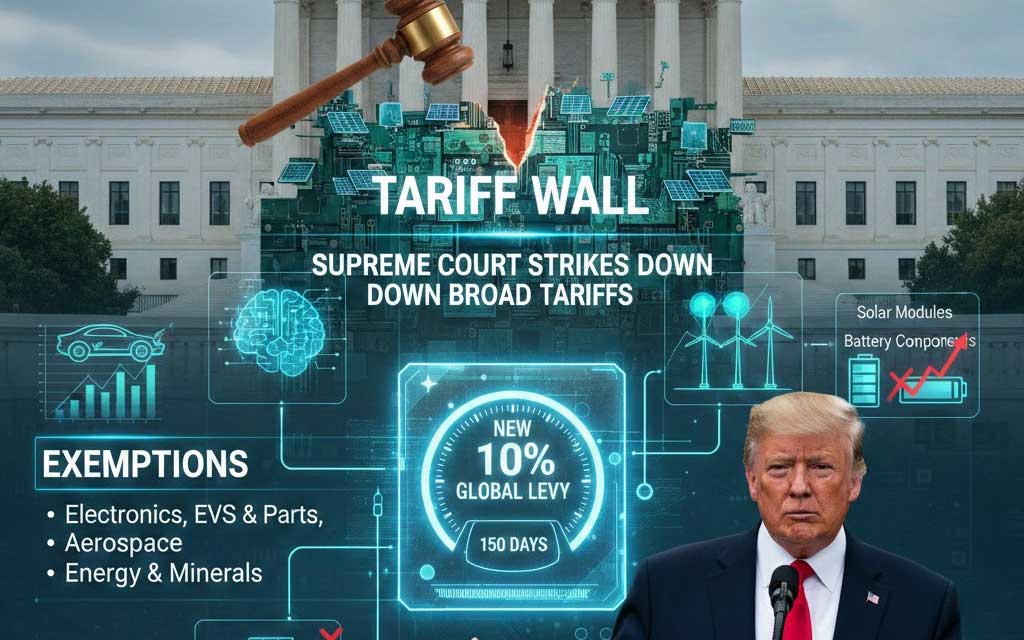
The U.S. Supreme Court’s 6-3 ruling on February 20, 2026, striking down President Donald Trump’s broad emergency tariffs under the International Emergency Economic Powers Act (IEEPA) has provided partial relief to high-tech and clean energy sectors reliant on global imports. The court ruled that IEEPA does not authorize unilateral broad duties, invalidating much of the 2025 tariff regime and potentially enabling refunds of billions in collected duties.
Hours later, Trump imposed a temporary 10% ad valorem global import surcharge under Section 122 of the Trade Act of 1974—a provision never before used for tariffs—effective February 24, 2026, for up to 150 days. This aims to address trade imbalances and maintain revenue, with officials signaling future use of Sections 301 and 232 for targeted actions.
Exemptions Relevant to EV, AI, and Green Tech
Per the White House proclamation and fact sheet, key exemptions from the new 10% levy include:
- Certain electronics (potentially covering semiconductors, chips, and related components).
- Passenger vehicles, light trucks, medium/heavy-duty vehicles, buses, and certain parts (directly benefiting EV assembly and imports).
- Certain aerospace products and parts.
- Energy products, critical minerals, metals (including those for batteries and renewables), and fertilizers/natural resources not sufficiently produced domestically.
- Pharmaceuticals and ingredients (less directly relevant but part of broader tech supply chains).
These carve-outs soften immediate impacts on many EV, AI, and green tech imports, especially from allies under deals like USMCA. However, non-exempt items (e.g., some battery components, solar modules, or non-specified chips) face the added 10% surcharge on top of existing duties.
Sector-Specific Impacts
- Electric Vehicles (EVs) and Batteries: The ruling offers relief by invalidating prior broad IEEPA tariffs (e.g., higher rates on Chinese EVs and components), potentially lowering costs for importers and accelerating supply chain adjustments. Exemptions for passenger vehicles, parts, critical minerals, and energy products limit the new 10% hit on many EV-related imports. Domestic battery manufacturing (boosted by prior incentives) gains breathing room, though lingering Section 232/301 duties on steel, aluminum, or specific minerals could sustain some cost pressures. Analysts note temporary cost reductions for solar/batteries as a key win, aiding adoption amid supply chain volatility.
- AI and Semiconductors: Narrower prior tariffs targeted advanced AI chips (e.g., 25% on certain imports under Section 232), but the ruling eases broader pressures on semiconductors and electronics. Exemptions for certain electronics provide protection for AI hardware imports (e.g., Nvidia/AMD chips). This stabilizes pricing for data centers and cloud computing, supporting AI growth. However, ongoing national security-focused probes could lead to future targeted duties.
- Green Tech (Solar, Renewables, Batteries): Clean energy sectors faced some of the highest prior tariffs (e.g., elevated rates on Chinese solar panels/components). The IEEPA invalidation brings significant relief, reducing costs and potentially reversing project delays/cancellations seen in early 2025. Exemptions for energy products, critical minerals, and related items cushion the new 10% levy on batteries and renewables. Broader uncertainty persists, but the temporary nature and exemptions position green tech for steadier progress toward grid reliability and deployment goals.
Broader Outlook and Future Risks
Markets reacted with modest gains post-ruling, viewing it as curbing executive overreach, though the new surcharge and potential Section 301/232 expansions sustain protectionism. The temporary 150-day window limits long-term disruption but invites congressional action or negotiations. Refunds for invalidated duties remain unresolved, likely through litigation.
For innovators, investors, and adopters in EV, AI, and green tech:
- Monitor U.S. Customs for detailed exemption lists and refund processes.
- Track potential escalations via Section 301 (unfair practices) or 232 (national security).
- Prepare for supply chain diversification amid ongoing trade shifts.
This pivot underscores Trump’s commitment to tariffs for domestic manufacturing and trade rebalancing, tempered by exemptions that preserve key tech and clean energy flows. vFutureMedia will continue covering developments in emerging technologies, trade policy, and their intersection. For official details, refer to White House proclamations, Supreme Court opinions, or sector-specific analyses.
I’m Ethan, and I write about the tech that’s actually going to change how we live — not the stuff that just sounds impressive in a press release. I cover AI, EVs, robotics, and future tech for VFuture Media. I was on the ground at CES 2026 in Las Vegas, walking the show floor so I could give you a real read on what matters and what’s just noise. Follow me on X for daily takes.
You made it to the end, which means you actually care about this stuff. So do we. Check out our AI and EV sections for more stories worth your time.




Leave a Comment