
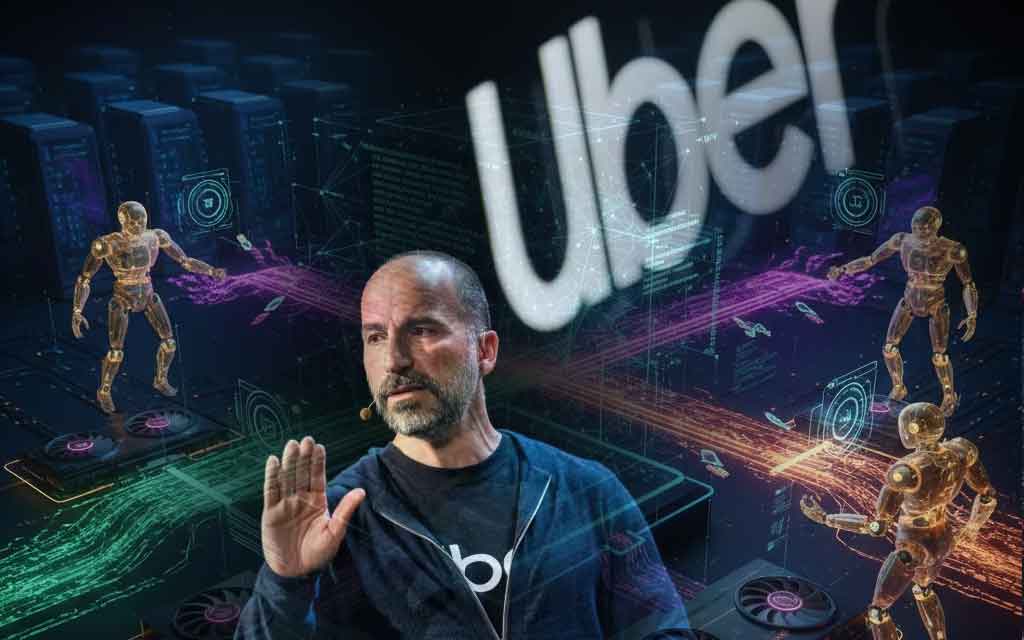
In a candid February 2026 interview on The Diary of a CEO podcast with Steven Bartlett, Uber CEO Dara Khosrowshahi laid bare the transformative — and potentially disruptive — role of artificial intelligence within one of the world’s largest tech platforms. Speaking from a company that has already turned itself from a perennial loss-maker into a profitable powerhouse, Khosrowshahi described how AI is reshaping engineering workflows at Uber, delivering massive productivity leaps, and setting the stage for a future where human hires may take a backseat to scalable AI agents powered by GPU infrastructure.
The standout revelation: Approximately 90% of Uber’s engineers now incorporate AI tools into their daily work. But the real story lies in the stratification — the top 30% of these users, whom Khosrowshahi calls “power users,” are achieving unprecedented gains. These elite adopters are pushing far more “diffs” (code changes or pull requests) to Uber’s massive codebase than their peers, a direct metric of output velocity in a company where software underpins everything from ride matching and dynamic pricing to fraud detection and global operations.
“About 90% of our coders are using AI,” Khosrowshahi explained. “Now, that’s easy to say, but there are probably 30% of them that are power users. They are showing a clear differentiation in the number of diffs, for example… how much a diff is a code release that’s different from the last code release. So one of the measurements of productivity is just how many diffs are you putting to the code base.”
This bifurcation highlights a broader trend in frontier tech: AI adoption is widespread, but mastery creates exponential advantages. Power users aren’t just coding faster — they’re orchestrating AI agents to handle complex, repetitive, or exploratory tasks, allowing humans to focus on high-level architecture, innovation, and oversight. Khosrowshahi noted that AI agents now continuously monitor systems, diagnose issues in real time, and eliminate the need for large on-call teams that once spent “hours and hours” troubleshooting. “The human can look over the shoulder of the AI agent,” he said, painting a picture of hybrid human-AI collaboration that amplifies rather than replaces capability.
For now, the impact is overwhelmingly positive at Uber. Rather than using these gains to shrink headcount — as some tech leaders do when seeing 20-30% productivity boosts — Khosrowshahi is doubling down on talent. “I just think they become superhumans,” he said in a prior December 2025 interview. “So we are actually hiring more engineers because every engineer got more valuable to me.” The company has woven AI deeply into operations, from recommendation engines and customer service reasoning to backend reliability, generating hundreds of millions in measurable value.
Yet the conversation took a sharper turn toward the horizon. Khosrowshahi predicted a tipping point within roughly five years — around 2031 — when the return on investment (ROI) for adding a human software engineer will be surpassed by the ROI of scaling AI agents and investing in more GPU compute power, particularly from leaders like NVIDIA.
“So at that time he will just hire more AI agents and pay for NVIDIA GPUs instead of human software engineers,” the CEO forecasted, framing it as an economic inevitability rather than a dystopian choice. As agentic AI systems — capable of longer unsupervised reasoning, multi-step planning, and autonomous iteration — mature, the marginal cost of “hiring” an additional agent drops dramatically compared to salary, benefits, and onboarding for humans. GPU infrastructure, while capital-intensive upfront, scales efficiently and delivers compounding returns through faster training, inference, and deployment.
This vision aligns with Uber’s broader AI and autonomy strategy. The company is aggressively pursuing robotaxis, with Khosrowshahi envisioning the majority of trips fulfilled by automated vehicles in 15-20 years. He has also highlighted internal innovations like “Dara AI” — an internal chatbot clone of himself that teams use to rehearse presentations and refine pitches before facing the real executive. Such tools demonstrate how deeply AI is embedding itself into even leadership workflows.
The implications ripple far beyond Uber. In an era where frontier labs race toward more capable models, companies like Uber serve as applied AI powerhouses, riding atop massive investments from OpenAI, Google, Anthropic, and xAI. Khosrowshahi’s comments underscore a pragmatic realism: AI isn’t just a tool for marginal efficiency — it’s reshaping the fundamental economics of knowledge work.
Critics worry about job displacement, not only for drivers (with Uber’s platform supporting millions globally) but for engineers themselves. Khosrowshahi has acknowledged that AI could automate 70-80% of human-capable work over the next decade, urging society to prepare for profound disruption. Yet he frames the engineering side as augmentation-first: supercharged humans today, hybrid-to-autonomous teams tomorrow.
As of February 25, 2026, Uber continues aggressive engineering hiring amid these gains, betting that human ingenuity paired with AI remains the winning formula — for now. But the CEO’s five-year outlook serves as a stark warning and opportunity: the companies that master agentic scaling and compute economics will define the next era, potentially rearchitecting not just codebases but entire workforces.
In the relentless march of AI progress, Uber’s story illustrates both the thrill of superhuman productivity and the cold calculus of when augmentation gives way to substitution. For engineers, investors, and policymakers alike, Khosrowshahi’s words are a call to adapt — or risk being left behind in a world increasingly powered by agents and silicon.
Ethan Brooks doesn’t just follow tech news — he questions it. As a journalist at VFuture Media, he’s spent the past year digging into the AI boom, the EV market’s growing pains, and the robotics revolution quietly entering our homes and factories. He attended CES 2026 in person, where he navigated the packed Las Vegas show floor to separate real innovation from carefully staged demos. When a story needs a skeptical eye and a plain-English explanation, that’s where Ethan shows up. Follow on X
We started VFuture Media because we wanted tech news written by people who actually follow this industry — not content farms chasing keywords. If that resonates, we’d love to have you as a regular reader. Pull up a chair.


Leave a Comment