
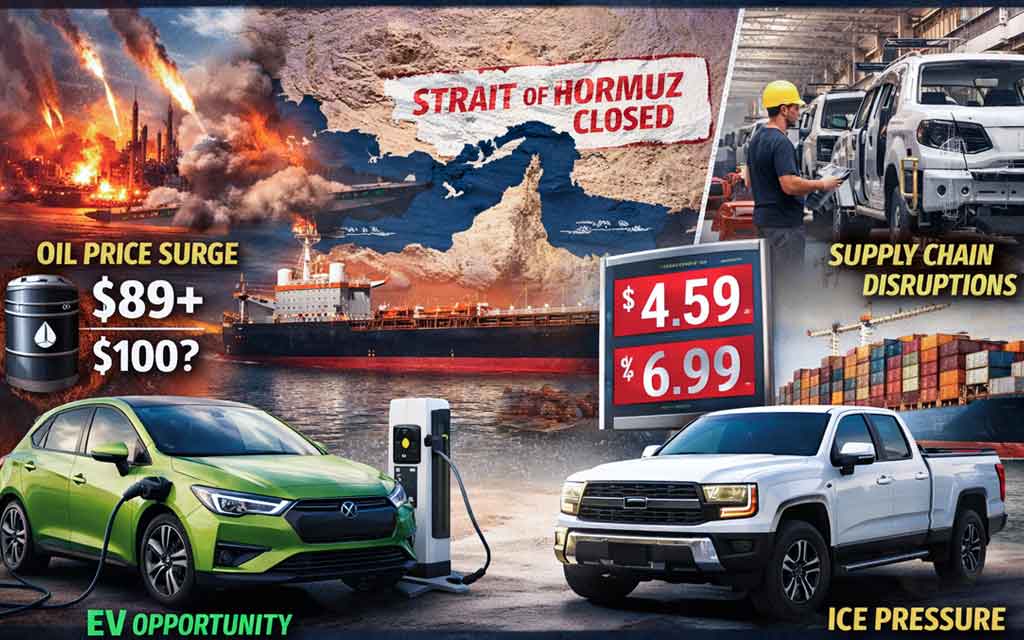
The 2026 Iran war erupted on February 28 with coordinated U.S. and Israeli strikes on Iranian targets, escalating rapidly into a broader conflict involving missile barrages, attacks on energy infrastructure, and Iran’s closure of the Strait of Hormuz. This critical chokepoint handles roughly 20% of global seaborne oil trade and significant LNG flows. Within days, tanker traffic halted, prompting immediate surges in crude prices and widespread concerns over energy security.
Brent crude, the global benchmark, jumped from pre-conflict levels around $70–$75 per barrel to the mid-to-high $80s by early March, with some sessions pushing toward $89 amid fears of prolonged disruption. Analysts warn that sustained blockades or damage to Gulf production could drive prices beyond $100 per barrel, evoking memories of past oil shocks but in a more fragile global economic environment.
The automotive industry—already navigating post-pandemic recovery, EV transition challenges, and supply chain vulnerabilities—faces compounded pressures. Higher oil directly elevates gasoline and diesel costs, impacting consumer vehicle choice, operating expenses for fleets, and manufacturing inputs like plastics and chemicals derived from petroleum. At the same time, rerouted shipping around conflict zones adds transit times and freight surcharges, straining just-in-time production models prevalent among global OEMs.
This conflict arrives at a pivotal moment for the sector. Many manufacturers had been recalibrating toward more ICE-focused lineups in key markets after slower-than-expected EV uptake, yet sustained high fuel prices could reverse that trend by making electric vehicles comparatively more attractive over time. Short-term disruptions risk parts shortages and production halts, particularly for Asian exporters reliant on efficient sea routes.
The war’s trajectory remains uncertain, with ongoing strikes, retaliatory actions, and diplomatic efforts. Early assessments suggest contained but volatile effects rather than a full global recession trigger, though prolonged instability could amplify inflationary pressures and slow consumer spending on big-ticket items like cars.
Oil Price Impacts
The most immediate and visible effect of the Iran war has been the sharp rise in global oil prices. Brent crude climbed rapidly in the first week of March 2026, reaching levels not seen since mid-2024 peaks, with daily fluctuations reflecting headline risks around the Strait of Hormuz. Market reactions included risk premiums of $10–$15 per barrel to account for potential supply shortfalls, even as OPEC+ spare capacity offers some buffer.
For gasoline and diesel vehicles, the impact is straightforward and painful. U.S. pump prices have already risen significantly, with national averages jumping in line with crude gains and regional variations exacerbated by logistics costs. Higher fuel erodes the total cost of ownership advantage for ICE vehicles, especially in markets where consumers are sensitive to operating expenses. Fleet operators, delivery services, and ride-hailing companies face immediate margin compression, potentially accelerating scrutiny of electrification options.
Paradoxically, this oil shock could provide a tailwind for EV adoption. Higher gasoline prices make the economics of electric driving more compelling, particularly for high-mileage users. Industry observers note that past fuel spikes—such as those in 2022—correlated with temporary upticks in EV interest and inquiries. In the current environment, where many buyers hesitate over upfront EV costs or charging infrastructure, sustained $4+ gasoline (or equivalent in other regions) could tip more consumers toward plug-in options.
However, the boost is not guaranteed to be structural. Short-term economic uncertainty from inflation and potential recession fears could deter big purchases altogether, hitting both ICE and EV segments. Petrochemical derivatives—plastics, rubbers, adhesives, and tires—also rise in cost with crude, adding 15–25% to certain input prices in a prolonged scenario. This squeezes manufacturer margins and could lead to higher vehicle MSRPs across powertrains.
Longer-term, persistent high oil reinforces policy pushes toward energy independence and diversification. Governments may double down on EV incentives or infrastructure spending to reduce reliance on imported fuels, indirectly supporting the shift away from oil-dependent transport.
Supply Chain Disruptions
The Strait of Hormuz closure forces rerouting around the Cape of Good Hope for vessels avoiding the region, adding 10–14 days to transit times and thousands in extra costs per container. Major carriers have imposed emergency surcharges, war-risk premiums, and bunker adjustments, inflating freight rates globally.
Automotive supply chains, heavily reliant on Asian components (semiconductors from Taiwan/South Korea, batteries and electronics from China, steel and parts from multiple origins), face compounded delays. Just-in-time manufacturing leaves little buffer; even modest disruptions can idle assembly lines. Asian OEMs exporting to Europe and North America are particularly exposed, as longer sea routes disrupt component flows for models built in multiple regions.
Petrochemical and raw material shortages loom if Gulf production or refining sustains damage. Plastics and synthetic rubbers, critical for interiors, bumpers, and wiring, derive from oil and could see shortages or price volatility. Shipping disruptions also affect container availability, echoing 2021 bottlenecks but triggered by geopolitics rather than pandemic factors.
European and U.S. manufacturers with diversified sourcing may fare better initially, but cascading effects—such as delayed chips or specialty chemicals—could still propagate. The industry has built some resilience post-COVID through nearshoring and inventory buffers, yet a multi-month conflict tests those limits.
Insurance costs for vessels and cargo have risen sharply, further elevating landed costs. This contributes to broader inflationary pressure, potentially forcing production cuts or price hikes that dampen demand.
Detroit vs. Global Makers
Detroit’s Big Three (GM, Ford, Stellantis) face a mixed outlook. Heavily invested in North American production, they are less directly exposed to Strait rerouting than import-reliant competitors. However, higher U.S. gasoline prices threaten sales of profitable full-size trucks and SUVs, core to their profitability. Recent pivots back toward ICE models could backfire if fuel costs remain elevated long-term, pressuring resale values and fleet transitions.
Global makers like Toyota, Hyundai/Kia, and Volkswagen, with strong Asian manufacturing bases, encounter greater logistics headaches. Longer shipping lanes and surcharges hit export-heavy strategies, potentially delaying launches or forcing allocation shifts. Japanese and Korean brands, already navigating tariff and incentive landscapes, may see margin erosion from freight and material costs.
Opportunities emerge for those with flexible supply footprints. Toyota’s hybrid emphasis could gain traction as a “bridge” technology amid high fuel prices without full EV infrastructure reliance. Hyundai/Kia, aggressive in EVs, might capitalize if consumers accelerate shifts to lower-operating-cost options.
Vulnerabilities differ: Detroit’s domestic focus shields from some shipping woes but exposes to U.S. consumer sentiment swings. Global players face broader disruption but benefit from diversified markets and powertrain portfolios.
Long-Term Shifts
Beyond immediate shocks, the conflict could catalyze lasting changes. Sustained high energy costs accelerate inflation, tightening monetary policy and raising borrowing costs for vehicle financing. This dampens overall demand but disproportionately affects discretionary ICE purchases.
EV adoption may accelerate as a hedge against oil volatility. Behavioral shifts—where consumers prioritize lower running costs—could outpace policy drivers alone. Charging infrastructure investments gain urgency for energy security reasons.
The industry may further de-risk supply chains through regionalization, increased inventories, or alternative sourcing. Petrochemical alternatives or recycling could see renewed interest.
Broader economic slowdown risks loom if energy prices stay elevated, potentially delaying EV investments or forcing OEMs to prioritize cash-flow-positive ICE lines short-term.
Conclusion
The 2026 Iran war delivers a severe test to an already challenged auto sector. Oil price surges and supply disruptions create headwinds for sales, costs, and production, yet offer potential catalysts for faster electrification.
Resilience strategies include diversifying sourcing, building buffers, hedging commodities, and flexible powertrain planning. Buyers should weigh total ownership costs amid volatility, while monitoring conflict developments for market signals.
Automakers adapting quickly—balancing short-term survival with long-term sustainability—will emerge stronger.
About the Author Ethan Brooks is a seasoned automotive technology journalist with over 10 years of experience, including contributions to The vfuturemedia and vsolutionsinc and analysis of geopolitical risks affecting mobility. He draws on primary sources like Autovista24, industry reports, and expert insights for trustworthy coverage of global conflicts and their industry ripple effects.
Comment your thoughts on the war’s impact on EV adoption below.



Leave a Comment