
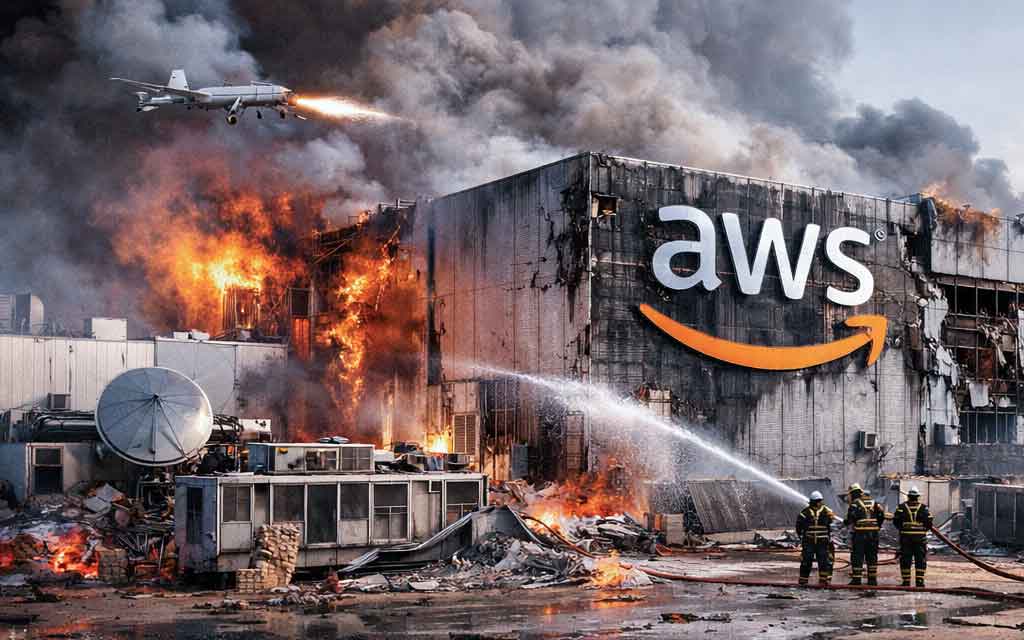
The 2026 Iran war, ignited by U.S. and Israeli strikes on Iranian targets starting February 28, has rapidly escalated into a multi-front conflict involving missile barrages, drone attacks, and infrastructure targeting. In retaliation, Iranian forces launched drone strikes that directly impacted critical cloud computing facilities, marking a historic first: the physical military attack on a major U.S. hyperscaler’s data centers.
Amazon Web Services (AWS), the leading cloud provider, confirmed that Iranian drones struck two facilities in the United Arab Emirates (UAE) and caused damage to one in Bahrain through a nearby strike. These incidents, occurring primarily on March 1–3, 2026, triggered fires, power outages, structural damage, and activation of fire suppression systems leading to water-related issues. AWS’s Middle East regions (including ME-CENTRAL-1 in UAE) experienced widespread disruptions, with dozens of services degraded or offline, affecting connectivity, APIs, and instances across availability zones.
This marks the first documented case of a U.S. hyperscaler’s infrastructure being hit by state-directed military action, highlighting how the rapid expansion of cloud facilities in geopolitically volatile regions has introduced new physical risks. The Gulf’s push to become an AI and data hub—driven by investments from AWS, Microsoft, Google, and local operators—has placed billions in digital assets near conflict zones, including choke points like the Strait of Hormuz and Red Sea shipping lanes now disrupted.
Outages cascaded to dependent services: regional banks, payment platforms like Alaan, ride-hailing apps such as Careem, and other consumer/financial tools faced interruptions. AWS advised customers to migrate workloads out of the Middle East, noting the “unpredictable” operating environment.
Broader implications extend beyond AWS. The conflict has exposed vulnerabilities in global cloud architecture, where redundancy across availability zones assumes isolated failures—not simultaneous kinetic attacks. Analysts warn this precedent could reshape site selection, security protocols, and investment strategies for hyperscalers.
Key Risks to Cloud Datacenters
The Iran war has illuminated several acute vulnerabilities for cloud infrastructure in conflict zones:
- Physical Kinetic Threats — Drones and missiles can cause direct structural damage, power loss, fires, and secondary water damage from suppression systems. In the AWS case, strikes hit multiple facilities across zones, straining failover capacity.
- Geopolitical Targeting — Iranian state media claimed strikes were deliberate to disrupt U.S. military/intelligence dependencies, framing data centers as strategic assets.
- Cascading Service Disruptions — Even with multi-zone redundancy, simultaneous hits reduce available capacity, leading to latencies, errors, and outages for global users reliant on regional low-latency access.
- Connectivity Choke Points — Closed sea routes (Strait of Hormuz, Red Sea) threaten undersea cables, isolating Gulf data traffic and amplifying outage impacts.
- Cyber Spillover — Heightened state-sponsored and hacktivist activity risks DDoS, intrusions, or destructive attacks on cloud endpoints, compounding physical damage.
These risks challenge the assumption that cloud infrastructure is inherently resilient due to geographic distribution—when distribution clusters in high-risk areas, it becomes a liability.
Regional Impacts Table
The table below summarizes reported impacts across key Gulf locations based on recent developments:
United Arab Emirates (UAE) – AWS
- Facilities Impacted: Two facilities (ME-CENTRAL-1 zones)
- Damage: Direct drone strikes caused fires, power cuts, and structural/water damage
- Service Disruptions: Major outages affecting APIs, cloud instances, and connectivity; several regional services went offline
Bahrain – AWS
- Facilities Impacted: One facility
- Damage: Nearby drone strike damaged surrounding infrastructure
- Service Disruptions: Power instability and network disruptions caused degraded services
Broader Gulf Region – Various Providers (including local operators)
- Facilities Impacted: Multiple potential facilities
- Damage: Risk from proximity to conflict zones and possible submarine cable route disruptions
- Service Disruptions: Increased latency, migration pressure on other regions, and service slowdowns
Iran (Tehran) – Local / Affiliated Providers
- Facilities Impacted: At least two data centers (including one IRGC-linked facility)
- Damage: U.S. and Israeli strikes damaged digital infrastructure
- Service Disruptions: Nationwide digital blackout and shutdown of several online services.
This concentration in UAE and Bahrain reflects AWS’s Middle East footprint, with regions in Bahrain, UAE, and Israel—now all near active conflict.
Solutions and Mitigation Strategies
To build resilience amid rising geopolitical risks:
- Multi-Region Redundancy — Distribute workloads across distant geographic regions (e.g., Europe, North America, Asia-Pacific) to isolate conflict impacts. AWS urged immediate migrations post-strikes.
- Enhanced Physical Security — Invest in hardened facilities (bunkers, anti-drone systems, perimeter defenses) or site selection away from flashpoints. Experts suggest treating data centers more like critical military infrastructure.
- Diversification Beyond Hyperscalers — Use multi-cloud or hybrid approaches to avoid single-provider dependency in volatile areas.
- Cyber-Physical Defense Integration — Combine kinetic defenses with advanced cybersecurity monitoring for hybrid threats. IDC forecasts accelerated investments in resilient architectures despite higher costs.
- Policy and Insurance Adjustments — Governments and insurers may require war-risk clauses or incentives for diversified infrastructure.
Long-term, the war accelerates rethinking of Gulf AI ambitions, potentially slowing megaprojects while boosting demand for secure, distributed cloud models.
Conclusion
The 2026 Iran war has transformed cloud datacenters from presumed safe commercial assets into frontline targets, with Iranian drone strikes on AWS facilities in UAE and Bahrain serving as a stark wake-up call. Physical damage, service outages, and cascading effects underscore the intersection of geopolitics and digital infrastructure. As Big Tech’s Gulf investments face scrutiny, the industry must prioritize true geographic diversification, hardened defenses, and multi-layered resilience to safeguard the cloud era.
Proactive migration, redundancy planning, and security upgrades are now essential—not optional.
About the Author Ethan Brooks is a cloud technology authority with deep expertise in infrastructure resilience and geopolitical risk analysis.
Contact us for a custom cloud security consultation to assess and strengthen your infrastructure against emerging threats.




Leave a Comment