
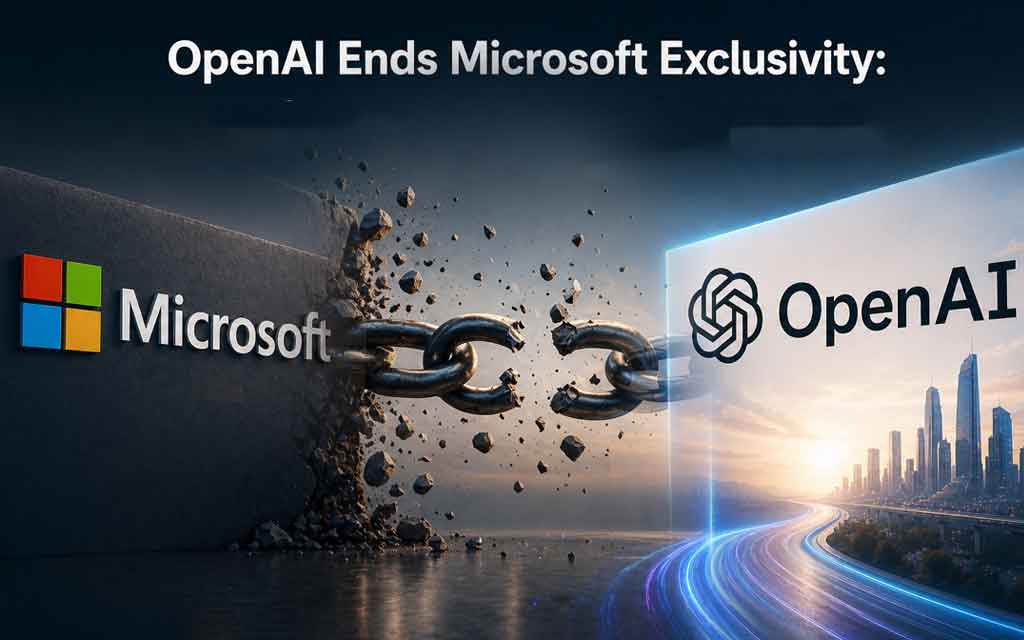
By Ethan Brooks San Francisco, California – April 24, 2026 — In a significant shift in one of tech’s most powerful alliances, OpenAI is loosening some of Microsoft’s long-held exclusive rights to its AI models and infrastructure, allowing the company to expand partnerships with other cloud providers and distribute its technology more broadly.
While the core partnership remains intact through at least 2032, recent moves mark the end of full exclusivity in several areas, reflecting OpenAI’s push for independence and Microsoft’s parallel efforts to build its own AI capabilities.
What’s Changing in the OpenAI-Microsoft Relationship
- Cloud Compute Exclusivity Ends: Microsoft Azure is no longer the sole cloud provider for OpenAI’s workloads. OpenAI has struck major deals with Amazon Web Services, Google Cloud, Oracle, and others, enabling multi-cloud deployment for greater scale and resilience.
- Broader Model Access: OpenAI is expanding direct access to its models (including the newly launched GPT-5.5) beyond Microsoft’s platforms. Enterprises and developers can now engage with OpenAI more directly or through alternative providers.
- Microsoft Retains Strong IP Rights: Despite these changes, Microsoft maintains exclusive licensing to OpenAI’s intellectual property for its products until 2032 (or AGI verification). Azure remains the exclusive host for stateless OpenAI APIs sold through Microsoft channels.
The evolution stems from a major restructuring agreement signed in October 2025. That deal reduced Microsoft’s equity stake in OpenAI, extended certain IP rights, and freed both companies to pursue independent strategies while keeping their collaboration alive.
Why OpenAI Is Making This Move
OpenAI needs enormous computing power to train and run frontier models like GPT-5.5. Diversifying beyond Microsoft helps the company secure the massive GPU capacity required for rapid iteration and global scale. It also gives OpenAI more negotiating power and flexibility as it grows into a multi-hundred-billion-dollar business.
Microsoft, meanwhile, has responded by accelerating its own in-house AI development (including recent MAI models for speech, voice, and image generation) to reduce long-term dependence on OpenAI.
Impact on Users, Developers, and Enterprises
- More Choices: Businesses can now access OpenAI models through multiple cloud platforms, potentially lowering costs and improving performance based on regional needs.
- Continued Deep Integration: Microsoft’s Copilot products will keep strong access to OpenAI’s latest technology, maintaining a competitive edge in enterprise AI.
- Increased Competition: The shift intensifies the AI arms race, benefiting consumers through faster innovation and more options.
The Future of the OpenAI-Microsoft Partnership
Both companies continue to describe their relationship as “strong and central.” Microsoft remains OpenAI’s largest investor and a key strategic partner, while OpenAI benefits from Microsoft’s enterprise reach and distribution muscle.
Analysts see this as a healthy maturation rather than a breakup. The two firms are moving from a highly exclusive dependency to a more balanced, multi-faceted alliance — common in the fast-evolving AI industry.
As OpenAI CEO Sam Altman and Microsoft leaders have emphasized in joint statements, the collaboration will persist even as both pursue ambitious independent goals.
For the latest on OpenAI Microsoft partnership updates, GPT-5.5 developments, AI industry shifts, and cloud AI strategies, stay tuned to vfuturemedia — your source for tomorrow’s technology today.
This article was written by Ethan Brooks for vfuturemedia on April 24, 2026. Details based on official partnership announcements and recent developments.



Leave a Comment