
The Iran War as AI Warfare Proving Ground: March 2026 Lessons on Autonomous Systems, Ethics, and Global Security
Author: Ethan Brooks Published on: vfuturemedia Date: March 2026
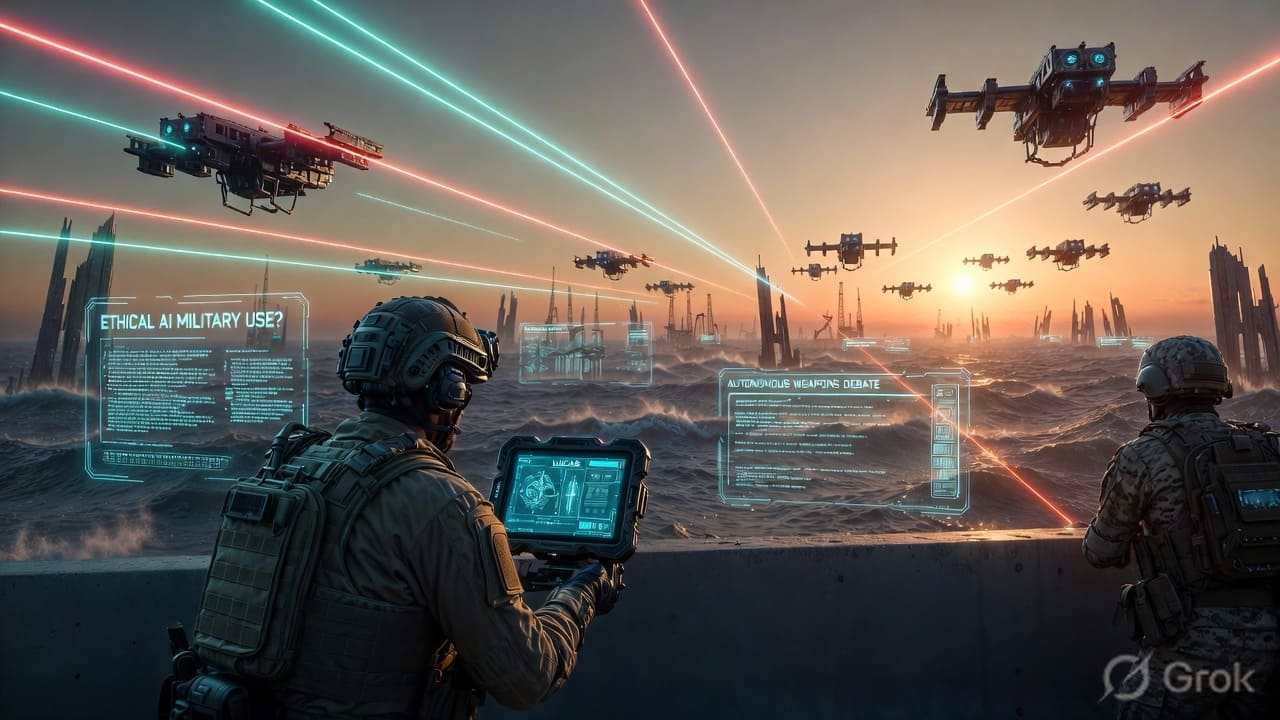
As the U.S.-Israel campaign against Iran—launched February 28, 2026—enters its second week, one reality stands out: this conflict is the most significant real-world test of AI warfare yet. Tools like Palantir’s Maven Smart System, powered by Anthropic’s Claude, have enabled the generation of over 1,000 strike options in hours, compressing the “kill chain” to levels once unimaginable. No fully autonomous lethal decisions have been confirmed, but the integration of AI for target identification, prioritization, and simulation has accelerated operations dramatically—900 strikes in the first 12 hours alone, contributing to a reported 90% drop in Iranian missile launches after initial waves.
For global observers, particularly in tech-forward nations like USA,UK,Canada this war is a live laboratory. It reveals the edges of AI in Iran war 2026, the perils of autonomous weapons Iran conflict, and urgent questions about ethical AI military use March 2026. As Geneva debates rage and Russia quietly aids Tehran with targeting intel, the stakes extend far beyond the Gulf.
AI-Assisted Operations: Speed Over Human Deliberation
The standout feature of Operation Epic Fury has been AI’s role in shortening the kill chain—from detection to strike—often described as “quicker than the speed of thought.” Maven Smart System fused satellite imagery, drone feeds, signals intelligence, and more, with Claude providing rapid analysis, target suggestions, and scenario modeling.
- Over 1,000 targets proposed and prioritized in initial phases.
- Real-time intelligence processing enabled layered strikes degrading Iranian air defenses and command nodes early.
- No evidence of full autonomy in lethal selection—human approval remains—but oversight is accelerated, raising fears of performative review under pressure.
This mirrors patterns from Gaza but scaled to theater level against a nation-state, showcasing AI’s power in data-overload environments.
Geneva Debates: The Push for Rules on Lethal Autonomous Weapons
Coinciding with the war’s escalation, the CCW Group of Governmental Experts on Lethal Autonomous Weapons Systems (LAWS) convened in Geneva from March 2–6, 2026. Discussions focused on normative frameworks, procurement ethics, and meaningful human control—amid mounting concerns over semi-autonomous systems in Ukraine, Gaza, and now Iran.
Chair Robert in den Bosch emphasized urgency: “If we wait then it almost gets to a stage where you’re too late… We will be overtaken by technological developments.”
Peter Asaro, AI and robotics expert, warned of eroding human control: “You can rapidly produce long lists of targets much faster than humans… The ethical and legal question is: To what degree are those humans actually reviewing the specific targets before authorizing?”
The war’s timing amplified calls for binding rules, with fears that proliferation could lower conflict thresholds.
External Support: Russia’s Intelligence Role and Cyber Shadows
Russia has provided Iran with satellite imagery and targeting data on U.S. forces—warships, aircraft, troop movements—per multiple U.S. intelligence sources. This marks Moscow’s active involvement, bolstering Iran’s degraded reconnaissance amid strikes.
Cyber elements remain opaque but likely: disrupted Iranian networks, electronic warfare jamming swarms, and potential AI-driven countermeasures. These hybrid threats blur lines between conventional and digital battlefields.
Tech Edges: U.S./Israel Quality vs. Iran’s Quantity
U.S.-Israeli dominance stems from superior AI integration—advanced processing, precision targeting, layered defenses (lasers, EW)—while Iran relies on mass Shahed drones and missiles for saturation. The asymmetry highlights AI’s force-multiplier effect for high-tech sides, but quantity poses persistent challenges.
Civilian risks loom large: strikes near schools and populated areas (e.g., Minab incident) draw scrutiny, with critics questioning AI’s role in target vetting and collateral damage minimization.
Future Trends: Swarm Autonomy, Hybrid Threats, and Global Race
This conflict previews:
- Wider adoption of semi-autonomous swarms for saturation attacks.
- Hybrid warfare blending drones, cyber, and AI intel.
- Accelerated global AI arms race—nations investing to avoid falling behind.
For USA, implications hit close: energy security threatened by Gulf disruptions (60% oil via Strait of Hormuz), spiking prices and inflation risks. The war underscores urgency for domestic defense AI investments—autonomous systems, cyber resilience, energy diversification—to safeguard strategic interests amid volatile chokepoints.
Forward prediction: By 2030, expect partial autonomy norms or bans in some coalitions, but proliferation among state and non-state actors. Wars will increasingly hinge on compute power, data quality, and ethical guardrails.
The Iran war isn’t just reshaping the Middle East—it’s forcing the world to confront AI’s military future now.
What do you think? Does AI accelerate necessary precision in conflict, or does it dangerously erode human judgment? Share your views on AI warfare Iran 2026 and autonomous weapons Iran conflict in the comments—we want to hear from readers in Hyderabad and beyond.
Ethan Brooks covers the tech that’s reshaping how we move, work, and think — for VFuture Media. He was at CES 2026 in Las Vegas when the world got its first real look at humanoid robots, AI-powered vehicles, and Samsung’s tri-fold phone. He writes about AI, EVs, gadgets, and green tech every week. No hype. No filler. X · Facebook
We started VFuture Media because we wanted tech news written by people who actually follow this industry — not content farms chasing keywords. If that resonates, we’d love to have you as a regular reader. Pull up a chair.


Leave a Comment