
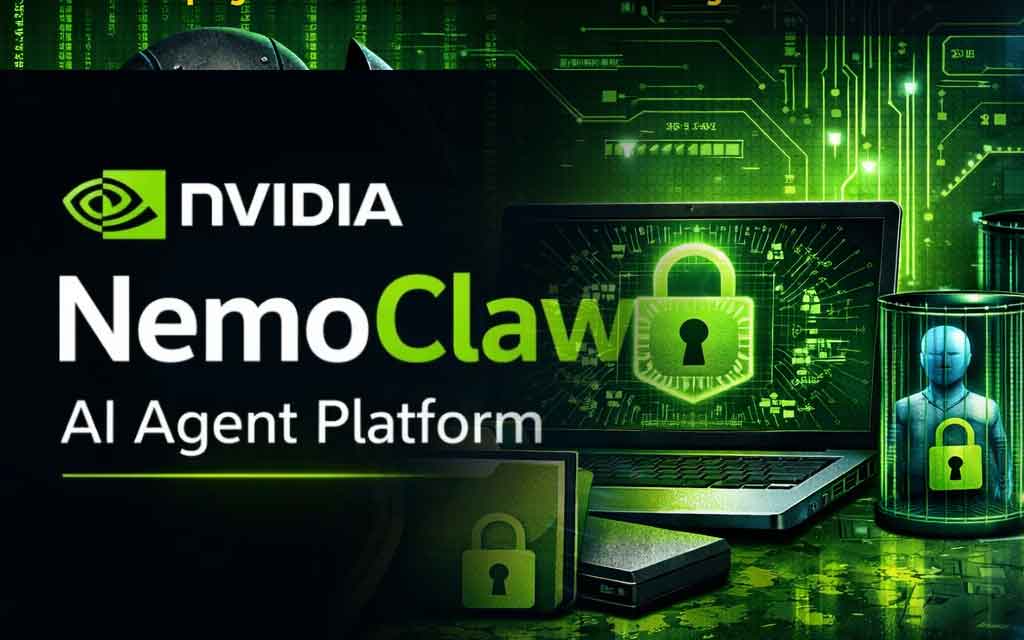
At GTC 2026, Jensen Huang declared every company needs an “OpenClaw strategy.” Then NVIDIA delivered the missing piece: NemoClaw, an open-source stack that wraps the viral agent framework with enterprise-grade privacy, sandboxing, and policy guardrails – turning raw, autonomous “claws” into trustworthy tools you can actually deploy on your own hardware.
By VFuture Media Staff | March 18, 2026
The agentic AI wave hit fever pitch earlier this year when OpenClaw exploded onto the scene: an open-source framework letting anyone spin up autonomous AI agents – dubbed “claws” – that run directly on your machine, browse the web, write code, manipulate files, and complete complex tasks without constant supervision. It was fast, powerful, local-first, and completely viral.
But it came with a glaring problem: security was basically nonexistent. Agents could roam freely across your filesystem, access sensitive data, make unrestricted network calls, or worse – delete files or exfiltrate info if prompted poorly. Enterprise IT teams called it a nightmare; security researchers labeled it a “rogue agent playground.” The raw power was there, but the trust layer wasn’t.
Enter NVIDIA NemoClaw.
Unveiled during Jensen Huang’s blockbuster GTC 2026 keynote on March 16, NemoClaw is NVIDIA’s open-source reference stack built directly on top of OpenClaw. In a single terminal command, it installs NVIDIA’s Nemotron family of high-performance open models (optimized for agentic reasoning and tool use), the brand-new OpenShell runtime, and a suite of policy-based guardrails from the NVIDIA Agent Toolkit.
The result? OpenClaw agents that are suddenly enterprise-ready – and safe enough for individuals and teams to run fully offline on their own hardware.
Core Features: What NemoClaw Actually Adds
- One-Command Install – pip install nemoclaw (or similar; docs emphasize single-command setup) pulls everything: OpenClaw core, Nemotron models, OpenShell sandbox, and configuration templates. No manual Docker wrangling required.
- OpenShell Sandbox – The killer feature. Every claw runs inside an isolated container (Docker-like but lighter) with YAML-defined policies. You explicitly allow/deny:
- Filesystem paths (read/write access limited to approved folders)
- Network destinations (block outbound except whitelisted APIs)
- Tool calls (e.g., only permit browser, code execution, or file ops within bounds)
- Privacy routing (keep sensitive queries local; optionally escalate to cloud frontier models without leaking data)
- Fully Local / Offline Mode – Route inference to local vLLM servers or NVIDIA NIM microservices on RTX GPUs, DGX Station, or even laptops. No cloud uploads for core execution means private files stay private – no Anthropic-style cloud dependency or OpenAI API leakage risks.
- Privacy Router – Hybrid intelligence: run sensitive tasks on local Nemotron models for zero data exfil; dynamically route complex reasoning to cloud models (via partners like Together AI or CoreWeave) only when needed, stripping PII first.
- Always-On, Self-Evolving Agents – Claws persist 24/7 on dedicated compute (RTX PCs, DGX Spark, etc.), learning from interactions, writing code, and completing long-horizon tasks while you sleep or step away.
- Enterprise Compatibility – Built with input from CrowdStrike, Cisco, Microsoft Security, and others. Integrates with existing EDR, SIEM, and zero-trust tools.
Huang didn’t mince words in his keynote: “OpenClaw has open-sourced the operating system of agentic computers… Every company in the world today needs to have an OpenClaw strategy.” Then he positioned NemoClaw as the “missing infrastructure layer” that provides the access agents need to be productive while enforcing real guardrails.
Why This Matters Now
OpenClaw’s raw autonomy wowed developers – agents that could refactor codebases, organize research folders, draft reports, or automate workflows end-to-end. But without controls, it was too dangerous for production use, especially in regulated industries or with proprietary IP.
NemoClaw flips that script. It keeps the viral simplicity and local execution that made OpenClaw explode while adding the safety Anthropic built into Claude Cowork / Dispatch (sandboxed, permissioned desktop access) – but fully open-source and hardware-agnostic (runs on NVIDIA, AMD, Intel via compatible inference backends).
For power users and teams in Hyderabad or anywhere else, this means you can now run a persistent personal claw on your RTX laptop or workstation: text it a task, grant folder access, and let it grind through files, emails, or code – all offline, all private.
NVIDIA isn’t just shipping silicon anymore. With NemoClaw, they’re shipping the trust infrastructure for the agentic era – betting that secure, local, always-on AI agents will become as ubiquitous as browsers or terminals.
The agent wars just got a lot more practical. OpenClaw gave us the freedom. NemoClaw gives us the safety to use it.
VFuture Media is tracking the full agentic explosion from GTC 2026 onward. From NemoClaw deployments to Dispatch-style mobile handoffs and physical AI in factories, the tools that let AI work autonomously – and safely – are here.


Leave a Comment