
Published: March 29, 2026 | By VFuture Media Team | Category: EV Market Analysis & Automotive
Introduction: The Shifting EV Power Balance in 2026
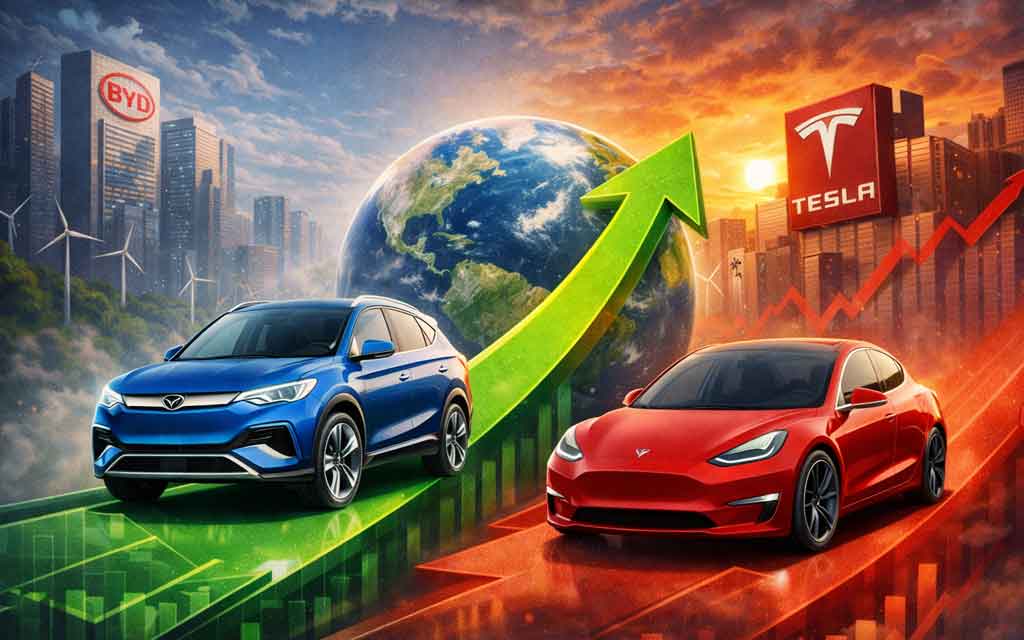
The global electric vehicle (EV) market continues its rapid expansion in 2026, but the competitive landscape has dramatically shifted. BYD has firmly overtaken Tesla as the world’s largest EV seller, while legacy automakers are accelerating their electrification efforts amid policy changes, price wars, and technological advancements.
In 2025, global plug-in EV sales (BEVs + PHEVs) reached approximately 20.7 million units, up about 20% from 2024, representing roughly 23–25% of total new car sales. China dominated with over 12.9 million units, while growth continued in Europe and the Rest of the World despite headwinds in the US following the elimination of federal EV tax credits.
As we move through Q1 2026, BYD leads in volume thanks to its broad lineup of affordable BEVs and PHEVs (NEVs), Tesla focuses on premium BEVs with strong software differentiation, and legacy brands leverage hybrids and new EV platforms to defend market share.
Here’s the complete story on EV market share 2026: Tesla vs. BYD vs. legacy brands.
2025 Full-Year Recap: BYD Dethrones Tesla
- BYD: Sold ~4.6 million NEVs (New Energy Vehicles, including BEVs and PHEVs), with 2.26 million pure BEVs — up nearly 28% YoY. This marked the first time BYD surpassed Tesla in annual EV sales. BYD captured roughly 18–19% of the global EV/NEV market.
- Tesla: Delivered ~1.64 million vehicles (almost entirely BEVs), down 9% from 2024. Tesla’s global BEV market share slipped to around 7.8–8%.
- Legacy Automakers:
- Volkswagen Group: Strong growth in EVs, with ~568,000 units (~2.7% share).
- BMW: ~536,000 units (~2.6% share).
- Other notables: Geely, SAIC, and other Chinese groups gained ground, while Toyota, GM, and Ford relied more on hybrids.
BYD’s strength came from its vertical integration (batteries, semiconductors), aggressive pricing, and massive scale in China, plus expanding exports (over 1 million units in 2025).
Tesla faced challenges from policy shifts in the US, increased competition, and a broader slowdown in premium EV demand.
Early 2026 Trends: Mixed Signals and Regional Dynamics
As of March 2026:
- Global EV Sales Outlook: Analysts project 21–24+ million plug-in EVs in 2026, potentially reaching 25–27% market share of new vehicle sales. Growth is driven by China and emerging markets, with slower progress in North America.
- Tesla Q1 2026 Expectations: Wall Street consensus points to ~365,645 deliveries (up ~8% YoY from Q1 2025), with Model 3/Y accounting for the bulk (~351,000). Full-year 2026 projections hover around 1.69–1.88 million units, signaling modest recovery but continued pressure.
- BYD Performance: Early 2026 sales showed softness in China (down significantly in Jan-Feb due to intense domestic competition and holiday effects), but exports surged (exports exceeded domestic sales in February for the first time). BYD targets 1.3 million overseas sales in 2026. It maintains leadership with ~15–17% global share in recent monthly data.
- Legacy Brands:
- Volkswagen is rolling out new affordable EVs (ID.Polo, ID.Cross, etc.) and aims to challenge for higher rankings.
- GM and Ford have scaled back some pure EV plans in favor of hybrids amid US policy changes.
- Toyota continues strong hybrid sales while gradually expanding BEVs.
- Chinese challengers like Geely and SAIC are pushing hard, with potential for a Chinese-dominated top tier.
In the US, Tesla still holds a dominant ~45–59% of the EV market (depending on the quarter), but overall US EV adoption has slowed post-incentive removal.
Head-to-Head Comparison: Key Metrics in 2026
| Manufacturer | 2025 Sales (approx.) | Est. 2026 Outlook | Strengths | Weaknesses | Global Share (2025/early 2026) |
|---|---|---|---|---|---|
| BYD | 4.6M NEVs (2.26M BEVs) | Strong volume growth, 1.3M exports | Affordable lineup, vertical integration, China dominance + exports | Intense Chinese competition, early 2026 softness | ~18–19% (leader) |
| Tesla | 1.64M (mostly BEVs) | ~1.69M+ (modest growth) | Brand, FSD tech, energy business, premium appeal | Sales declines in 2024–2025, US policy impact | ~7.8–11.8% |
| Volkswagen Group | ~568K EVs | New models to boost share | Scale, European presence, new affordable EVs | Slower past transition | ~2.7% |
| BMW | ~536K EVs | Steady premium focus | Luxury EV lineup | Higher pricing | ~2.6% |
| Toyota | Strong hybrids + growing BEVs | Hybrid leadership + EV ramp | Reliability, hybrid tech | Slower pure EV push | Lower in pure BEVs |
| GM / Ford | Lower pure EV volumes | Hybrid focus in US | US truck/SUV expertise | Reduced EV investment | Declining in some segments |
Note: Shares vary by definition (pure BEV vs. plug-in NEV). Chinese brands (BYD, Geely, SAIC) collectively dominate volume, while Tesla leads in many Western markets for pure BEVs.
Key Drivers Shaping the 2026 EV Market Share Battle
- China’s Dominance: Accounts for ~60–65% of global EV sales. Intense price competition benefits consumers but squeezes margins.
- Policy Shifts: US tax credit removal hurt Tesla and slowed adoption. Europe maintains incentives but faces economic pressures. Emerging markets (Brazil, Southeast Asia, Middle East) offer growth for exporters like BYD.
- Technology & Differentiation:
- Tesla: Leads in software (FSD), over-the-air updates, and ecosystem (energy storage).
- BYD: Excels in battery tech (Blade Battery) and cost efficiency.
- Legacy: Catching up with better software and platforms but often lag in pure EV scale.
- Affordability & Lineup: BYD wins on volume with entry-level models. Tesla’s refreshed Model Y (Juniper) and future models aim to regain momentum. Legacy brands push hybrids as a bridge.
- Exports & Globalization: BYD’s aggressive international push contrasts with Tesla’s factory-focused approach (Fremont, Shanghai, Berlin, upcoming Mexico/Texas).
Challenges and Opportunities Ahead
- For Tesla: Recovering growth through new models, robotaxi progress, and energy storage (a bright spot). FSD safety data and autonomy ambitions could be major differentiators.
- For BYD: Sustaining leadership amid domestic rivals while scaling globally. Early 2026 sales dips highlight the need for product refreshes.
- For Legacy Brands: Many are hedging with hybrids while selectively investing in BEVs. Success depends on executing affordable EV platforms without losing profitability.
Broader headwinds include raw material costs, charging infrastructure gaps in some regions, and macroeconomic uncertainty. Tailwinds: Falling battery prices, improving range, and policy support in key markets.
Future Outlook: Toward a Multi-Polar EV Market
2026 is shaping up as a year of stabilization and selective growth rather than explosive gains for all players. BYD is expected to maintain the volume crown, Tesla to leverage technology for premium positioning and potential recovery, and legacy automakers to defend share through hybrids and targeted EVs.
By 2030, projections suggest EVs could reach 40–50% global market share, with China continuing as the epicenter. No single player is likely to dominate indefinitely — the market is becoming more fragmented and competitive.
At VFuture Media, we’ll continue tracking quarterly deliveries, policy impacts, and technological breakthroughs that will define the winners in the EV transition.
What’s your prediction for 2026 EV market share leaders? Will Tesla rebound strongly, or will BYD extend its lead? Share your thoughts in the comments.



Leave a Comment