
Published: March 29, 2026 | By VFuture Media Team
Introduction: A Game-Changing Safety Leap
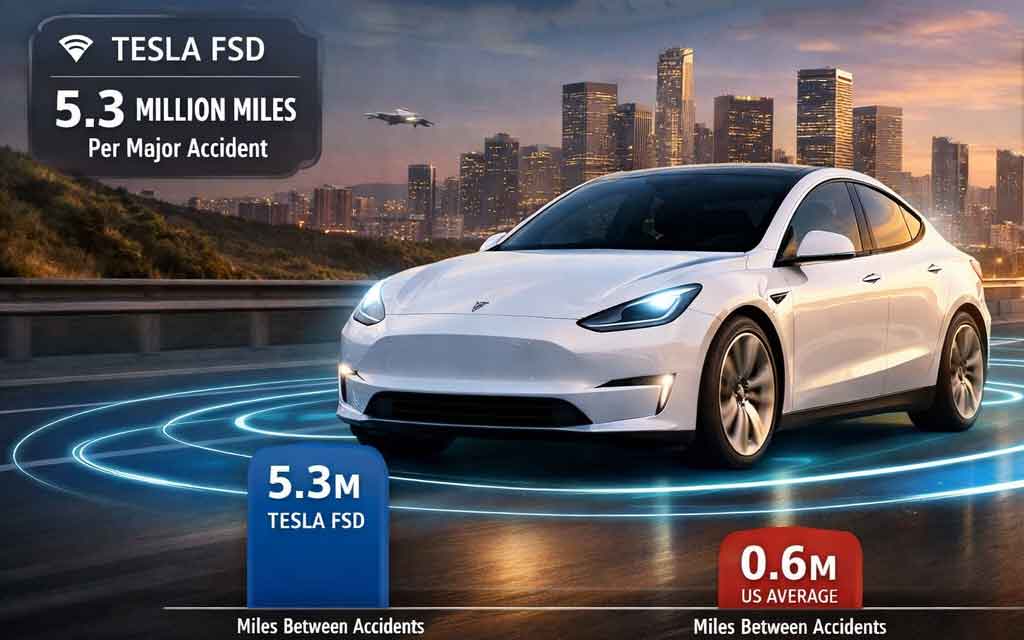
Tesla’s Full Self-Driving (FSD) Supervised system has reached a remarkable milestone: one major collision every 5.3 million miles driven in North America.
For context, the US national average stands at approximately one crash every 660,000 miles. That makes FSD roughly 9 times safer than the typical human driver on American roads today.
This isn’t just incremental progress. With over 8.2–8.9 billion cumulative miles logged on FSD (Supervised) as of early 2026, Tesla’s AI-driven system is demonstrating real-world safety advantages that continue to widen. And as Elon Musk highlighted, “It’s only getting better.”
In this complete story, we dive into the latest Tesla Vehicle Safety Report data, direct comparisons with manual driving and the US average, the technology behind the gains, ongoing challenges, and what lies ahead for unsupervised autonomy.
The Numbers Don’t Lie: Latest FSD Safety Statistics (2026 Update)
According to Tesla’s official Full Self-Driving (Supervised) Vehicle Safety Report and recent North American data:
- FSD (Supervised): 1 major collision every 5,300,676 miles
- Tesla Manual Driving (with Active Safety features): 1 major collision every 2,175,763 miles
- Tesla Manual Driving (without Active Safety): 1 major collision every 855,132 miles
- US National Average: 1 major collision every 660,164 miles
During the measured period, Tesla recorded 830 major collisions with FSD engaged across roughly 4.4 billion miles. In contrast, the broader US fleet sees far higher rates.
FSD also shows strong advantages in minor collisions and off-highway scenarios, with Tesla claiming up to 7x fewer major collisions, 7x fewer minor collisions, and 5x fewer off-highway collisions compared to baseline driving in certain analyses.
Cumulative FSD Miles: The fleet has now surpassed 8.2 billion miles (with some reports citing up to 8.9 billion), including massive growth — over 4.25 billion miles in 2025 alone and more than 1 billion miles in the first 50 days of 2026. Daily FSD usage in Q1 2026 has averaged over 20 million miles per day, up nearly 30% in recent months.
These figures focus on major collisions (those involving airbag deployment or pyrotechnic seatbelt pretensioners), providing a standardized measure of significant incidents.
Why FSD Outperforms Human Drivers
Several factors drive Tesla’s safety edge:
- End-to-End Neural Networks — FSD uses vision-based AI trained on billions of real-world miles, enabling rapid learning and generalization across diverse scenarios.
- Constant Over-the-Air (OTA) Updates — Improvements deploy fleet-wide instantly, unlike human drivers who don’t “update” their skills overnight.
- Active Safety Suite — Even without FSD, Tesla vehicles benefit from Automatic Emergency Braking, collision warning, and other features that already outperform the US average.
- Data Flywheel — Every mile driven adds to the training dataset, accelerating improvements in edge cases like complex intersections, construction zones, and poor weather.
- 24/7 Vigilance — Unlike humans, the system never gets distracted, fatigued, or impaired.
When engaged (with required active driver supervision), FSD reduces collision likelihood significantly compared to manual Tesla driving and dramatically versus the national average.
Contextualizing the US Driving Average
The US figure of ~660,000 miles between major collisions comes from NHTSA-derived statistics on police-reported crashes and broader traffic data. It reflects all drivers, all vehicle types, and includes factors like distraction, speeding, impairment, and varying road conditions.
Tesla’s data is specific to its fleet in North America and focuses on major incidents. Critics note that comparisons aren’t perfectly apples-to-apples (e.g., FSD usage patterns, urban vs. highway bias, or reporting thresholds), but the gap remains substantial even against Tesla vehicles driven manually with active safety features.
Broader 2025 NHTSA data shows overall US traffic fatalities declining (down ~6–8% in early estimates despite increased miles traveled), yet per-mile crash rates for average drivers lag far behind Tesla’s supervised autonomy results.
Rapid Improvement Trajectory: It’s Only Getting Better
Tesla’s safety metrics have trended upward over time:
- Previous reports showed FSD at ~5.1 million miles between major collisions.
- 2026 data reflects continued gains as software versions advance and more miles accumulate.
- FSD usage is surging, creating an even larger data moat for training.
With unsupervised robotaxi ambitions on the horizon, Tesla aims to push these numbers even higher by removing the human supervision variable while maintaining or exceeding current safety levels.
Challenges and Regulatory Scrutiny
Despite the impressive stats, FSD (Supervised) is not yet fully autonomous and requires attentive driver oversight. Tesla emphasizes this “supervised” nature in all communications.
In March 2026, NHTSA upgraded an investigation into approximately 3.2 million Tesla vehicles regarding FSD’s performance in low-visibility conditions (glare, dust, etc.) and driver alerts for capability degradation. The probe links several incidents, including one fatal crash, though full details remain under review.
Tesla continues to cooperate with regulators while iterating rapidly via software. Past investigations into Autopilot and FSD have led to updates that further enhanced safety.
What This Means for the Future of Driving
Tesla’s FSD safety data strengthens the case for advanced driver-assistance systems and eventual unsupervised autonomy:
- Lives Saved: Scaling current reductions could prevent millions of collisions annually if adopted widely.
- Robotaxi Potential: Safer-than-human performance is foundational for commercial autonomous ride-hailing.
- Insurance & Economics: Lower crash rates could reduce premiums and operating costs dramatically.
- Industry Shift: Legacy automakers and regulators are watching closely as vision-only, data-driven approaches challenge traditional sensor-heavy methods.
As miles accumulate and versions improve (with v12+ architectures showing notable leaps in smoothness and capability), the safety gap is expected to widen further.
Conclusion: A Safer Road Ahead with Tesla FSD
Tesla’s Full Self-Driving (Supervised) achieving 5.3 million miles between major accidents — nearly 9 times safer than the US average of 660,000 miles — marks a pivotal moment in automotive safety history. Backed by billions of real-world miles and continuous AI improvements, FSD is proving that software-defined vehicles can outperform human drivers in controlled, supervised scenarios.
While challenges and regulatory hurdles remain, the trajectory is clear: autonomous technology is getting safer, faster. And as Tesla often states, it’s only getting better.
At VFuture Media, we track the intersection of AI, EVs, and mobility. The FSD story is far from over — it’s accelerating.
What’s your experience with Tesla FSD? Do you trust the safety data, or do you have concerns? Share your thoughts in the comments below.

Leave a Comment