
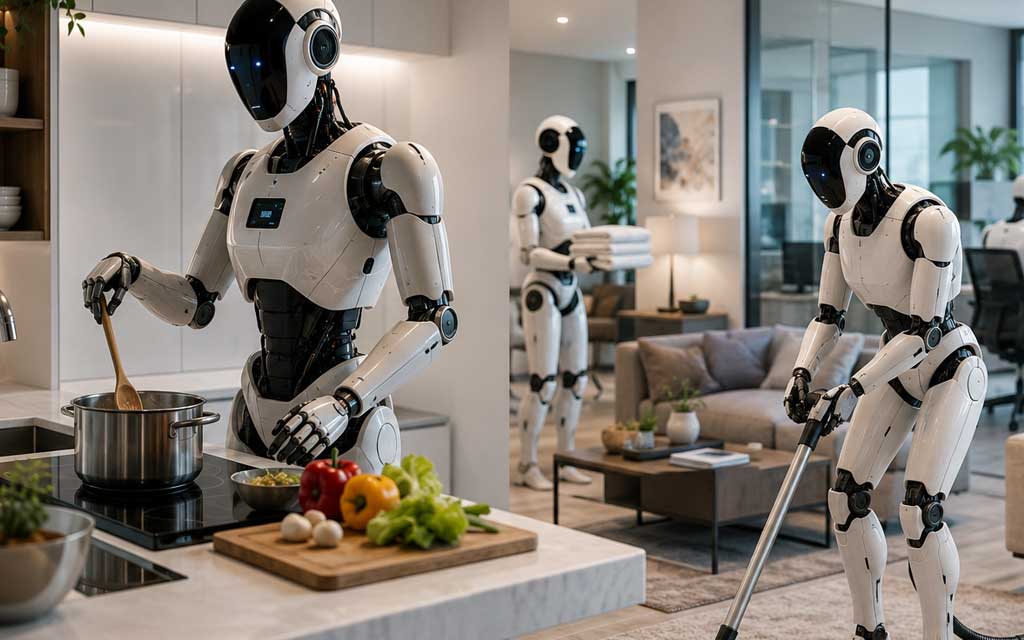
In a quiet suburban kitchen outside Austin, Texas, a slender humanoid robot named NEO carefully folds a stack of laundry while an elderly resident watches from a nearby chair. The machine moves deliberately, its soft exterior and tendon-driven joints designed to minimize risk in a human environment. A few hundred miles west, inside a California warehouse, a Figure 03 robot sorts packages for hours on end with minimal intervention, feeding a conveyor that never slows for a coffee break. At Tesla’s Fremont factory, newly converted production lines prepare for the next generation of Optimus robots, even as Model S and Model X assembly winds down.
July 2026 finds the United States at an uneasy but accelerating threshold. Consumer and light-commercial AI robots are no longer pure laboratory curiosities. They are entering pilot programs, early home deliveries, and industrial workflows. The promise is straightforward: machines that can handle repetitive physical labor, support aging populations, and free humans for higher-value work. The reality remains constrained by cost, reliability, safety standards, and profound questions about the American workforce.
The Contenders Taking Shape
Figure AI has pushed aggressively into both industrial and domestic territory. Its Figure 03, powered by the Helix AI system, has demonstrated long-horizon autonomy in structured environments—sorting packages for consecutive days in live streams and contributing to automotive production at partners such as BMW. Company updates throughout 2026 highlight full-body autonomy improvements, bedroom and living-room tidy demonstrations, and production ramping. Helix is designed to let the robot learn and adapt in less structured spaces, including homes. Figure’s vision is a general-purpose humanoid that navigates stairs, tight corners, and shifting layouts while performing laundry, cleaning, and dishwashing.
Tesla’s Optimus program continues its industrial-first trajectory. By mid-2026 the company had begun converting Fremont capacity toward Gen 3 production, with upgraded hands (higher degrees of freedom), improved locomotion, and internal factory testing. Elon Musk has repeatedly framed Optimus as potentially Tesla’s highest-value product, yet public commentary also acknowledges the difficulty of scaling dexterity, supply chains, and reliable task performance. Consumer availability remains further out; the near-term focus is factory and controlled commercial settings.
The most concrete consumer signal comes from 1X Technologies. The Norway-originated company opened a manufacturing facility in Hayward, California, with ambitions to produce thousands of NEO home robots. Pre-orders are live at roughly $20,000 for early-access ownership (with warranty and priority delivery) or $499 per month on subscription. US deliveries are scheduled to begin in 2026. NEO is marketed as a soft, safe humanoid capable of basic household chores, personalized assistance, and gradual skill improvement through AI updates. At about 5-foot-5 and 66 pounds, it is explicitly designed for home environments rather than heavy industrial work.
Practical Applications Emerging
Elderly care sits near the top of the hopeful use cases. Early pilots and marketing materials emphasize assistance with daily tasks—fetching items, simple tidying, reminders, and companionship through conversational AI—without requiring constant human presence. In states with rapidly aging populations, the potential to extend independent living is compelling. Cleaning and household maintenance form the most immediate commercial pitch: laundry folding, surface wiping, and organization in relatively controlled domestic settings.
Education applications remain more speculative but appear in pilot discussions—robots that can retrieve materials, demonstrate simple physical concepts, or provide consistent practice partners for motor skills. Small-business support is already more tangible. Light commercial robots handle package sorting, basic material movement, and repetitive logistics tasks in warehouses and retail backrooms across California and Texas pilot sites. These deployments reduce strain on human workers for the most monotonous physical work while still requiring human oversight for exceptions and complex judgment.
Safety, Standards, and the American Regulatory Landscape
Safety is the non-negotiable gate. Consumer humanoids must operate around children, pets, and older adults without causing injury. Designs such as NEO emphasize soft exteriors and force-limiting actuators. Industrial units operate behind more structured safeguards and geofencing. U.S. standards bodies and regulators are still catching up to general-purpose robots that move freely through human spaces rather than fixed industrial cells. Product liability, insurance models, and certification pathways remain evolving. Early adopters accept higher intervention rates; widespread deployment will demand far lower failure modes.
California and Texas have become natural testing grounds. California’s dense tech ecosystem, aging demographics, and progressive regulatory culture make it a hub for both development (Hayward factory, Figure activity) and cautious pilots. Texas offers logistics volume, business-friendly environments, and large commercial facilities willing to experiment with automation. These state-level experiments are generating the data that will eventually shape national norms.
Cost Versus Benefit and the Workforce Conversation
The economics are still forbidding for most households. A $20,000 robot or $500 monthly subscription competes with human labor rates in many markets and exceeds the budget of average American families. Benefits accrue most clearly where labor is expensive, scarce, or physically taxing—warehouses facing high turnover, households managing elder care, or businesses with repetitive material handling. Over multi-year horizons, proponents argue total cost of ownership can improve through continuous operation and software updates that expand capability without new hardware. Critics note that maintenance, electricity, connectivity, and inevitable software lock-in create new ongoing costs.
Job displacement discussions are unavoidable and polarized. In warehouses and light manufacturing, robots already absorb tasks that were once entry-level physical roles. Supporters frame this as augmentation: humans move into supervision, exception handling, and higher-skill maintenance. Skeptics point to historical patterns in which automation first eliminates the most accessible jobs, particularly for workers without advanced credentials. American workforce data continues to show pressure on routine manual occupations even as demand grows for robot technicians, AI trainers, and systems integrators. The net effect will depend heavily on the pace of adoption, the quality of retraining programs, and whether productivity gains translate into broadly shared prosperity or concentrated returns.
Voices from the Field
Robotics engineers working on these systems describe a measured optimism. One Figure-aligned engineer, speaking on background, noted that long autonomous runs in structured environments are no longer theoretical, but “the jump from warehouse floor to living room is still measured in reliability, not capability.” Tesla engineers emphasize the compounding value of real-world factory data for training. At 1X, public materials stress gradual capability growth: early units arrive with basic autonomy and improve through updates and, in some models, remote expert assistance.
Ethicists urge caution. The introduction of semi-autonomous agents into private homes raises questions of data privacy (cameras and microphones in living spaces), accountability when a robot causes harm, and the subtle social effects of outsourcing care and companionship. “We risk designing systems that make human presence feel optional in the very places where human presence matters most,” one academic researcher observed in recent industry panels. Users in early pilot programs report mixed but often positive experiences—relief from physical chores balanced against the need to supervise, correct, and occasionally restart the machine.
Optimistic Scenarios and Persistent Challenges
In a plausible near-future scenario, a middle-class household in 2028 owns or subscribes to a home robot that handles laundry, basic cleaning, and light assistance for an aging parent. The robot does not replace family care; it extends it. Small businesses run overnight sorting and restocking with minimal staff. Factories operate hybrid human-robot teams where machines take the most repetitive or dangerous tasks. Productivity rises. Physical strain on workers declines. New technical jobs emerge.
The challenges that stand between that picture and today’s reality are substantial. Reliability in unstructured homes remains imperfect. Costs must fall dramatically. Safety certification must mature. Public trust must be earned through transparent performance data rather than carefully edited demos. Workforce transitions require deliberate policy—training, safety nets, and incentives for human-centered applications—rather than pure market forces.
July 2026 is not the year robots became ubiquitous in American life. It is the year the first credible consumer humanoids began accepting deposits, industrial humanoids logged multi-day autonomous shifts, and major manufacturers committed factory floors to robot production. The gadgets are crossing the threshold from spectacle to tool. Whether they become trusted collaborators or expensive curiosities will depend on how thoughtfully American engineers, regulators, businesses, and families navigate the next several years of imperfect, incremental progress.
The frontier is no longer distant. It is standing in a few California factories, Texas warehouses, and early-adopter living rooms—learning, sometimes stumbling, and waiting to see whether the country is ready to live and work alongside it.



Leave a Comment