
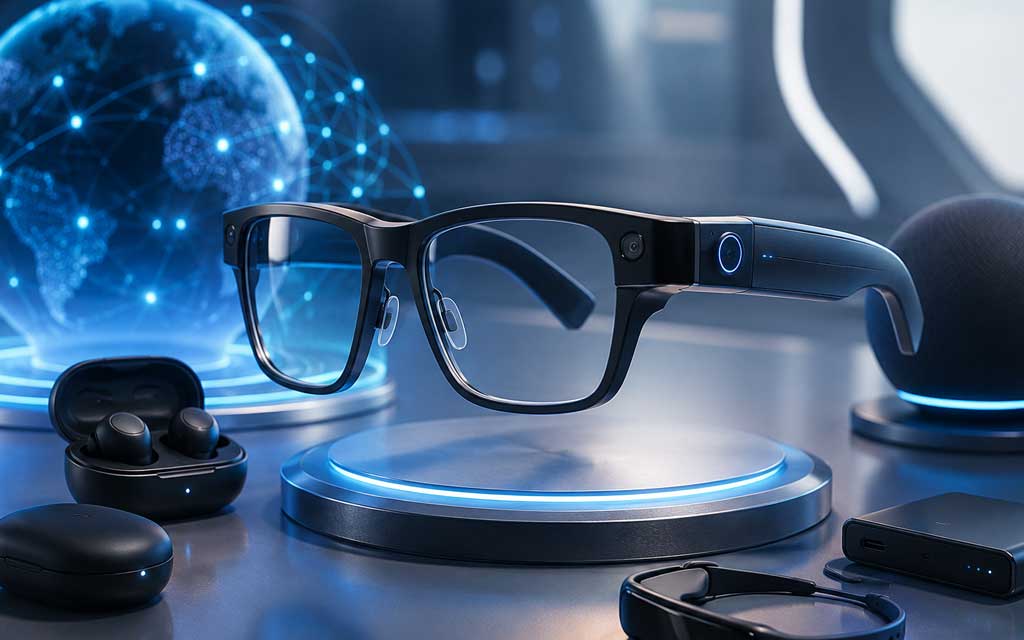
In a sunlit co-working space in San Francisco’s SoMa district, a product manager named Priya adjusts a pair of understated frames and speaks softly. “Claude, summarize the latest competitor pricing from the PDF I just glanced at and draft three talking points for the 2 p.m. call.” Within seconds a calm voice replies through the open-ear speakers. She never touches her phone. Across the country in a Brooklyn coffee shop, a freelance photographer wearing similar glasses asks Meta’s AI to identify the architectural style of a nearby building and suggest composition tips while framing a shot. The camera LED glows discreetly.
July 2026 marks a quiet but decisive inflection point for AI smart glasses in the United States. What began as awkward prototypes and luxury experiments has become everyday hardware. American companies and U.S.-marketed devices are pushing the category toward mainstream adoption through aggressive pricing, deeper AI integrations, and practical features that finally feel useful rather than novelty.
The July Wave: Lucyd Brings Claude, Meta Goes Affordable
On July 10, Miami-based Innovative Eyewear announced that every model of its Lucyd smart glasses would receive free Claude AI integration via a software update rolling out the following week. Users open the Lucyd app, select a Claude model (or switch to ChatGPT mid-conversation without losing context), and converse through the glasses’ audio interface. The system supports image and document analysis, real-time streaming responses, source citations, and an “Incognito Mode” that wipes conversations after the session. A later update expected in late Q3 2026 aims for fully hands-free use even when the phone is locked in a pocket. CEO Harrison Gross described it as making “the most flexible and powerful AI glasses on the market,” with a pending patent on multi-AI access.
Just weeks earlier, on June 23, Meta and EssilorLuxottica launched a new own-brand line simply called Meta Glasses starting at $299—significantly cheaper than previous Ray-Ban Meta models. The Adventurer and Fury styles match core hardware of higher-priced predecessors: 12-megapixel ultrawide camera, five-microphone array, open-ear speakers, and Meta AI with multimodal vision capabilities. Battery life is rated at more than eight hours of mixed use, extendable to roughly 40 hours with the charging case. A higher-profile Starfire model co-designed with Kylie Jenner starts at $399. Meta has rolled out improved conversation memory, live translation, and vision features that let the glasses describe or answer questions about what the wearer sees.
These are not isolated moves. Solos, another player active in the U.S. market, made its AirGo V2 available earlier in 2026 at a similar $299 price point with a 16-megapixel camera and multimodal AI support spanning ChatGPT, Gemini, Claude, and others, plus live translation. The competitive pressure is clear: sub-$300 pricing combined with capable AI is collapsing the barrier that kept smart glasses niche.
Real-World American Use Cases
In productivity environments, the shift is tangible. Knowledge workers in tech hubs use the glasses for continuous, low-friction assistance. Instead of switching apps or typing prompts, they dictate meeting notes, ask for real-time research summaries, or generate follow-up emails while walking between buildings. Navigation becomes conversational: “What’s the least crowded subway route to the meeting, factoring in the rain?” Health monitoring is emerging more slowly—some users pair the devices with companion apps for reminders, posture cues, or basic activity logging—but accessibility applications are already meaningful. Live translation helps non-native speakers in customer-facing roles, while visual description features assist people with low vision by narrating surroundings or reading text aloud.
Early adopters in San Francisco and New York describe a common pattern. The first week feels novelty-driven—people ask the glasses random questions just to hear the answers. By week three the device becomes infrastructure. One New York-based accessibility consultant reported using Lucyd frames daily for document scanning and verbal summaries during client visits, noting that the multi-model flexibility (Claude for careful reasoning, ChatGPT for speed) reduced cognitive load. A San Francisco engineer using Meta Glasses highlighted the value of hands-free photo capture and quick environmental queries during field work, though he still preferred a phone for complex editing.
The Practical Friction: Battery, Price, and Social Norms
Battery life remains the persistent constraint. Eight hours of mixed use is workable for a standard workday but insufficient for heavy continuous recording or always-on vision processing without the case. Users report planning around charging the way smartphone owners once planned around early battery anxiety. Pricing has improved dramatically—$299 is a mainstream consumer price—but prescription lens costs, prescription adaptation fees, and the need for multiple pairs (clear and sunglasses) still add expense.
Social interaction is the subtler challenge. Indicator LEDs signal when the camera is active, and Meta has tightened software so that tampering with the light can disable recording. Yet the mere presence of a camera on someone’s face changes dynamics in meetings, restaurants, and public spaces. Early adopters in both cities describe moments of awkwardness: colleagues asking whether they are being recorded, or strangers noticing the frames and becoming self-conscious. Some users develop etiquette—removing the glasses during sensitive conversations or announcing when the AI is active. Others simply treat the social friction as temporary growing pains of a new interface.
Privacy Under American Rules
Privacy concerns sit at the center of the American conversation. Always-available cameras and microphones raise legitimate questions about consent, data retention, and potential misuse. Meta has faced scrutiny over facial-recognition capabilities that have appeared in related software (and been walked back after civil-rights pressure). State laws on recording in public and private spaces already apply; California and New York have particularly attentive privacy frameworks. Federal AI regulation remains fragmented, but the devices are testing the boundaries of existing wiretapping, biometric, and consumer-protection statutes.
Companies respond with design choices—LED indicators, physical camera covers on some competitors, local processing where possible, and clear user controls. Lucyd’s Incognito Mode is one explicit attempt to address ephemeral use. Still, the fundamental tension remains: the value of an always-available visual AI companion depends on the glasses seeing the world, and that capability creates new vectors for data collection and potential surveillance.
Jobs, Interaction, and the Broader Ecosystem
The productivity upside is real for certain roles—field technicians, accessibility support, multilingual customer service, and knowledge work that benefits from continuous low-friction AI. The downside risk is subtler: if glasses become expected equipment, workers who prefer not to wear them or who cannot afford seamless prescription versions may face quiet disadvantage. Social interactions risk becoming more mediated; an AI that can whisper context about a person or place changes the texture of spontaneous conversation.
In the larger AR/VR landscape, these lightweight AI glasses occupy a different niche from full mixed-reality headsets. They prioritize all-day wearability and conversational AI over immersive 3D overlays. Success here could accelerate demand for higher-end display glasses later, or it could prove that most people prefer subtle, audio-first assistance over visual clutter. Meta’s volume ambitions (earlier targets pointed toward millions of units) and the multi-model approach of Lucyd and Solos suggest the category is consolidating around practical utility rather than pure spectacle.
Looking Forward: Always-On Companions and Regulatory Reality
Imagine a 2028 morning in which the glasses quietly surface calendar conflicts, translate a street sign, flag a potential health cue from gait analysis, and draft a reply to a message—all while the wearer simply moves through the day. The technology is moving in that direction. The open questions are cultural and legal. Will American regulators demand stronger consent mechanisms, on-device processing mandates, or restrictions on continuous recording? Will social norms evolve to treat AI glasses the way we now treat smartphones—ubiquitous but governed by unspoken rules—or will persistent discomfort slow adoption?
For now, the devices are shipping. Lucyd’s Claude integration is live or imminent for existing owners. Meta’s $299 frames are on shelves. Early users in America’s tech hubs are already incorporating them into daily routines, discovering both genuine leverage and new frictions. The glasses no longer feel like science fiction. They feel like the next contested interface between human attention and machine intelligence—one that sits literally in front of our eyes.
The mainstream moment has arrived. Whether it becomes a quiet productivity revolution or a new front in the privacy and social-norms wars will be decided not only in labs and boardrooms, but in the everyday choices of people who decide, each morning, whether to put the frames on.



Leave a Comment