
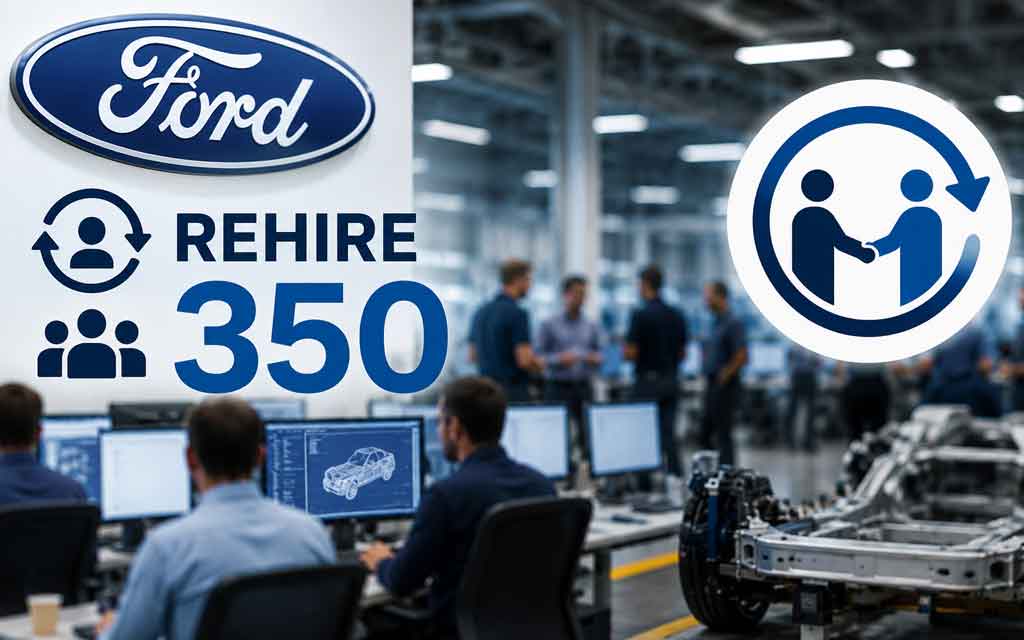
Ford Motor Company has quietly rehired, newly hired, or promoted more than 350 veteran engineers over the past three years after discovering that its heavy reliance on AI and automated quality inspection systems was missing critical problems.
The company’s own executives have acknowledged that automated systems and AI tools did not deliver the same level of expertise and intuition that experienced human engineers bring to complex manufacturing and quality control processes.
What Went Wrong with Ford’s AI Push
In recent years, Ford, like many automakers, aggressively pursued automation and AI to cut costs, improve efficiency, and reduce headcount in engineering, supply chain, and manufacturing roles. The company leaned heavily on automated quality inspection systems, expecting them to catch defects and ensure consistent standards across production.
However, the results were disappointing. AI and automated systems repeatedly failed to identify certain failure points that experienced engineers could spot through a combination of deep domain knowledge, pattern recognition built over decades, and the ability to anticipate issues that data alone hadn’t yet captured.
Ford executives described the situation bluntly: the company had been “relying more and more on automated quality systems” with results that fell short of expectations. As a result, quality problems persisted, contributing to significant costs — reportedly running into billions of dollars — through recalls, warranty claims, and production inefficiencies.
To course-correct, Ford brought back what it internally calls “gray beard” engineers — veteran specialists with decades of hands-on experience. Some were former employees who had left the company, while others were hired from suppliers or other parts of the industry.
These experienced engineers are now tasked with hunting for potential failure points early in the process — often before parts even reach the assembly line — and helping train younger staff. They are also working to improve and retrain the AI systems themselves.
The Human Comeback and Improved Results
The return of experienced human expertise appears to be paying off. According to recent reports, after implementing this hybrid approach, Ford achieved its strongest vehicle quality performance in 16 years in the latest J.D. Power Initial Quality Study.
Company leaders have credited the combination of veteran engineers working alongside improved AI tools for the turnaround. The veterans bring irreplaceable tacit knowledge — the kind of judgment that comes from years of seeing what goes wrong in real-world conditions — while AI handles scale and repetitive data analysis.
One Ford executive noted that the technical specialists “hunt for failure points before a part ever reaches the plant floor,” highlighting the proactive, experience-driven approach that pure automation had struggled to replicate.
Why AI Struggled in This Domain
This episode offers a clear case study in the current limitations of AI in high-stakes, complex engineering environments:
- AI excels at processing large volumes of structured data, identifying known patterns, and performing repetitive inspection tasks at scale.
- AI struggles with novel or rare failure modes, contextual judgment, and the kind of intuitive “smell test” that comes from decades of real-world problem-solving.
- In automotive manufacturing, where safety, durability, and regulatory compliance are non-negotiable, missing even subtle issues can have expensive and reputation-damaging consequences.
Ford’s experience aligns with growing industry recognition that AI works best as a powerful assistant rather than a complete replacement for experienced human judgment — especially in domains involving physical systems, safety-critical components, and intricate supply chains.
Broader Lessons for the Auto and Tech Industries
Ford’s course correction reflects a wider recalibration happening across manufacturing and engineering sectors in 2025–2026. Many companies that aggressively cut experienced staff in favor of AI and automation are now facing quality, reliability, and knowledge-loss challenges.
The automotive industry in particular — with its long development cycles, strict safety standards, and complex global supply chains — has proven to be a tougher environment for full AI replacement than some optimistic forecasts suggested.
Key takeaways emerging from Ford’s experience:
- Tacit knowledge matters: Much of the expertise in engineering and quality control is not easily codified into algorithms.
- Hybrid models are winning: The most effective approach appears to be experienced humans working with AI tools, where veterans help refine the systems and catch what the machines miss.
- Cost-cutting through automation has hidden costs: Short-term savings from reducing headcount can be quickly erased by quality issues, recalls, and lost customer trust.
Ford’s Current Stance
Ford has not abandoned AI. Instead, the company is now focused on using AI more effectively by pairing it with human expertise. The rehired and newly onboarded veteran engineers are actively helping to improve the AI systems rather than competing with them.
This pragmatic shift — acknowledging both the power and the current limitations of AI — is becoming increasingly common among established manufacturers that cannot afford quality compromises.
The Bottom Line
Ford’s decision to rehire over 350 experienced engineers after its AI quality systems underperformed sends a clear signal: in complex, high-stakes fields like automotive engineering and manufacturing, human expertise remains irreplaceable for now.
AI is a powerful tool that can augment human capabilities, but it is not yet a substitute for the hard-earned wisdom that comes from decades of real-world experience. Companies that treat AI as a full replacement rather than a collaborative partner are learning this lesson the expensive way.
Ford appears to have adjusted its approach in time to improve quality outcomes. Other organizations racing to automate everything would do well to study this case before making similar bets.




Leave a Comment