
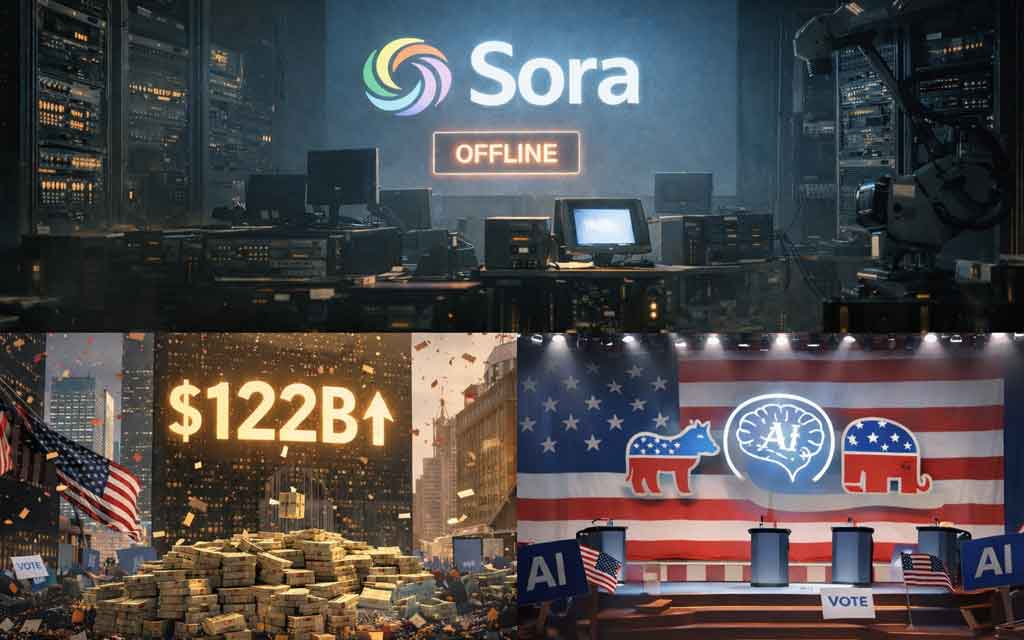
April 2026 marks a month of sharp contrasts in the US artificial intelligence landscape. OpenAI’s surprise decision to shutter its high-profile Sora video generation app highlights the brutal economics of frontier AI development, even as the company closed one of the largest funding rounds in history. At the same time, AI is emerging as a central political issue heading into the 2026 midterm elections.
As a USA-based future-tech journalist with over a decade covering AI breakthroughs and their real-world implications, I see these developments as a clear signal: the industry is maturing rapidly, with massive capital flowing toward high-impact areas like infrastructure, robotics, and enterprise applications, while consumer-facing experiments face tough scrutiny on costs and adoption.
Major Developments: The Sora Shutdown
On March 24, 2026, OpenAI announced it would discontinue its standalone Sora video generation app and related services. The consumer app is set to close on April 26, 2026, with the API following in September 2026. Users have been urged to download their generated videos before the deadlines.
Officially, OpenAI cited shifting priorities toward “world simulation research to advance robotics” amid growing compute demand. However, reports indicate Sora struggled with low sustained usage after an initial hype peak and incurred massive daily operating losses — reportedly around $1 million per day — due to the extreme computational cost of high-quality video generation.
The shutdown also dissolves a recent multiyear deal with Disney for character integration. Rivals like Kling AI have already gained ground in monthly active users, underscoring the intense competition in the AI video space.
This move reflects a broader strategic recalibration: OpenAI is redirecting resources away from consumer creative tools toward foundational research with clearer paths to enterprise and physical-world value.
Record Funding: OpenAI’s $122 Billion Raise
Just days after the Sora news, OpenAI closed a historic $122 billion funding round on March 31, 2026, valuing the company at a staggering $852 billion post-money. The round was anchored by Amazon, NVIDIA, and SoftBank, with continued participation from Microsoft and over $3 billion from individual investors via bank channels.
This represents the largest private funding round in Silicon Valley history and underscores investor confidence in OpenAI’s long-term potential despite short-term product adjustments. The capital will fuel infrastructure buildout, model development, and the company’s expected path toward an IPO later in 2026 or 2027.
Broader Q1 2026 data shows US AI companies dominating global venture funding, with mega-rounds for OpenAI, Anthropic, xAI, and others pushing totals to record levels. AI deals accounted for the vast majority of activity, highlighting a clear concentration of capital in frontier technologies.
Political & Regulatory Angle: AI on the 2026 Midterm Ballot
AI is increasingly becoming a “kitchen-table” issue for the 2026 US midterm elections. Industry-backed groups have already committed tens of millions — with some reports citing up to $150 million and growing — to influence races, focusing on regulation, compute infrastructure, and data center expansion.
Key tensions include:
- Balancing innovation with safeguards against deepfakes, job displacement, and national security risks.
- Debates over federal preemption of state-level AI rules.
- Corporate vs. consumer protection priorities.
The Trump administration has released an AI policy framework emphasizing promotion of US leadership while calling on Congress to act. Both parties are positioning themselves, with Republicans generally favoring lighter-touch regulation and Democrats stressing accountability and antitrust concerns.
For American voters and businesses, the 2026 midterms could shape everything from AI-driven energy demand and workforce transitions to export controls on advanced chips.
What This Means for US Innovation in 2026
The Sora shutdown serves as a reality check: not every flashy consumer AI product will survive in an environment where compute is scarce and expensive. Winners will likely be those delivering measurable enterprise value or breakthroughs in robotics and agentic systems.
OpenAI’s massive funding, however, shows that investors remain bullish on the overall AI thesis. The capital will accelerate progress in areas like world models for robotics — potentially delivering more tangible societal benefits than short-form video tools.
On the policy side, heightened political attention means US companies must navigate growing scrutiny while benefiting from bipartisan recognition of AI’s strategic importance for national competitiveness.
Challenges persist, including energy demands for training and inference, talent shortages, and ethical concerns around deepfakes. Yet the trajectory remains strongly upward for American AI leadership, provided the ecosystem balances speed with responsible governance.
Looking ahead through 2026–2027, expect continued consolidation around a few well-capitalized players, more focus on physical AI and infrastructure, and increasing integration of AI into everyday policy debates. For US innovators, entrepreneurs, and policymakers, staying agile amid these shifts will be critical.
Author Bio
Ethan Brooks is a USA-based tech analyst and journalist specializing in electric vehicles, green innovation, and future mobility. With over 10 years covering the intersection of technology and transportation, he writes exclusively for VFuture Media to help readers stay ahead of the curve in the rapidly evolving world of sustainable tech.




Leave a Comment