
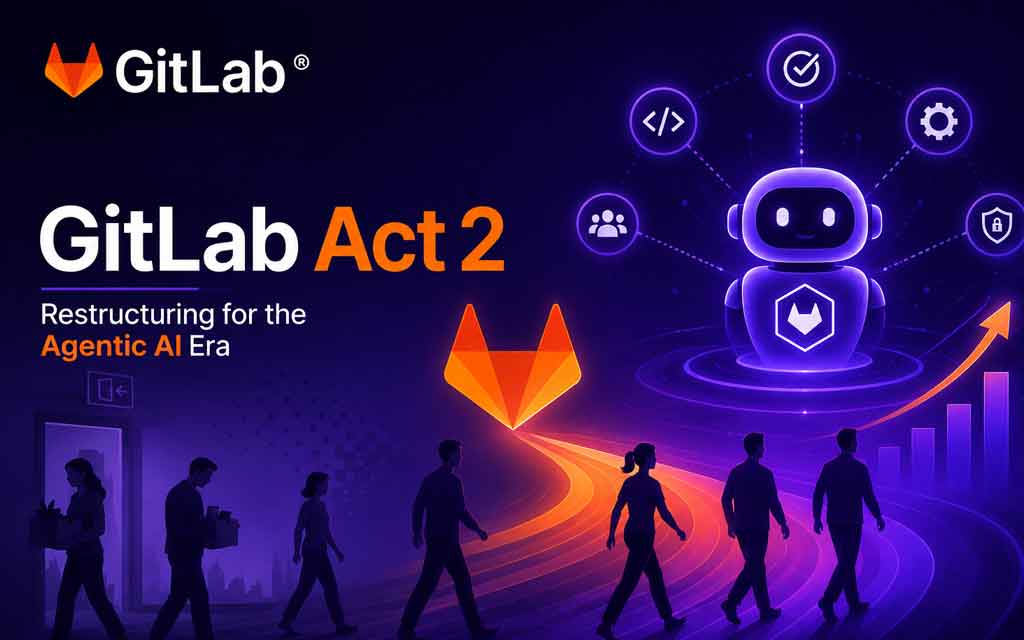
GitLab Inc. (NASDAQ: GTLB) has launched a major restructuring plan, including a global workforce reduction, to reposition the company for what it calls the “agentic era” of AI-driven software development. The move, announced on May 11, 2026, frames the changes as a strategic investment rather than traditional cost-cutting, with CEO Bill Staples emphasizing that the vast majority of savings will be reinvested to accelerate growth and innovation.
Details of the Restructuring and Workforce Reduction
The initiative, dubbed “GitLab Act 2”, involves four key operational shifts:
- Reducing GitLab’s operational footprint by exiting smaller teams in up to 30% of the countries where it currently operates (previously active in nearly 60 countries), while continuing to serve those markets through partner networks.
- Flattening the organization by removing up to three layers of management in some functions.
- Reorganizing the Research & Development (R&D) organization into roughly 60 smaller, autonomous teams with end-to-end ownership — nearly doubling the number of independent teams.
- Rewiring internal processes by deploying AI agents to automate reviews, approvals, and handoffs, with corresponding right-sizing of roles.
The exact number of roles affected has not yet been disclosed. GitLab is conducting the process transparently, including a voluntary separation window open until May 18, 2026 (where local laws permit). The final scope and financial impact will be detailed during the company’s Q1 FY27 earnings call on June 2, 2026.
CEO Statement and Strategic Rationale
In a memo to employees and a letter to customers and investors, CEO Bill Staples acknowledged the difficulty of the changes while framing them as essential for the future:
“Today is hard. I want to acknowledge how difficult today is given the volume of change we’re asking you to take in, and the uncertainty of a transparent restructuring process… This restructure process is not like others you may be seeing in the news… We intend to reinvest the vast majority of savings back into the business to accelerate our unique opportunity in the agentic era.”
Staples stressed that the restructuring “is neither an AI optimization nor simply a cost-cutting measure.” Instead, it aims to build a leaner, faster organization optimized for AI agents that will increasingly build software under human direction. He noted: “The agentic era affords GitLab the largest opportunity in our history as a company, and we’re making the structural and strategic decisions to meet it.”
In the agentic era, AI agents are expected to handle large portions of software creation, dramatically lowering production costs and expanding overall demand for software. GitLab is betting its platform — with features like its Duo Agent Platform — will become the trusted infrastructure for this shift.
Timeline and Employee Impact
- May 11, 2026: Announcement and start of transparent planning.
- May 18, 2026: Voluntary separation window closes.
- On or before June 1, 2026: Finalization of the plan (subject to local requirements).
- June 2, 2026: Q1 earnings call — full details on job impact and financials.
- June 10, 2026: GitLab Transcend event — updated innovation roadmap.
The company has reassured customers that there will be no disruption to support, product roadmap, or terms of service.
Market Reaction
GitLab’s shares fell more than 8% in after-hours trading following the announcement, reflecting investor uncertainty about the scale of the cuts despite the growth-focused messaging.
Industry Context
The announcement comes as AI is fundamentally reshaping developer tools economics. Traditional per-seat licensing is giving way to hybrid models that account for agent-driven usage. GitLab’s move aligns with broader industry trends, where companies are streamlining operations to fund AI initiatives amid rapid innovation in autonomous coding agents. Analysts note that while AI may augment or replace some roles, it is also expected to multiply demand for sophisticated DevSecOps platforms.
GitLab, which reported approximately 2,580 employees as of early 2026, joins other tech firms in balancing workforce adjustments with heavy AI investment. The company plans to launch internal AI acceleration programs, introduce new bonuses for non-incentive employees, and adopt operating principles centered on speed, ownership, and customer outcomes.
Overall, GitLab positions “Act 2” as a generational rebuild of its infrastructure and culture to lead in an era where “software will be built by machines, directed by people.” For the latest updates, refer to GitLab’s official blog or upcoming earnings materials.



Leave a Comment