
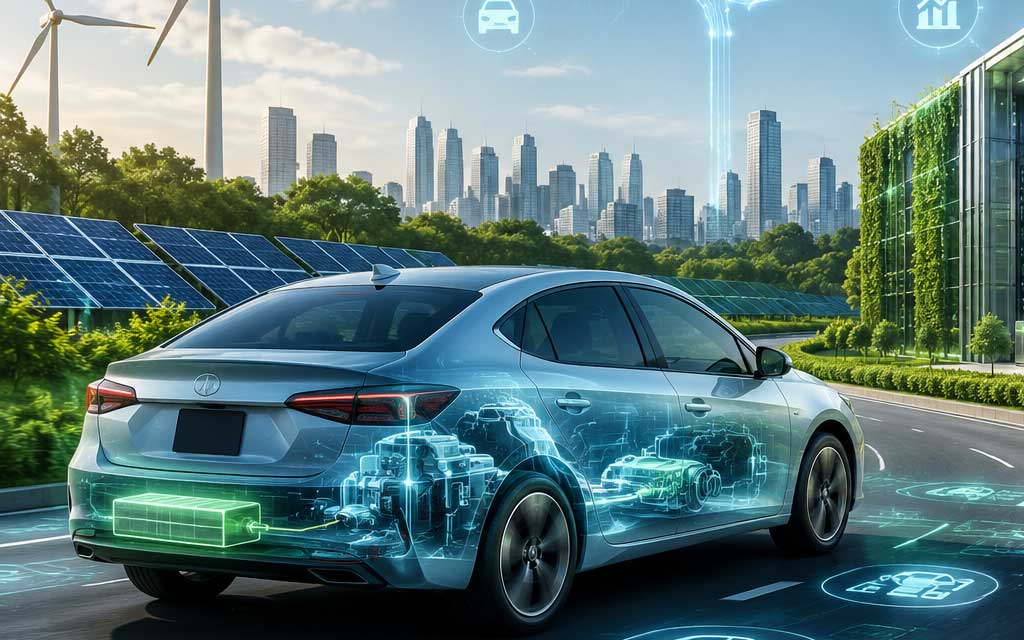
On a humid July morning outside Atlanta, a late-model hybrid crossover glides through suburban traffic. Its onboard AI continuously weighs battery state-of-charge, engine efficiency maps, traffic predictions, and even the slight elevation changes ahead. The system decides in milliseconds whether to lean on the electric motor, the gasoline engine, or a precise blend of both. At the same time, anonymized telemetry—temperature readings, vibration signatures, software health—streams to a regional data center powered largely by renewable contracts. There, algorithms scan for early signs of component wear and queue an over-the-air update that will refine the vehicle’s energy strategy overnight.
This quiet coordination between a hybrid powertrain and the computing infrastructure that supports it captures a defining sustainability story of 2026: the tightening loop between smarter vehicles and greener information technology. As pure-electric adoption faces infrastructure and cost headwinds in parts of the U.S. market, hybrids remain a high-volume bridge technology. AI is making them markedly more efficient, while the data centers and edge systems that keep connected cars intelligent are under growing pressure to reduce their own carbon and water footprints. The result is an emerging, if still imperfect, ecosystem in which automotive and IT sustainability reinforce each other.
Intelligent Energy Management Inside the Vehicle
Modern hybrids have moved far beyond simple on/off electric assist. Advanced energy management systems now treat the powertrain as a continuous optimization problem. Machine-learning models trained on millions of real-world driving miles predict upcoming energy demand with greater accuracy than rule-based controllers of earlier generations. They factor in navigation data, learned driver behavior, weather, and even cabin climate-control load. The payoff appears in measurable fuel-economy gains and lower emissions under mixed driving conditions that pure laboratory cycles often miss.
Predictive maintenance amplifies these gains. Sensors monitor battery thermal behavior, inverter health, and mechanical components. Edge AI flags anomalies before they become failures, reducing unplanned downtime and the secondary environmental cost of roadside assistance or premature part replacement. Studies and industry reports from recent years consistently show predictive approaches cutting maintenance costs substantially while extending component life—benefits that translate directly into lower lifetime emissions per vehicle.
Over-the-air updates close the loop. A hybrid sold in 2024 can receive refined energy-management algorithms in 2026 without a dealer visit. Automakers treat the vehicle software stack as a living system, iteratively improving efficiency long after the car leaves the factory. This software-defined approach turns every hybrid into a platform that can become cleaner over time rather than locked into its original calibration.
U.S. Market Examples and Partnerships
In the American market, Toyota continues to lean heavily on hybrids as a pragmatic volume strategy, projecting substantial hybrid share of U.S. sales. Its systems increasingly incorporate AI-driven optimization for both conventional hybrids and plug-in variants. Ford and General Motors, while maintaining electric roadmaps, have expanded hybrid and plug-in hybrid offerings and paired them with deeper software capabilities. Partnerships with technology firms supply the underlying compute, connectivity, and cloud services that make continuous improvement possible.
These collaborations extend beyond the vehicle. Automakers work with hyperscale cloud providers and specialized automotive-data platforms to process the torrent of telematics. The same companies that deliver navigation, remote diagnostics, and fleet services are also the ones investing heavily in data-center efficiency. The commercial logic is clear: the more intelligent and connected the vehicle fleet becomes, the greater the volume of data that must be stored, processed, and secured—and the greater the incentive to do that work with lower carbon intensity.
The Other Half of the Equation: Greener Data Centers
Connected hybrids and EVs generate continuous streams of data. Even modest fleets produce terabytes that feed navigation services, predictive models, usage-based insights, and regulatory compliance systems. That data lives in data centers whose electricity demand has become a national conversation in 2026. Projections of rapid growth in data-center power consumption have sharpened scrutiny of their environmental impact.
In response, major U.S. operators have accelerated green practices: long-term renewable energy contracts, advanced cooling that reduces water use, AI-optimized power distribution inside the facilities themselves, and siting decisions that favor regions with cleaner grids or excess renewable capacity. Edge computing—processing more data closer to the vehicle or in regional facilities—further reduces the need to ship every byte to distant hyperscale campuses. For automotive workloads specifically, the combination of vehicle-edge intelligence and efficient cloud backends lowers the total energy cost of keeping a car “smart.”
The carbon arithmetic is not automatic. Training large AI models and running inference at scale consume significant electricity. Yet when those models deliver measurable reductions in vehicle fuel use or prevent inefficient maintenance events across millions of cars, the net system-level impact can turn positive. The critical variable is how aggressively both the automotive and IT sides pursue efficiency rather than simply adding capability.
Carbon Reduction Potential and Policy Context
Hybrids already deliver substantial tailpipe and well-to-wheel emission reductions compared with conventional gasoline vehicles, particularly in real-world mixed driving. AI optimization stretches those gains further by keeping the powertrain in its most efficient operating regions more of the time. When the supporting digital infrastructure itself runs on cleaner power, the full lifecycle benefit improves.
U.S. policy shapes the incentives. Corporate Average Fuel Economy standards, state-level zero-emission vehicle requirements, and remaining elements of industrial policy around domestic manufacturing all reward efficiency. California’s regulatory environment and consumer incentives continue to pull the market, while other states experiment with their own approaches. Data-center operators face growing pressure from utilities, local governments, and customers to demonstrate renewable matching and water stewardship. The convergence of these pressures creates a shared language of sustainability metrics across sectors that once operated in relative isolation.
Challenges in Scaling Responsibly
Obstacles remain significant. The energy and mineral intensity of both advanced batteries and high-performance computing hardware cannot be wished away. Rapid growth in data-center demand risks straining local grids and water resources even as individual facilities become more efficient. On the vehicle side, the complexity of AI systems raises questions of reliability, cybersecurity, and explainability—especially when those systems control energy flows that affect safety and emissions compliance.
Equity concerns also surface. The most sophisticated hybrid and connectivity features tend to appear first on higher-priced models. Ensuring that efficiency gains and predictive services reach broader segments of the market will require deliberate product strategy and policy attention. Finally, the environmental benefits depend on continued progress in the electricity grid itself. A hybrid optimized by AI still draws from the same power system that charges pure EVs and runs data centers; cleaner electrons multiply the value of every efficiency improvement.
Expert Perspectives and Case Narratives
Automotive engineers describe the current moment as one of pragmatic integration rather than revolutionary rupture. “The hybrid is no longer a transitional compromise,” one powertrain specialist noted in industry discussions. “With continuous software improvement, it becomes a platform that can keep delivering better efficiency for years.” Data-center operators and sustainability officers emphasize measurement and additionality—ensuring that renewable claims represent real incremental clean generation rather than simple accounting.
A midwestern utility fleet that adopted connected hybrids with predictive maintenance reported both lower fuel spend and fewer unexpected repairs, while routing its vehicle data through a cloud region matched to renewable supply. A California logistics operator using similar systems found that AI-managed energy strategies reduced fuel use on mixed urban-highway routes more consistently than earlier calibrations. These are incremental rather than transformative stories, yet they illustrate the compounding effect when vehicle intelligence and infrastructure efficiency move in the same direction.
Toward an Integrated Sustainable Ecosystem
Looking ahead, the most compelling scenario is one of tighter coupling. Vehicles become more efficient nodes in a larger energy and information system. Data centers that serve them operate as responsible loads that can respond to grid conditions. Over-the-air updates and federated learning techniques improve models without constantly centralizing raw data. Policy rewards measured outcomes—grams of CO₂ avoided, kilowatt-hours saved—rather than simply counting electric vehicles or renewable certificates.
In that future, a hybrid leaving a dealership in Texas or Michigan is not a static product. It is an evolving participant in a sustainability network that includes the powertrain, the driver’s patterns, the regional grid, and the computing fabric that keeps the whole system learning. The convergence of smart hybrids and green computing will not solve the climate challenge alone. But in 2026 it has become one of the more practical, scalable, and already-deployed pathways for reducing the carbon intensity of everyday mobility and the digital infrastructure that now surrounds it.
The cars are getting smarter about energy. The computers that serve them are getting cleaner. The remaining work is to ensure the two advances reinforce each other at the scale the moment demands.

Leave a Comment