
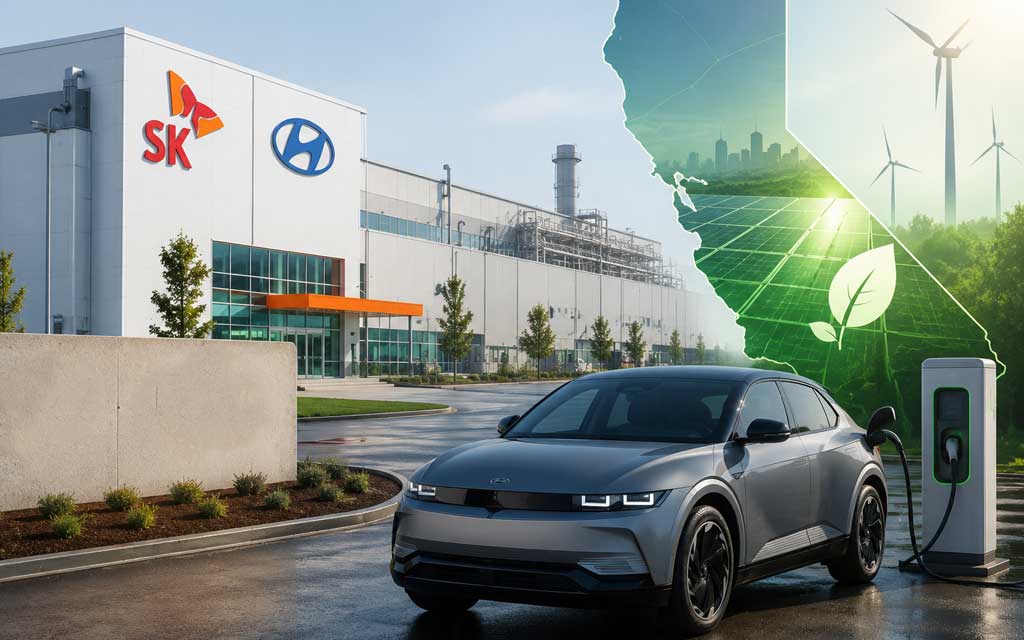
In the rolling hills of Bartow County, Georgia, northwest of Atlanta, a sprawling $5 billion complex has begun humming with purpose. In June and early July 2026, Hyundai-SK Battery Manufacturing America (HSBMA) started commercial production of electric vehicle battery cells. The first packs are already moving toward Hyundai Motor Group’s Metaplant America near Savannah, destined for vehicles including the three-row IONIQ 9. Workers in clean-room environments and automated lines are turning raw materials into the high-energy cells that power the next wave of American-made EVs.
This is more than another factory opening. It is a concrete step in the long, expensive effort to localize the battery supply chain that underpins the electric transition. At roughly the same moment, California—still the nation’s largest EV market—rolled out a fresh consumer rebate program designed to reignite demand after the expiration of the federal tax credit and the earlier closure of its long-running Clean Vehicle Rebate Project. Together, the Georgia production ramp and the Golden State’s new incentives form a timely snapshot of America’s uneven but determined push toward domestic electrification.
Georgia’s Newest Battery Fortress
The Bartow County plant represents a joint 50-50 investment by Hyundai Motor Group and South Korea’s SK On. With an annual capacity of about 35 GWh—enough batteries for roughly 300,000 electric vehicles—the facility is sized to feed Hyundai, Kia, and Genesis production in the United States. Officials had originally targeted a 2025 start; the mid-2026 commercial launch reflects the familiar complexities of scaling advanced manufacturing, yet the plant is now shipping.
Stakeholders project more than 3,500 jobs at full capacity. Many of those positions are already being filled in production, maintenance, quality control, and support roles. For a rural and suburban county that has courted manufacturing for years, the arrival of a high-tech battery operation brings both payroll and secondary economic activity—housing demand, local suppliers, and training partnerships with nearby technical colleges.
The strategic logic is straightforward. Batteries remain the single most expensive and geopolitically sensitive component of an EV. By producing cells in Georgia, Hyundai reduces exposure to trans-Pacific shipping risks, currency swings, and the policy uncertainties that have surrounded Chinese-dominated supply chains. The plant sits within a growing Southeast battery corridor that also includes SK On’s earlier Commerce, Georgia, facility. Cells made here can reach the Metaplant in hours rather than weeks, tightening inventory and enabling more responsive production schedules.
HSBMA CEO Hang Ki Moon framed the start of operations around operational excellence, quality, and safety in support of broader North American electrification. Industry observers note that SK On’s cell technology—known for energy density and performance characteristics suited to longer-range and higher-volume vehicles—gives Hyundai Group a competitive tool as it expands its U.S. EV lineup.
California’s Rebate Revival
While batteries begin rolling off lines in Georgia, California has moved to stimulate the demand side. In early July 2026, details solidified around a new state-backed incentive funded in part by $135 million in the latest budget. Eligible first-time EV buyers who are California residents can receive an instant $3,500 discount on new electric vehicles with a manufacturer’s suggested retail price generally under $50,000. Used EVs under roughly $25,000 qualify for $1,750. Participating automakers match the state contribution, creating point-of-sale savings rather than a delayed tax credit.
Thirteen brands, including Hyundai, Kia, Tesla, Ford, GM, Toyota, and others, have signed on. The program deliberately targets first-time buyers to expand the pool of EV owners rather than simply subsidizing replacements among existing enthusiasts. Price caps aim to focus benefits on more affordable models, though exceptions exist for certain California-headquartered manufacturers.
The timing is deliberate. The federal clean vehicle tax credit has expired or become far more restricted for many buyers. California’s earlier CVRP, which once handed out thousands of dollars per vehicle, stopped accepting new applications years ago after exhausting funds. Dealers and advocates had warned that the absence of meaningful incentives risked stalling adoption precisely when more models were reaching the market. The new rebate is smaller than peak CVRP or federal amounts, yet its immediacy and matching structure make it visible at the dealership.
Early market response is still forming, but analysts expect the program to provide a measurable lift in volume for qualifying vehicles, particularly in the mid-priced crossover and sedan segments where Hyundai and Kia compete strongly. Combined with existing utility rebates, HOV-lane access, and local air-quality programs, the incentive helps keep California’s EV share elevated even as national growth rates moderate.
Supply Chain Resilience and the China Question
The Georgia plant’s significance is magnified by global battery geopolitics. China continues to dominate refining of critical minerals, cathode and anode production, and cell manufacturing capacity. U.S. and European policymakers have responded with tariffs, local-content requirements under the Inflation Reduction Act framework, and industrial policy aimed at building alternative capacity. Every gigawatt-hour produced in Bartow County is a gigawatt-hour that does not need to cross an ocean from Asia.
This localization does not eliminate dependence—raw materials still often originate abroad—but it shortens the most visible and politically sensitive links in the chain. It also creates domestic know-how. Engineers, technicians, and process experts trained in Georgia become part of an expanding American battery workforce that can support future plants and technology iterations.
Technological progress continues in parallel. SK On and peers are refining cell chemistries for higher energy density, faster charging, longer cycle life, and reduced reliance on the most constrained materials. While solid-state batteries and sodium-ion alternatives remain mostly in pilot stages, incremental improvements in nickel-manganese-cobalt and lithium-iron-phosphate formulations are already flowing into production vehicles. Localized manufacturing allows automakers to iterate faster with suppliers who share the same regulatory and logistics environment.
Impacts on Automakers and Consumers
For Hyundai and Kia, the plant is both a risk-mitigation tool and a marketing asset. Vehicles assembled at the Metaplant with Georgia-made batteries strengthen “Made in USA” credentials and improve eligibility for any remaining or future incentives tied to domestic content. Cost reductions from shorter supply lines and scale can eventually translate into more competitive pricing or higher margins—though the precise pass-through to consumers will depend on competitive dynamics and raw-material prices.
Consumers benefit indirectly through greater model availability and, over time, potentially lower prices as manufacturing matures. Directly, California’s rebate puts thousands of dollars back into the hands of first-time buyers at the moment of purchase. In a high-cost state, that difference can decide whether a household chooses an EV or continues with a gasoline vehicle.
Environmental gains are real but nuanced. Local production reduces the carbon footprint of shipping heavy battery packs. When paired with a progressively cleaner U.S. grid, the lifetime emissions of these vehicles improve. Yet battery manufacturing itself is energy- and water-intensive; the net climate benefit depends on the electricity mix powering the Georgia plant and the full upstream mineral supply chain.
Economic Forecasts and Future Scenarios
Economic development officials in Georgia project sustained employment and tax-base growth. Multipliers from supplier networks and worker spending could amplify the direct 3,500 jobs. Nationally, the accumulation of similar projects—across the Southeast, Midwest, and Southwest—forms the backbone of a domestic battery industry that did not exist at scale a decade ago.
Challenges remain substantial. Construction and ramp-up costs have been high across the sector. Skilled labor shortages persist. Global overcapacity in cells periodically pressures pricing. And consumer demand, while growing, is sensitive to interest rates, gasoline prices, and the availability of reliable home and public charging.
In one optimistic scenario for the late 2020s, a dense network of U.S. battery plants supplies the majority of cells for vehicles built in North America. Costs continue to decline. California-style incentives and federal policy keep demand healthy. Automakers like Hyundai achieve true supply-chain resilience and can respond quickly to shifts in consumer preference. Localized manufacturing becomes a competitive advantage rather than a compliance burden.
A more cautious scenario sees slower demand growth, persistent cost premiums versus Asian production, and political volatility around incentives and trade policy. In that world, plants operate below capacity and the promised job numbers materialize more slowly.
July 2026 sits between those futures. The lights are on in Bartow County. Cells are moving to Savannah. California buyers can once again see a meaningful discount at the dealership. The battery boom is no longer aspirational policy language. It is concrete, steel, and chemistry operating on American soil—imperfect, expensive, and essential to the country’s electric ambitions. How quickly it scales, how fairly its benefits are shared, and how resilient it proves against global competition will shape the next chapter of the American EV story.


Leave a Comment