
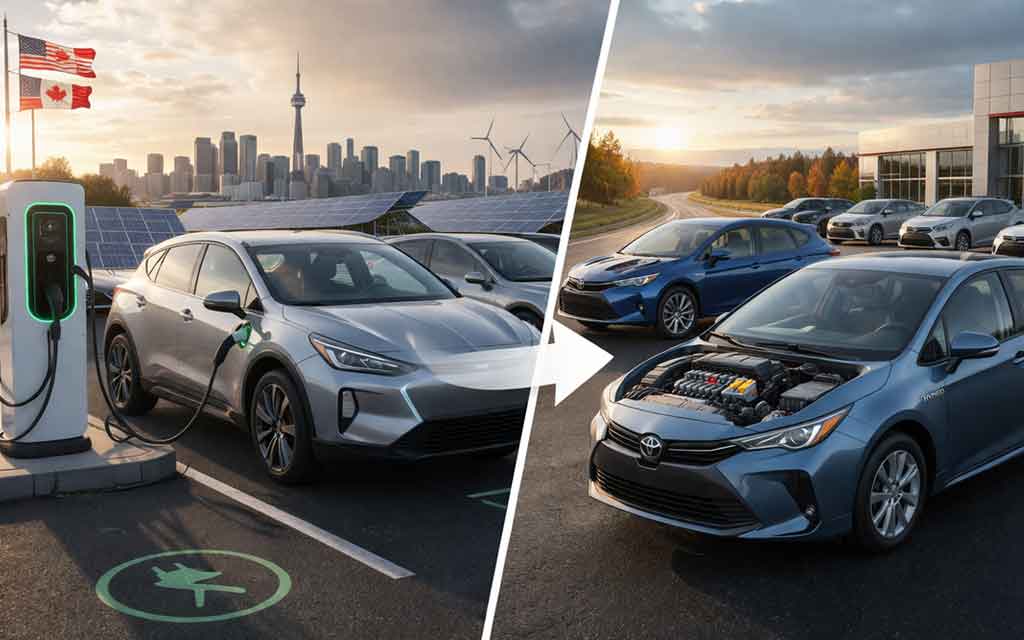
The electric vehicle revolution hit a speed bump in early 2026. While global EV sales reached 1.1 million units in February, the market showed sharp regional differences — with North America experiencing a steep decline and Europe maintaining solid growth. In response, major automakers like Ford, General Motors (GM), and Stellantis are pragmatically shifting focus toward hybrids as a bridge technology while scaling back aggressive full-EV timelines.
This strategic pivot reflects changing consumer preferences, policy shifts, and economic realities. Here’s a detailed look at why it’s happening and what it means for buyers across the USA, Europe, and Canada.
Global EV Sales Snapshot: A Tale of Two Continents (Jan-Feb 2026)
According to Benchmark Mineral Intelligence data:
- Global: 2.2 million EVs sold (down 8% YoY)
- Europe: 600,000 units (up 21% YoY) — supported by subsidies in Germany, France, and Italy
- North America: 170,000 units (down 36% YoY) — heavily impacted by the end of U.S. federal tax credits
- China: Down 26% amid policy adjustments
In the U.S., new EV market share hovered around 5.8–7.8% in early 2026, while hybrids continued to gain ground due to lower upfront costs and no range anxiety.
Europe, by contrast, saw battery-electric vehicles (BEVs) reach nearly 19–20% market share in early 2026, with plug-in hybrids also performing strongly.
Major Automaker Announcements: Billions in Writedowns
Legacy automakers have collectively booked over $70 billion in charges related to EV restructuring since late 2025. Key moves include:
- Ford: Took a $19.5 billion writedown and canceled the next-generation F-150 Lightning. The company is now prioritizing hybrids and more affordable vehicle platforms, citing eroded business cases due to weak demand and regulatory changes.
- General Motors (GM): Recorded approximately $6–7.6 billion in charges. The company scaled back EV production plans and is reallocating resources. A standout move is the retooling of its Ultium Cells joint venture plant in Spring Hill, Tennessee — shifting from EV batteries to LFP (lithium-iron phosphate) cells for energy storage systems (targeting data centers and grid applications). This $70 million investment will recall around 700 laid-off workers starting Q2 2026.
- Stellantis: Booked the largest single hit — around $26 billion — as part of a broad “strategic reset.” The company is ending some plug-in hybrid lines in North America, replacing the all-electric Ram 1500 plan with extended-range EV (EREV) options, and focusing on hybrids and gasoline models to better match consumer demand.
Other players like Hyundai/Kia scaled back certain U.S. EV trims due to inventory buildup, while Honda canceled multiple planned U.S. EV models.
This wave of writedowns highlights a clear industry message: Electrification timelines are being recalibrated to align with actual buyer behavior rather than optimistic forecasts.
Why the Pivot? Consumer Demand Realities
Buyers in North America (USA and Canada) are showing strong preference for hybrids:
- No charging infrastructure worries, especially on long trips or in rural areas
- Lower purchase prices compared to full EVs
- Familiar refueling experience with better fuel economy
In the U.S., hybrids have been outselling BEVs in several segments. Cold winters in Canada further amplify range concerns for pure EVs.
In Europe, the picture is more positive for full EVs thanks to continued incentives (e.g., new subsidy programs in Germany and France) and denser charging networks. However, even here, hybrids and plug-in hybrids remain popular for their flexibility, often accounting for 30–40%+ combined electrified share.
Common barriers to full EV adoption include high prices, charging anxiety, and slower-than-expected infrastructure rollout in North America.
Regulatory and Policy Pressures
- USA: Expiration of federal EV tax credits (post-September 2025), proposed rollbacks in fuel economy/CO₂ standards, and policy uncertainty have reduced incentives.
- Canada: Mirrors U.S. trends with additional cold-climate challenges; some provinces maintain local incentives.
- Europe: While some emission targets have been softened under industry pressure, national subsidies continue to support growth in key markets like Germany (+26%), France (+30%), and Italy.
These shifts forced automakers to move away from rigid 2030–2035 EV-only targets toward a more flexible “multi-energy” approach.
Positive Notes: Innovation Continues
The pivot doesn’t mean the end of electrification — it signals a more realistic path forward:
- New Battery Tech: Advances in LFP and next-generation chemistries are reducing costs and improving safety.
- Supercharger Access: More non-Tesla EVs are gaining access to Tesla’s extensive network, improving real-world usability — especially beneficial in the USA and Canada.
- Energy Storage Opportunity: GM’s Tennessee plant shift shows how battery expertise can pivot to the booming demand from AI data centers and renewable grid storage — creating new revenue streams and preserving jobs.
- Hybrid Bridge: Models with hybrid or EREV powertrains offer a practical stepping stone — delivering electric driving benefits with gasoline backup for peace of mind.
Long-term, analysts expect electrification to accelerate again with more affordable EVs, better infrastructure, and potential policy stabilization later in the decade. Europe is likely to lead BEV adoption, while North America may remain hybrid-heavy for longer.
What This Means for Buyers in USA, Europe & Canada
- USA: Hybrids from Ford, Toyota, Honda, and others are excellent options right now. Used EVs are becoming more affordable due to price drops — a good entry point for budget-conscious buyers. Watch for potential policy changes.
- Europe: Strong incentives make new BEVs attractive in countries like Germany, France, and Italy. Hybrids serve as a flexible alternative where full charging access is limited.
- Canada: Similar to the U.S., focus on hybrids for practicality in colder climates. Check provincial rebates and compare total cost of ownership.
Buying Advice: Consider your daily driving distance, access to home/work charging, and long-trip needs. Hybrids often win on convenience and upfront cost, while full EVs shine on efficiency and lower running costs where infrastructure supports them.
The Road Ahead
The 2026 “EV winter” feels real in North America but is milder in Europe. Automakers’ pivot to hybrids demonstrates adaptability rather than abandonment of electrification. By balancing consumer realities with technological progress, the industry is positioning itself for more sustainable long-term growth.
What are your thoughts on the hybrid surge? Are you considering a hybrid, plug-in hybrid, or full EV for your next vehicle? Share in the comments below.
Subscribe to VFutureMedia for monthly EV and automotive industry updates, comparison guides, and buying advice tailored to North American and European readers.

Leave a Comment