
By the VFuture Media Team Published: March 31, 2026 | www.vfuturemedia.com
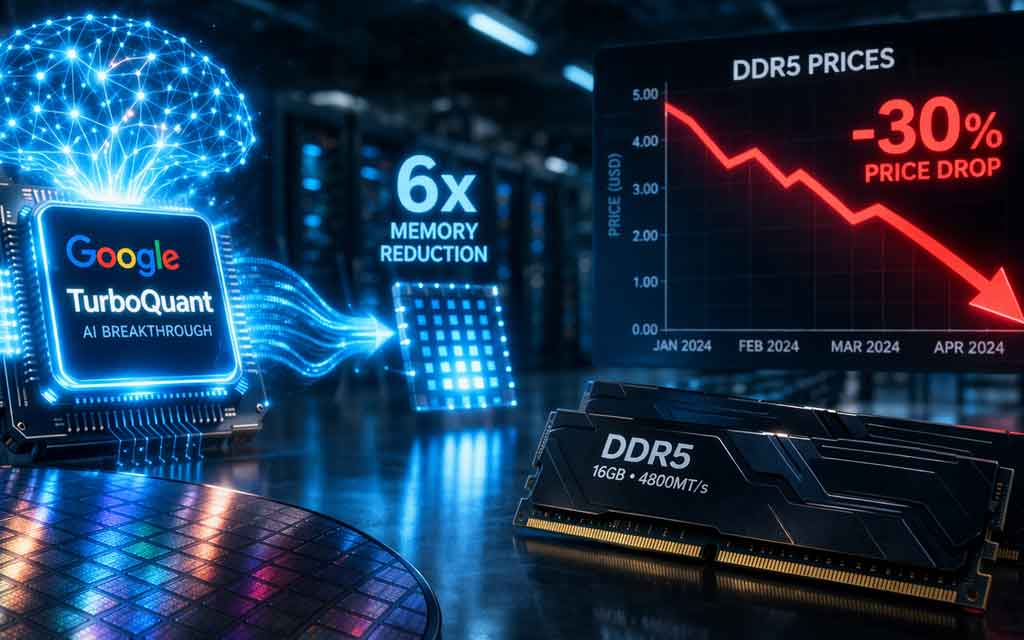
In a stunning turn for the semiconductor market, DDR5 memory prices have crashed up to 30% in just days following Google’s announcement of TurboQuant, a groundbreaking AI compression algorithm. The technology slashes AI memory usage to 1/6th of previous levels, triggering immediate fears of reduced long-term demand for DRAM chips and sending shockwaves through the industry.
Memory prices had skyrocketed 106% since their 2024 lows due to insatiable AI data center demand. Now, they’re falling fast. On Amazon, a popular 32GB DDR5 kit dropped from around $490 to $379.99, while 16GB DDR5 modules fell from about $260 to $219.99. Similar 30% declines are being reported in China, with consumer and enterprise pricing easing across major retailers.
This isn’t just a blip — it’s a direct market reaction to TurboQuant’s potential to reshape AI infrastructure costs.
What Is Google TurboQuant? The AI Memory Breakthrough Explained
Google Research unveiled TurboQuant earlier this week as a set of advanced quantization algorithms designed for extreme compression in large language models (LLMs). It targets the key-value (KV) cache — the working memory that AI models use during inference — and achieves up to 6x memory reduction (down to as low as 3 bits per value) with zero loss in accuracy across demanding benchmarks like LongBench, Needle-in-a-Haystack, and RULER.
Key performance claims include:
- 6x lower KV cache memory footprint
- Up to 8x faster inference in some tests
- No retraining or fine-tuning required
- Perfect downstream results on question answering, code generation, and summarization tasks
Unlike traditional quantization methods that degrade output quality, TurboQuant maintains full model performance while dramatically cutting the memory and power needed to run AI workloads. This directly attacks one of the biggest bottlenecks in scaling AI: the exploding demand for high-bandwidth memory in data centers.
Why Memory Prices and Stocks Are Crashing
The announcement hit the memory industry like a bombshell. AI hyperscalers had been hoarding DRAM to fuel massive data center buildouts, driving prices to record highs. TurboQuant’s promise of using 1/6th the memory for the same AI performance has investors worried about a sudden slowdown in demand.
- Memory chip stocks plummet: Nearly $450 billion has been wiped out from the market capitalization of major players including Samsung, SK Hynix, and Micron since the news broke. Shares in these companies dropped sharply on fears that TurboQuant could reduce the need for new memory modules in AI training and inference.
- Consumer DDR5 relief: After months of relentless price increases, U.S. and global retailers are finally seeing inventory pressure ease. The drop aligns with reports of AI companies pausing or scaling back aggressive RAM purchases.
Analysts note this could be a temporary “knee-jerk” reaction, but the message is clear: software efficiency breakthroughs are finally starting to bite into hardware demand.
Broader Market Context: From Shortage to Potential Glut?
DDR5 prices remain well above 2024 lows even after the crash, reflecting ongoing supply constraints and strong baseline demand from gaming, PCs, and servers. However, TurboQuant highlights a growing trend: AI’s memory wall is being attacked from the software side.
Experts caution that TurboQuant primarily optimizes inference (running models) rather than training, and real-world deployment may take time. Still, the immediate market reaction shows how sensitive the semiconductor sector has become to any signal of reduced AI hardware intensity.
For American consumers and builders, this is welcome news after months of frustration:
- Gamers and PC enthusiasts can finally find more affordable upgrades.
- Small businesses and content creators running local AI tools may see lower hardware costs.
- The ripple effect could extend to laptops, workstations, and even next-gen consoles if the trend continues.
What This Means for the Future of AI and Hardware
Google’s TurboQuant is a textbook example of first-principles innovation — solving the memory bottleneck through smarter algorithms rather than simply building bigger data centers. It could accelerate AI adoption by making it cheaper and more energy-efficient to run advanced models at scale.
At the same time, it underscores the volatility of the memory market. While today’s price crash benefits buyers, long-term demand for high-performance DRAM is unlikely to disappear entirely. As one analyst put it, TurboQuant is “evolutionary, not revolutionary,” and AI computing will still require massive amounts of memory overall.
For U.S. readers: Whether you’re upgrading your gaming rig, building an AI workstation, or investing in tech stocks, keep a close eye on how quickly this efficiency gain translates into sustained price relief. Early signs point to more breathing room for consumers in 2026.
At VFuture Media, we track these pivotal moments where software meets hardware to redefine entire industries — from EVs and sustainable tech to AI infrastructure and beyond. TurboQuant proves that breakthroughs in efficiency can move markets overnight.
Stay ahead of the curve: Explore our latest coverage on AI innovations, semiconductor trends, and first-principles engineering stories right here on www.vfuturemedia.com.
This article is based on Google Research announcements, real-time market data from Wccftech, Amazon pricing, and financial reports as of March 31, 2026. Prices can fluctuate; check current listings for the latest deals.
SEO Keywords: DDR5 memory prices crash 2026, Google TurboQuant AI memory reduction, DDR5 price drop after TurboQuant, memory chip stocks fall 2026, AI KV cache compression 6x, 32GB DDR5 Amazon price, DRAM demand concerns Google.




Leave a Comment