
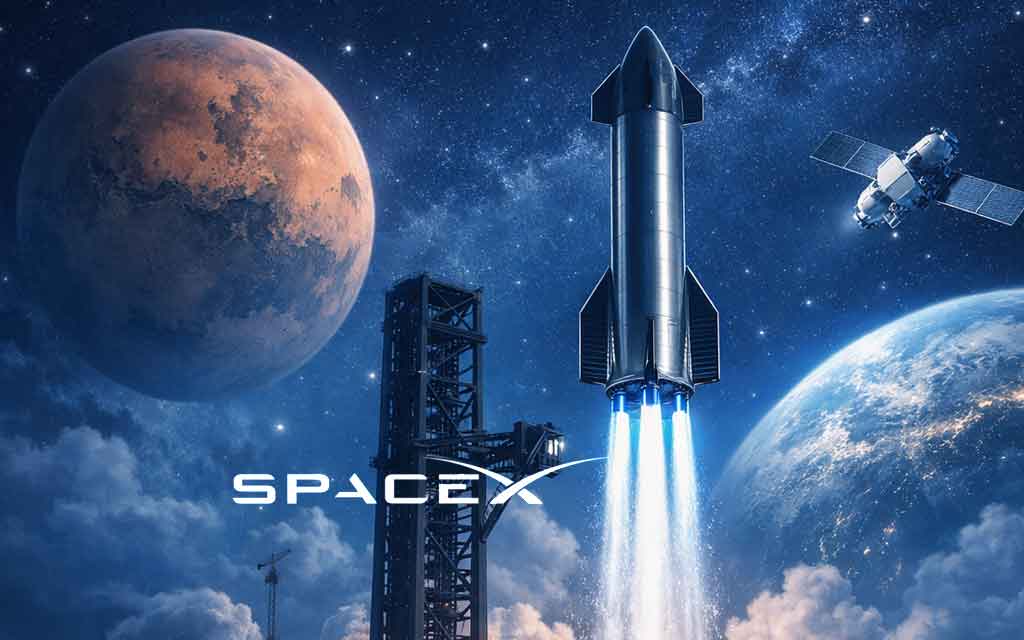
SpaceX Starship stands on the cusp of its most significant evolution yet. The next flight (widely expected as Flight 12) and the debut of the Version 3 (V3) ship and booster could occur in 4 to 6 weeks from early April 2026, targeting a launch window around early-to-mid April. This marks a pivotal step toward fully reusable, high-cadence operations essential for Starlink expansion, NASA Artemis lunar missions, and eventual Mars colonization.
What Is Starship Version 3 (V3)?
Starship V3 represents the third major iteration of SpaceX’s fully reusable super-heavy lift vehicle. It builds on lessons from previous Block 1 and Block 2 vehicles flown in 2023–2025 test flights.
Key upgrades in V3 include:
- Raptor 3 engines — More powerful, simpler, and reliable than prior versions, with higher thrust per engine (estimates suggest ~250–300 tf each). The Super Heavy booster retains 33 Raptors for massive liftoff thrust, while the Starship upper stage uses 3 sea-level + 3 vacuum-optimized Raptors.
- Increased propellant capacity and structural enhancements — Allowing greater payload mass to orbit and improved reusability.
- Redesigned heat shield, flaps, and payload systems — Better thermal protection for re-entry and features like payload doors for satellite deployment or docking ports for orbital refueling.
- Reusable hot-staging ring and other optimizations for faster turnaround and tower catches of both booster and (eventually) ship.
These changes aim to make Starship 3x more powerful than the Saturn V in some configurations, with liftoff thrust exceeding 7,500–8,000+ tons. V3 paves the way for rapid reuse, orbital refueling, and the high flight rates needed for ambitious goals.
The vehicles for this milestone flight are Super Heavy Booster 19 (V3 booster) paired with Ship 39 (first V3 upper stage).
Current Status and Timeline (as of April 2026)
SpaceX CEO Elon Musk stated in early March 2026 that the next Starship launch would occur in about 4 weeks, later refined to align with early April targets. As of now, the window points to 4–6 weeks away (roughly mid-April 2026), pending final testing, regulatory approvals, and weather.
Recent progress includes:
- Ship 39 (V3 Starship upper stage) — Completed successful cryoproof testing (multiple cryogenic propellant load cycles and structural “squeeze” tests simulating flight stresses and future tower catches). It has undergone flap actuation checks and is advancing toward Raptor installation and static fires.
- Booster 19 — Finished its own cryoproof campaign and moved into engine installation with Raptor 3s. A static fire occurred at the new Pad 2 (expanding Starbase capacity).
- Pad upgrades — New flame trench at Pad 1 and full activation of Pad 2 for higher cadence. Testing has shifted to these upgraded facilities.
SpaceX aims for this flight to demonstrate V3 performance, potentially including booster return attempts, in-space engine relights, and improved re-entry profiles. Previous flights achieved booster tower catches; V3 seeks to build reliability for both stages.
Note on regulatory and testing realities: Like prior flights, FAA oversight and mishap investigations (if any) could influence exact timing. SpaceX continues rapid iteration at Starbase, Texas, with parallel work on Ship 40 and Booster 20 for follow-on flights.
Why This Flight Matters: Technical and Strategic Impact
This V3 debut is more than another test flight. It accelerates Starship toward operational status:
- Payload and performance boost — Higher thrust and propellant loads enable more mass to low-Earth orbit, critical for deploying thousands of Starlink satellites faster and cheaper.
- Reusability leap — Successful tower catches of the booster (and eventually the ship) slash costs and turnaround time, targeting weekly or bi-weekly flights.
- Orbital refueling path — V3 features support tanker variants and docking, a prerequisite for lunar landings under NASA’s Artemis program (Human Landing System) and Mars missions.
- Cadence goals — SpaceX envisions dozens of flights per year. V3 reliability could unlock that, supporting mega-constellations, point-to-point Earth transport, and deep-space exploration.
Compared to earlier versions, V3 addresses issues like heat shield durability, engine reliability, and structural integrity seen in Flights 7–11. The transition to Raptor 3 simplifies manufacturing and improves margins.
What to Expect During the Flight
Typical Starship test flight profile (subject to updates):
- Liftoff from Starbase Pad (likely Pad 1 or 2) with all 33 booster Raptors firing.
- Hot staging — Starship engines ignite while still attached, separating from the booster.
- Booster return — Boostback burn and landing burn, aiming for a tower catch by the “Mechazilla” arms.
- Starship ascent — Continued burn to suborbital or near-orbital trajectory, testing relights, payload bay operations (if applicable), and re-entry plasma heating on the heat shield.
- Re-entry and landing — Controlled descent, potentially splashing down in the Indian Ocean or attempting future tower recovery.
Success metrics include full-duration burns, clean separation, booster catch, and ship survival through re-entry. Even partial achievements provide valuable data for rapid iteration.
Broader Context: Starship’s Role in the Future of Spaceflight
Starship is designed as the most powerful and fully reusable rocket ever built. Its success underpins:
- Global internet via Starlink — Delivering high-speed access worldwide.
- Lunar economy — Supporting sustained human presence on the Moon.
- Mars colonization — Enabling the transport of cargo, crew, and infrastructure for multi-planetary life.
With Florida launch sites (KSC LC-39A and others) also progressing, Starship operations could expand beyond Texas, increasing launch opportunities and resilience.
Stay Updated on Starship V3 and Flight 12
SpaceX moves fast—timelines can shift based on testing outcomes. For the latest visuals, live streams, and analysis, follow official SpaceX channels, Starbase updates, and reliable space media.
This upcoming flight could be the spark that propels Starship from experimental prototype to workhorse of the new space age. The 4–6 week window offers an exciting countdown for enthusiasts and industry watchers alike.


Leave a Comment