
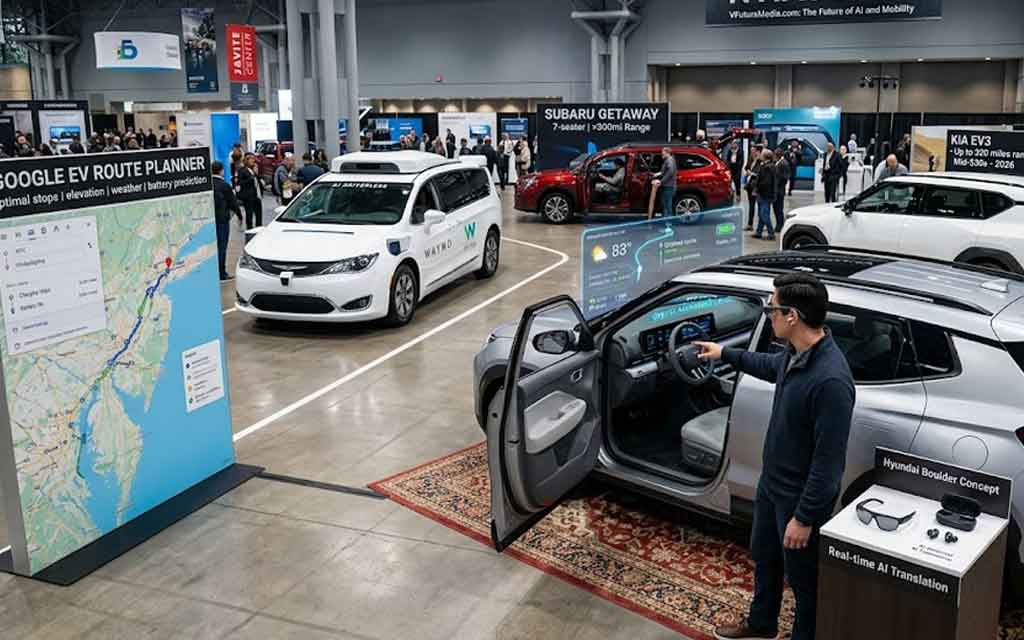
As artificial intelligence funding shattered records in Q1 2026 — with roughly $297–300 billion globally and ~80–81% ($239–242 billion) flowing to AI companies — the technology is rapidly moving from data centers into everyday gadgets and vehicles. Massive rounds for OpenAI ($122B), Anthropic ($30B), xAI ($20B), and Waymo ($16B) are fueling innovations that promise smarter cars, more intuitive wearables, and seamless integration between personal devices and mobility.
This convergence is already visible at the 2026 New York International Auto Show, where advanced driver assistance systems (ADAS), AI-enhanced route planning, and connected features took center stage alongside new EVs.
AI in Vehicles: From Route Planning to Advanced Autonomy
Google continues to expand its EV route planner within Android Auto, now supporting over 350 models. The AI-powered tool factors in real-time traffic, elevation changes, weather, and battery predictions to recommend optimal charging stops and estimate arrival battery levels — directly reducing range anxiety for EV drivers.
Fleet operators like DoorDash are integrating AI and autonomous elements, partnering on small delivery EVs and e-bikes that use smart routing to improve efficiency in last-mile logistics.
Meanwhile, Waymo’s $16 billion raise strengthens its robotaxi ambitions, pointing toward a future where AI handles more of the driving task in urban environments. Regulatory scrutiny continues, with ongoing NTSB reviews of systems like Ford’s BlueCruise highlighting the need for robust safety oversight as ADAS evolves.
Consumer Gadgets Meet Automotive AI
The broader AI gadget ecosystem is exploding with physical-world applications:
- Smart wearables and earbuds with real-time translation, health monitoring, and voice AI that can integrate with vehicle infotainment.
- AI-powered glasses and AR devices that could overlay navigation, hazard alerts, or vehicle status directly in the driver’s field of view.
- In-car AI assistants evolving beyond basic voice commands toward contextual awareness — adjusting climate, music, or routes based on driver mood, schedule, or energy levels.
These developments build on the massive compute investments announced this quarter, enabling edge AI (processing on-device) that keeps data private and responses fast even without constant cloud connectivity.
Supporting Mobility Trends in 2026
The gadget and auto AI push occurs against a backdrop of shifting EV adoption:
- Used EV sales surged nearly 30% in Q1 2026 (CarGurus), driven by national gas prices climbing above $4 per gallon. Average used EV prices around $28,000–$29,000 make electrification more accessible today.
- At NYIAS 2026, automakers highlighted practical new models:
- Kia EV3: Compact crossover with up to 320 miles range, fast charging, and expected mid-$30,000s pricing — arriving late 2026.
- Subaru Getaway: Three-row all-electric SUV with seating for seven, 420 horsepower, and over 300 miles range — Subaru’s fourth and most powerful EV.
- Hyundai Boulder Concept: Rugged body-on-frame off-road SUV preview, signaling adventure-focused future offerings.
Canada announced $10.6 million on April 8 for 14 EV charging projects adding over 1,600 new chargers, focusing on smaller communities to improve real-world usability.
Europe saw battery-electric vehicles reach an 18.8% market share in January–February 2026 (up from 15.2% the prior year), per ACEA data, with plug-in hybrids also gaining ground.
What This Means for Consumers in 2026
The intersection of AI gadgets and autos points to vehicles that are not just electric but increasingly intelligent — offering predictive maintenance, personalized experiences, and safer semi-autonomous driving. For gadget enthusiasts, expect tighter integration: your AI earbuds or glasses could seamlessly hand off navigation or alerts when you enter the car.
Challenges remain, including data privacy, over-reliance on AI, and ensuring these systems work reliably across diverse driving conditions. Yet the funding momentum suggests rapid progress.
At VFutureMedia.com, we’ll keep covering how AI transforms both personal gadgets and the broader mobility landscape — from in-car experiences to autonomous delivery solutions.
Which AI-powered gadget or vehicle feature are you most looking forward to in 2026? Do you see wearables and cars merging more closely? Share your thoughts in the comments.
Ethan Brooks is an independent U.S.-based journalist specializing in automotive technology, AI, sustainable mobility, and consumer gadgets. This article draws on publicly reported developments as of April 9, 2026, and is for informational purposes only.
Related Reading on VFutureMedia.com:
- Upcoming Affordable EVs 2026: Kia EV3, Subaru Getaway & More
- Q1 2026 VC Funding Explosion: AI Captures 80% of Record Raises
- Rising Gas Prices Push Used EV Sales Up Nearly 30%
Sources: Crunchbase, ACEA, CarGurus, Cox Automotive, Natural Resources Canada, Google, automaker statements from NYIAS 2026, and industry reports.




Leave a Comment