
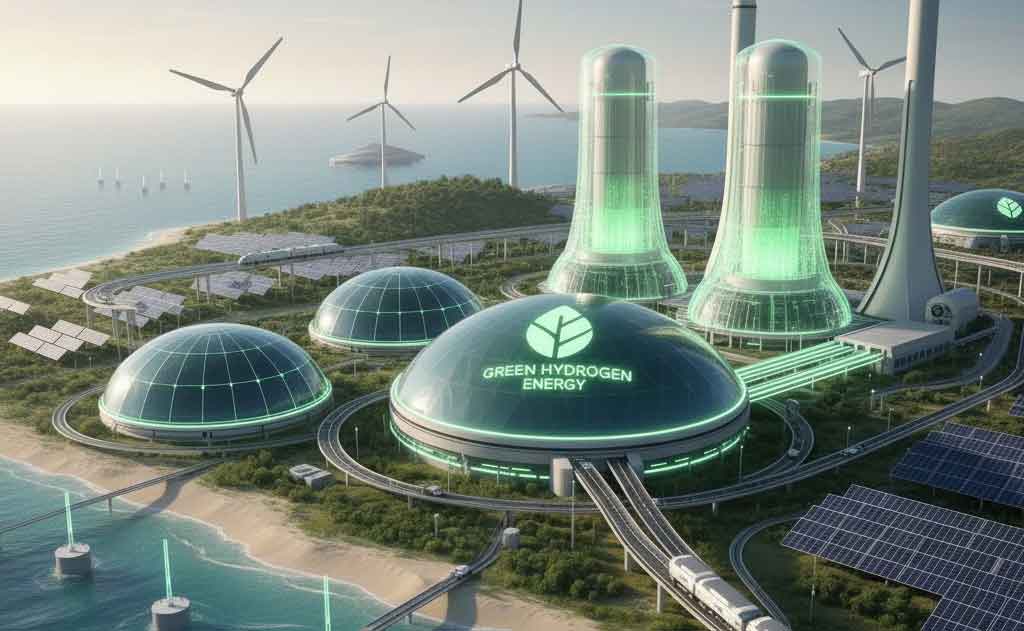
What if I told you there’s a fuel that leaves nothing behind but water vapor, can be made anywhere the sun shines or wind blows, and could replace fossil fuels in industries we thought were impossible to decarbonize?
Welcome to the world of green hydrogen energy—and the United States just bet billions that it’s about to transform everything.
While electric vehicles grab headlines and solar panels spread across rooftops, a quieter revolution is brewing in industrial parks, research labs, and government offices across America. Green hydrogen energy isn’t just another clean technology competing for attention. It’s the missing puzzle piece that could finally crack the code on truly zero-carbon industry, long-term energy storage, and energy independence.
The stakes? Only the future of how we make steel, grow food, store renewable energy, and power heavy transport. No pressure.
Here at VFutureMedia, we’re diving deep into why the U.S. government is pouring $9.5 billion into hydrogen hubs, how this invisible gas could decarbonize the hardest-to-clean industries, and whether green hydrogen energy lives up to the hype—or if it’s just hot air.
Spoiler alert: This is very, very real.
The Hydrogen Revolution Hiding in Plain Sight
Let’s start with something wild: hydrogen is already everywhere in our economy. Right now, industries consume about 90 million tons of hydrogen annually. It’s in the fertilizers growing your food, the gasoline refined for your car, and the chemicals making everything from plastics to pharmaceuticals.
The catch? Nearly all of it is “gray hydrogen”—extracted from natural gas in a process that belches out carbon dioxide like it’s going out of style. Which, actually, it is.
Green hydrogen energy flips this on its head with elegant simplicity: use renewable electricity to split water into hydrogen and oxygen. No carbon in, no carbon out. Just H₂O becoming H₂ and O₂, with water vapor as the only byproduct when you use it.
Think of it as capturing sunshine or wind in a bottle—a bottle you can store for months, ship across oceans, or use to make zero-carbon steel.
How Green Hydrogen Energy Actually Works
The magic happens in devices called electrolyzers, and understanding them is key to appreciating why green hydrogen energy is poised for explosive growth.
Picture this: electricity flows through water containing an electrolyte, splitting molecules apart. It’s high school chemistry meets industrial revolution.
Three types of electrolyzers are racing for dominance:
- Proton Exchange Membrane (PEM) Electrolyzers: The Formula 1 racers of hydrogen production. They’re fast, flexible, and can ramp up or down in seconds—perfect for pairing with intermittent solar and wind. When the sun comes out or wind picks up, PEM electrolyzers spring into action instantly.
- Alkaline Electrolyzers: The reliable workhorses. Older technology, but proven over decades. They’re cheaper and perfect for steady, large-scale production. Think of them as the pickup trucks of the hydrogen world—not flashy, but they get the job done.
- Solid Oxide Electrolyzers (SOEC): The efficiency champions operating at scorching temperatures (700-900°C). They’re the newest kids on the block but offer the highest efficiency, especially when integrated with industrial processes that generate waste heat.
The result? Pure hydrogen that can be compressed into tanks, liquefied for shipping, or converted into ammonia for easier handling—all without a single molecule of CO₂ escaping into the atmosphere if your electricity truly comes from renewables.
This is green hydrogen energy explained at its core: renewable power transformed into a clean fuel that can go places electricity can’t easily reach and do jobs batteries can’t handle.
Why America Is Going All-In: The $9.5 Billion Question
August 16, 2022, changed everything for green hydrogen energy in America.
That’s when President Biden signed the Inflation Reduction Act—the single largest climate investment in U.S. history. Hidden in its 750 pages was a weapon that could make green hydrogen competitive overnight: Section 45V, the Clean Hydrogen Production Tax Credit.
The deal is almost too good to be true: Produce the cleanest green hydrogen (less than 0.45 kg of CO₂ per kg of hydrogen), and the federal government hands you $3 per kilogram for 10 years.
Let’s put that in perspective. Gray hydrogen—the dirty stuff from natural gas—costs $1-2 per kilogram to make. Green hydrogen currently costs $3-8 per kilogram. That $3 tax credit? It’s not just an incentive. It’s a game-changer that makes green competitive or even cheaper than gray, immediately.
“This is the world’s most ambitious policy support for clean hydrogen,” energy analysts declared. They weren’t exaggerating.
The Hydrogen Hub Gold Rush
But the tax credits were just the opening act. The real drama came in October 2023, when the Department of Energy announced something unprecedented: $7-8 billion for seven Regional Clean Hydrogen Hubs scattered across America.
These aren’t just research projects. They’re industrial ecosystems designed to prove green hydrogen energy works at massive scale.
Meet the magnificent seven:
- ARCHES (California): $1.2 billion in federal funding, $12.6 billion total investment. Launching in 2025, focusing on heavy transport and renewable-powered production. If anyone can prove hydrogen works for trucks and ports, it’s California.
- Appalachian Hydrogen Hub: Leveraging the region’s energy expertise and infrastructure for industrial decarbonization. Coal country becoming hydrogen country—now that’s a transition story.
- Midwest Alliance for Clean Hydrogen: Targeting ammonia production and steel manufacturing across multiple states. The industrial heartland going green.
- HyVelocity (Gulf Coast): Using Texas’s renewable energy bounty and existing petrochemical infrastructure. Everything’s bigger in Texas, including hydrogen ambitions.
- Mid-Atlantic Clean Hydrogen Hub (MACH2): Connecting renewable production to the industrial Northeast corridor.
- Heartland Hydrogen Hub: Focusing on fertilizer production in America’s breadbasket.
- Pacific Northwest Hydrogen Hub: Leveraging hydropower for clean hydrogen production.
Combined with $750 million awarded in 2024 to 52 projects across 24 states for electrolyzer manufacturing and research, we’re talking about the largest coordinated push for a new energy technology since the Space Race.
The January 2025 Clarity Moment
On January 17, 2025, the Treasury and IRS finalized the rules for that $3/kg tax credit, and developers exhaled in relief.
The rules included flexibilities that matter: temporal matching requirements that make sense for real projects, pathways for existing nuclear power to qualify, and clear standards for what counts as “clean.” No more guessing games—project developers finally had the certainty needed to secure billions in financing.
Investment floodgates opened. Construction timelines accelerated. The green hydrogen energy revolution moved from “someday” to “right now.”
The Industrial Revolution 2.0: Why Green Hydrogen Changes Everything
Here’s where green hydrogen energy gets really interesting—and where the billions in investment start making sense.
The Battery Problem Nobody Talks About
Electric vehicles are brilliant for cars. Solar panels are perfect for homes. Batteries are getting better every year. But ask any industrial engineer how to make steel, cement, or ammonia with electricity alone, and you’ll get a long, uncomfortable silence.
Some things just can’t be electrified. Not easily. Not affordably. Not yet.
Steel production? Needs intense heat and chemical reactions that batteries can’t provide.
Fertilizer manufacturing? Requires hydrogen as a chemical feedstock—not just energy, but actual H₂ molecules.
Seasonal energy storage? Batteries are fantastic for hours or days, but storing summer sunshine for winter heating? The cost becomes astronomical.
This is where green hydrogen energy becomes the superhero nobody knew we needed.
Reinventing Steel: The $500 Billion Industry Going Green
Steel production is responsible for 7-9% of global CO₂ emissions—more than all cars in Germany, France, and the UK combined. The problem? For over a century, we’ve made steel basically the same way: blast furnaces using coke (baked coal) to chemically reduce iron ore, releasing torrents of CO₂ in the process.
Green hydrogen energy offers a stunning alternative called Hydrogen Direct Reduction of Iron (H-DRI).
Here’s how the revolution works:
Instead of using carbon (coke) to strip oxygen from iron ore, use hydrogen. The chemical reaction is beautifully simple:
Fe₂O₃ (iron ore) + H₂ (hydrogen) → Fe (iron) + H₂O (water vapor)
No coal. No carbon. Just iron and steam.
The resulting “sponge iron” gets melted in electric arc furnaces powered by renewables, and boom—you’ve got zero-carbon steel.
This isn’t science fiction. It’s happening:
- HYBRIT in Sweden delivered the world’s first fossil-free steel to Volvo in 2021. Swedish quality, now with a clear conscience.
- H2 Green Steel is building a massive plant in northern Sweden targeting 5 million tons annually by 2030—steel that could carry a “made with 95% less CO₂” label.
- U.S. hydrogen hubs are planning similar facilities, potentially creating a domestic “green steel” industry that could compete globally while slashing emissions.
With the IRA’s $3/kg hydrogen credit, American green steel could undercut imports while claiming the environmental high ground. That’s not just good policy—it’s good business.
Feeding the World Without Cooking the Planet
Let’s talk about something most people never think about: how we make fertilizer.
The Haber-Bosch process—combining hydrogen with nitrogen to create ammonia—is arguably the most important invention of the 20th century. It’s estimated that half the nitrogen in your body came from synthetic fertilizers, making this process literally responsible for feeding 4 billion people.
The problem? The Haber-Bosch process consumes 2% of the world’s energy and produces 1-2% of global CO₂ emissions. The culprit? That hydrogen comes from natural gas.
Green hydrogen energy offers a zero-carbon alternative: green ammonia.
Use renewable electricity to make green hydrogen, combine it with nitrogen from the air (which is 78% nitrogen anyway), and produce ammonia without any fossil fuels. The process itself is a century old—we’re just swapping the hydrogen source.
Why this matters more than you think:
- Food security without emissions: Keep feeding the world while cutting carbon.
- Ammonia as hydrogen carrier: Pure hydrogen is tricky to transport and store. Ammonia is easier—we’ve been shipping it globally for decades. Make green hydrogen, convert it to ammonia, ship it anywhere, and convert it back if needed. Or just use it as fertilizer.
- Export opportunity: Countries with abundant renewables (hello, sunny and windy America) could become major ammonia exporters.
The Heartland Hydrogen Hub is targeting exactly this: turning America’s Corn Belt into a green ammonia powerhouse.
Beyond Steel and Fertilizer: The Industrial Transformation
Green hydrogen energy doesn’t stop there. It’s coming for:
- Oil refining: Currently uses 40 million tons of gray hydrogen annually for removing sulfur and cracking crude oil. Swap it for green, and you’ve decarbonized a major emissions source.
- Chemical production: Methanol, plastics, pharmaceuticals—many need hydrogen as a feedstock.
- Cement and glass: Industries requiring intense heat that’s hard to electrify could use hydrogen burners.
- Heavy transport: Fuel cells for long-haul trucks, ships, trains, and potentially aviation (via synthetic e-fuels made from green hydrogen and captured CO₂).
Essentially, green hydrogen energy can reach the parts of the economy that electricity alone struggles with—roughly 20-30% of global emissions that are considered “hard to abate.”
The Secret Superpower: Energy Storage at Civilization Scale
Solar and wind power have one frustrating limitation: they’re intermittent. The sun doesn’t shine at night. Wind doesn’t blow on schedule. And seasonal variations mean summer sun can’t directly heat winter homes.
Batteries solve this brilliantly for hours to days. Tesla Powerwalls and grid-scale lithium batteries are changing how we use electricity. But try storing summer energy for winter, and batteries hit a wall—literally, the cost wall.
Enter green hydrogen energy as the ultimate long-duration storage solution.
How Hydrogen Becomes a Battery
The concept is ingenious in its simplicity:
- Excess renewable power? Fire up electrolyzers and make hydrogen.
- Store it: In tanks, pipelines, or underground caverns. Salt domes (like those in Texas and Utah) can hold gigawatt-hours of energy as compressed hydrogen.
- Need power later? Run hydrogen through fuel cells to generate electricity, or burn it in turbines. Or skip the conversion and use it directly in industry.
The Advanced Clean Energy Storage project in Utah is showcasing this brilliantly: massive salt caverns storing hydrogen for seasonal shifting. Produce hydrogen in summer when solar is abundant, store it underground, and extract it in winter when heating demand peaks.
Why Hydrogen Beats Batteries for Long-Duration Storage
Cost scaling: For 4-hour storage, batteries win. For 100-hour storage, hydrogen becomes dramatically cheaper. For seasonal storage (thousands of hours), batteries aren’t even in the conversation.
Energy density: Hydrogen contains 33.3 kWh per kilogram (as opposed to around 0.25 kWh/kg for lithium batteries). You can store massive amounts of energy in relatively small spaces.
No exotic materials: Lithium, cobalt, and other battery materials have supply constraints and geopolitical issues. Hydrogen needs water and renewable electricity—both abundant.
Scalability: Want to store a terawatt-hour? Build bigger caverns. With batteries, you’d need to mine and process millions of tons of materials.
As grids approach 50-80% renewable penetration, green hydrogen energy storage could provide the “firming capacity” needed to reach 100% clean power. It’s the missing link between ambitious renewable targets and actual grid reliability.
The Reality Check: Challenges That Need Solving
Let’s be honest: if green hydrogen energy were perfect, we’d already be using it everywhere. Several real challenges stand between today’s promise and tomorrow’s hydrogen economy.
The Cost Curve Battle
Current reality: Green hydrogen costs $3-8 per kilogram depending on location and renewable electricity prices. Gray hydrogen? $1-2 per kilogram.
The $3/kg tax credit helps enormously, but the industry needs to hit the DOE’s “Hydrogen Shot” goal: $1 per kilogram by 2030 for truly unsubsidized competitiveness.
Getting there requires:
- Cheaper electrolyzers (currently $500-1,500/kW, targeting $200/kW)
- Lower renewable electricity costs (already dropping fast)
- Mass production economies of scale
- Technology improvements in efficiency
The good news? This trajectory is realistic. Solar costs dropped 90% in a decade. Electrolyzers are following similar learning curves.
The Efficiency Question
Let’s talk numbers: Electrolysis is 70-80% efficient. Not bad. But if you’re using hydrogen for electricity (via fuel cells or turbines), round-trip efficiency drops to 30-50%. Compare that to batteries at 85-95% round-trip efficiency.
The counterargument: For applications where hydrogen is the chemical feedstock (steel, ammonia, refining), efficiency is less relevant—you need the H₂ molecules, not just energy. And for seasonal storage, 40% efficiency beats impossible economics from batteries.
Still, efficiency losses matter and drive ongoing research into better electrolyzers and fuel cells.
Water: The Resource Everyone Forgets
Making one kilogram of hydrogen requires about 9 liters of pure water. At massive scales, this adds up—particularly concerning in water-stressed regions like the Southwest U.S.
The perspective: 9 liters sounds like a lot until you compare it to:
- Growing almonds: 12 liters per almond
- Beef production: 15,000 liters per kilogram
- Many thermoelectric power plants: billions of gallons for cooling
Plus, hydrogen use releases water vapor, completing the cycle. Still, siting decisions matter—coastal electrolysis with desalination might make more sense than desert facilities.
Infrastructure: Building the Hydrogen Highway
Currently, hydrogen infrastructure is scattered and limited. Scaling green hydrogen energy requires:
- Pipelines: New dedicated lines or converted natural gas pipes (hydrogen embrittlement is a technical challenge)
- Storage facilities: Compressed gas tanks, liquid hydrogen terminals, or underground caverns
- Refueling stations: Especially for transport applications
- Safety systems: Hydrogen is highly flammable; detection and handling protocols are critical
The investment needed runs into hundreds of billions globally. The hubs approach helps by creating regional ecosystems where infrastructure can grow organically.
Supply Chain Constraints
Some electrolyzer types (particularly PEM) need rare materials like iridium and platinum. At gigawatt scales, this could become a bottleneck.
The solution pipeline:
- Alternative electrolyzer designs using abundant materials
- Recycling programs for precious metals
- Alkaline and solid oxide options that don’t need rare materials
The DOE’s $750 million for electrolyzer manufacturing specifically targets these supply chain issues.
The Global Race: Who’s Winning the Hydrogen Revolution?
The United States isn’t alone in betting big on green hydrogen energy—it’s part of a global stampede.
Europe’s massive push: The REPowerEU plan targets 10 million tons of domestic green hydrogen by 2030, plus 10 million tons of imports. Countries like Germany, Netherlands, and Spain are building pipelines and industrial clusters. The EU sees hydrogen as essential for both climate goals and energy independence from Russian gas.
Australia’s export ambitions: Blessed with massive land, sunshine, and wind, Australia is positioning itself as the “Saudi Arabia of green hydrogen.” Projects like the Asian Renewable Energy Hub aim to produce millions of tons for export to Japan, Korea, and beyond.
Middle East’s pivot: Saudi Arabia and UAE are investing billions to transition from oil/gas exporters to green hydrogen exporters. Neom’s $8.4 billion green hydrogen plant is one of the world’s largest.
China’s industrial focus: Targeting 100,000-200,000 tons of green hydrogen annually by 2025, focusing on industrial decarbonization.
The U.S. advantage? Abundant renewables, technological leadership, the IRA’s unmatched incentives, and the hub strategy creating multiple regional centers of excellence. Plus, as the world’s largest economy, domestic demand alone could sustain a major hydrogen industry.
This is shaping up as a clean energy space race, with tens of billions in national prestige and economic leadership at stake.
What Happens Next: The 2025-2030 Hydrogen Timeline
Right now (2025): Hub projects break ground, first IRA tax credit claims filed, electrolyzer factories under construction, major demonstrations beginning.
2026-2027: First hub-scale production facilities come online, green steel and green ammonia pilots prove commercial viability, costs continue dropping as scale increases.
2028-2029: Multiple hubs operational, infrastructure networks expanding, export markets developing, green hydrogen reaching $2/kg production costs in best locations.
2030 milestone: Projections suggest the U.S. could produce 10 million tons of clean hydrogen annually, employing hundreds of thousands in manufacturing, construction, and operations. Green hydrogen could supply 10-20% of energy needs in key sectors.
Beyond 2030: If successful, green hydrogen energy becomes embedded in the global economy—as common as natural gas is today but without the emissions. The technology proven, costs competitive, infrastructure built, and new applications constantly emerging.
The VFutureMedia Bottom Line: Hype or Reality?
We’ve seen countless “next big thing” energy technologies fizzle. Remember cellulosic ethanol? Algae biofuels? Cold fusion?
So is green hydrogen energy different?
The verdict: This is real, but it’s not magic.
Green hydrogen won’t replace batteries for cars or solar panels for homes. It won’t solve every energy problem. And the challenges we’ve outlined—cost, efficiency, infrastructure—are genuine hurdles requiring years of hard work and continued investment.
But here’s what makes this different:
Proven technology: Electrolysis has existed for 200+ years. Fuel cells are mature. We’re scaling, not inventing.
Real demand: 90 million tons of hydrogen used today, with built-in customers if we can make it green. Unsolvable problems elsewhere: Some industries genuinely can’t decarbonize any other way. Hydrogen isn’t optional—it’s necessary.
Policy commitment: $9.5 billion isn’t a pilot project. It’s a bet-the-farm commitment from the U.S. government, with bipartisan infrastructure and tax code backing.
Economic logic: With subsidies bridging the cost gap while scale and technology improvements kick in, there’s a clear path to competitiveness.
Global momentum: When the U.S., EU, China, Australia, and Middle East are all investing tens of billions simultaneously, something fundamental is shifting.
The smart take: Green hydrogen won’t do everything, but it will do critical things nothing else can do as well. For hard-to-abate industries, long-duration storage, and energy security, it’s not hype—it’s essential infrastructure for a zero-carbon economy.
Why This Matters to You
You might not work in steel production or fertilizer manufacturing. You might never fill up a hydrogen truck. But green hydrogen energy will still impact your life:
Lower emissions: Even if invisible to you, cleaner steel in buildings, zero-carbon fertilizers growing food, and decarbonized industrial zones mean cleaner air and slower climate change.
Jobs: The DOE estimates hundreds of thousands of jobs in manufacturing, construction, and operations—many in regions that need economic transition.
Energy security: Domestic hydrogen production means less dependence on global fossil fuel markets and their price swings.
Innovation spillovers: Technologies developed for hydrogen (advanced materials, efficient electrolysis, fuel cells) find applications elsewhere.
Grid stability: Hydrogen storage helping integrate renewables means more reliable electricity for everyone.
The clean energy revolution isn’t just solar panels you can see on rooftops. Much of it happens in industrial parks, underground caverns, and chemical plants—invisible infrastructure that makes modern life possible without cooking the planet.
The Final Word: Watching History Happen
We’re living through an energy transition that future historians will analyze for centuries. The move from wood to coal took 100 years. Coal to oil took 50 years. The transition to clean energy is attempting to happen in 30 years—an almost impossible timeframe.
Green hydrogen energy is a critical piece of that puzzle. Not the only piece, but an irreplaceable one.
The U.S. government’s $9.5 billion bet, the private sector’s matching investments, and the global race to secure leadership position tell you everything you need to know about where this is heading.
Seven hubs will rise across America in the next five years. Electrolyzers will roll off new factory lines. The first tons of green steel will bear “Made in the USA with zero carbon” stamps. Salt caverns in Utah will store energy from summer to winter. And slowly, invisibly, the emissions from some of our dirtiest industries will start dropping.
It won’t happen overnight. There will be setbacks, failed projects, and technical challenges nobody saw coming. But the direction is clear, the investment is real, and the technology is ready.
Green hydrogen energy isn’t just another clean tech story. It’s the industrial revolution running in reverse—taking the emissions out while keeping the civilization-building productivity in.
And that’s a future worth betting on.
Stay tuned to VFutureMedia for ongoing coverage of the hydrogen revolution, from hub groundbreakings to technology breakthroughs. The future is being built now—and we’ll be there to document it.
I’m Ethan, and I write about the tech that’s actually going to change how we live — not the stuff that just sounds impressive in a press release. I cover AI, EVs, robotics, and future tech for VFuture Media. I was on the ground at CES 2026 in Las Vegas, walking the show floor so I could give you a real read on what matters and what’s just noise. Follow me on X for daily takes.



Leave a Comment