
Published: April 14, 2026 By: Ethan Brooks, Senior AI & Cybersecurity Analyst, VFuture Media Ethan Brooks has 9+ years of experience analyzing frontier AI models and their enterprise security implications. He previously led threat intelligence at a major US fintech firm and regularly advises CXOs on AI-driven cyber risks and responsible AI deployment.
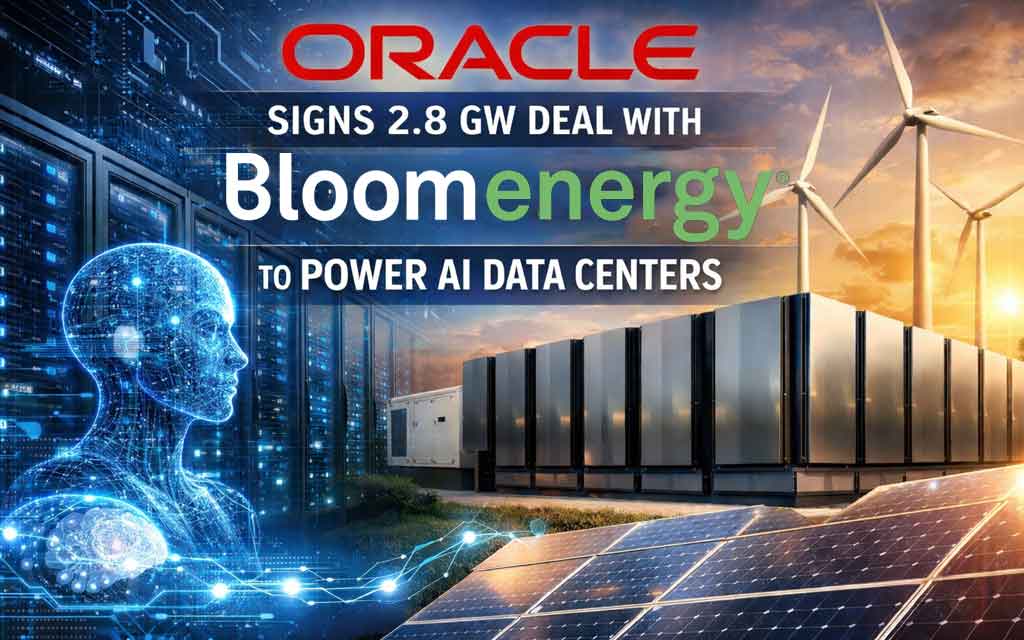
JUST IN: Oracle has dramatically expanded its strategic partnership with Bloom Energy, agreeing to procure up to 2.8 gigawatts (GW) — or 2,800,000,000 watts — of Bloom’s solid oxide fuel cell systems to accelerate its AI and cloud computing infrastructure buildout.
Under a new master services agreement announced on April 13, 2026, an initial 1.2 GW of capacity has already been contracted, with deployment already underway across multiple Oracle projects in the United States and continuing into 2027.
This represents one of the largest commercial fuel cell commitments in the data center sector to date and underscores the growing urgency for onsite power generation as traditional grid infrastructure struggles to keep pace with explosive AI demand.
At VFuture Media — your hub for AI, future tech, synthetic media, and the infrastructure powering the next wave of intelligent applications — this deal is a clear signal that energy innovation is now as critical as model architecture for AI progress.
Deal Breakdown: Scale, Timeline & Key Details
| Aspect | Details |
|---|---|
| Maximum Capacity | Up to 2.8 GW (2,800 MW) |
| Initial Contracted Capacity | 1.2 GW |
| Deployment Status | Underway across U.S. Oracle projects |
| Timeline | Initial phase 2026–2027 |
| Technology | Bloom Energy Solid Oxide Fuel Cells (SOFC) |
| Purpose | Primary power for AI & cloud infrastructure |
Scale perspective: 2.8 GW is enough electricity to power roughly 2.1 million average U.S. households simultaneously — all dedicated to Oracle’s high-performance AI workloads.
Why Fuel Cells Are the Go-To Solution for AI Data Centers in 2026
AI training and inference clusters are among the most power-intensive workloads ever created. A single large AI campus can demand hundreds of megawatts of constant, reliable electricity. Grid interconnection delays often stretch 3–7 years in many regions, creating a major bottleneck for hyperscalers.
Bloom Energy’s solid oxide fuel cell systems address these challenges head-on with:
- Ultra-fast deployment — Operational in months, not years (previous Oracle deployments achieved power in as little as 55–90 days).
- High reliability & uptime — Up to 99.999% availability with modular, load-following design perfectly suited for variable AI compute demands.
- Superior efficiency — ~55–60% electrical efficiency, significantly better than many traditional generators.
- Lower emissions & fuel flexibility — Cleaner than grid power in many regions when running on natural gas; fully hydrogen-ready for near-zero carbon operation in the future.
- Small footprint & high power density — Ideal for dense AI data center environments.
Oracle’s move signals that leading cloud providers are now treating onsite generation as a strategic competitive advantage rather than just backup power.
What This Means for the Future of AI Infrastructure
This partnership highlights several defining 2026 trends:
- Onsite & distributed power is going mainstream for AI factories.
- Time-to-power has become the #1 constraint for data center expansion — even ahead of chips in some cases.
- Fuel cells serve as a practical bridge between today’s energy reality and tomorrow’s fully renewable/hydrogen future.
- Hyperscalers are vertically integrating energy strategy to maintain speed and resilience in the AI race.
For Oracle Cloud Infrastructure (OCI) customers — including enterprises building large-scale AI applications — this translates to faster availability of reliable, high-performance compute resources.
Implications for Creators, Developers & AI-Powered Media
At VFuture Media, we track this space closely because the future of synthetic media, AI video generation, large-scale model training, and intelligent content creation depends entirely on abundant, reliable compute power.
This deal means:
- More stable and scalable AI cloud capacity from Oracle.
- Reduced risk of power-related delays for AI infrastructure projects.
- A model other cloud providers and AI companies are likely to follow.
Energy breakthroughs like this will directly accelerate innovation in the tools and platforms we cover every week.
5 Actionable Takeaways for AI & Data Center Leaders
- Prioritize power planning early — Evaluate onsite generation during site selection and RFP stages.
- Consider fuel cells for projects needing power in under 18 months.
- Factor total cost of ownership — Include avoided grid delay costs and opportunity losses from delayed AI rollout.
- Build fuel flexibility into your strategy — Systems that can transition to biogas or green hydrogen offer long-term advantages.
- Monitor the broader energy-AI ecosystem — Onsite solutions are evolving rapidly and becoming table stakes for competitive AI infrastructure.
FAQ
Q1: How much power is 2.8 GW in real-world terms? A: Enough to supply electricity to approximately 2.1 million U.S. households — or support thousands of high-density AI GPU racks continuously.
Q2: Are these fuel cells only for backup power? A: No. Bloom Energy systems are being deployed as primary, baseload power sources for Oracle’s AI data centers.
Q3: When will the initial 1.2 GW come online? A: Deployment is already underway and will continue through 2026 into 2027.
Q4: How sustainable are Bloom Energy fuel cells? A: They offer higher efficiency and lower emissions than many traditional sources today and are designed to run on 100% hydrogen or renewable biogas in the future.
How VFuture Media Helps You Navigate the AI Infrastructure Era
We don’t just report on frontier AI — we help businesses understand the full stack, including the energy systems that make it possible.
Whether you need:
- Insights on AI power strategy and sustainable infrastructure
- Guidance on emerging energy technologies for compute-intensive workloads
- Or simply the latest analysis on how AI infrastructure is evolving
…our team is here to keep you ahead.
Ready to future-proof your AI strategy? Download our free 2026 AI Data Center Energy Guide or contact us at business@vfuturemedia.com for custom briefings.
Final Thoughts
Oracle’s massive 2.8 GW fuel cell commitment with Bloom Energy confirms what we’ve been saying for months: the winners in the AI race will be those who solve the energy problem fastest and smartest. Onsite power generation using advanced fuel cells is rapidly moving from niche innovation to core infrastructure strategy.
Stay ahead with VFuture Media. Subscribe for weekly insights on AI, future tech, synthetic media, energy innovation, and the infrastructure powering tomorrow’s intelligent world. Follow us on Instagram @vfuturemedia and drop your thoughts in the comments below.
Sources :
- Bloom Energy Official Press Release (April 13, 2026)
- Oracle & Bloom Energy Joint Partnership Announcement
- Bloomberg, Reuters, Business Wire, and Seeking Alpha reporting (April 13–14, 2026)
Share this post with your AI or infrastructure team. What’s your biggest takeaway from this deal? We read every comment.




Leave a Comment