
By VFuture Media Team | April 18, 2026
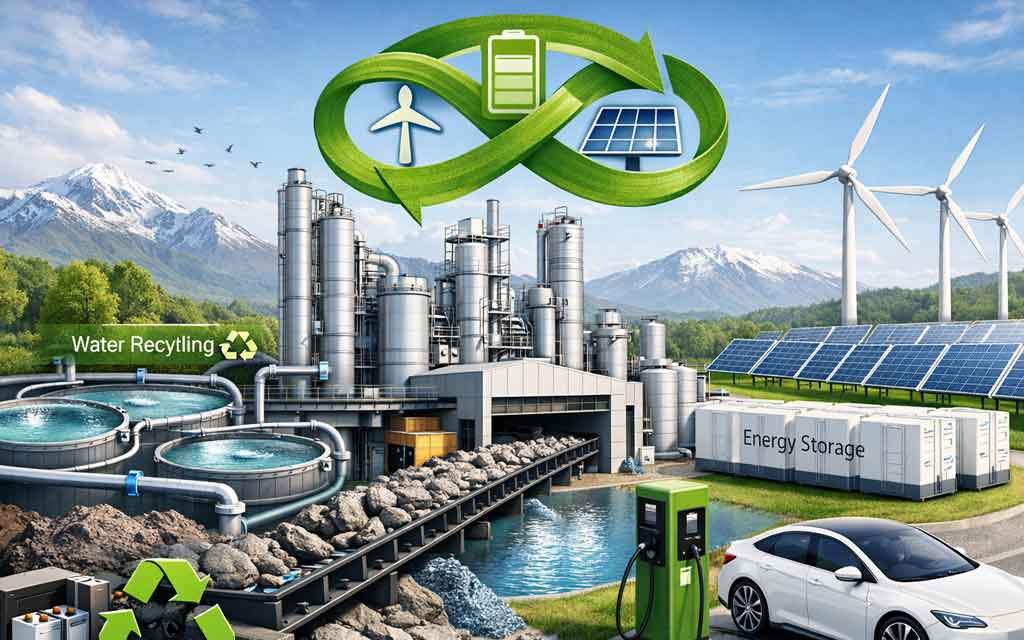
The future of electric vehicles and energy storage depends on cleaner, more sustainable lithium production. Traditional hard rock lithium refining relies on acid-intensive processes that generate hazardous waste and high emissions. Our advanced lithium refinery changes that with acid-free refining, dramatically lower carbon emissions, full water recycling, and a safe, usable coproduct — all designed to close the loop in America’s domestic battery supply chain.
At VFuture Media, we cover the technologies powering the clean energy transition. This refinery represents a major step forward for sustainable lithium processing in North America, reducing environmental impact while securing critical materials for EVs, grid storage, and beyond.
Why Traditional Hard Rock Lithium Refining Falls Short
Hard rock lithium (primarily from spodumene ore) is energy-intensive to refine. Conventional methods often involve high-temperature acid roasting with sulfuric acid, producing significant CO₂ emissions and problematic byproducts like sodium sulfate waste.
Hard rock-derived lithium chemicals can have a carbon footprint over three times higher than brine sources in some cases, with refining stages contributing the majority of emissions. These processes also consume large volumes of water and generate waste that requires careful management or disposal.
In a world racing toward electrification, scaling lithium production sustainably is essential — and that’s exactly what our refinery achieves.
Our Lithium Refinery: Designed for a Much Lower Carbon Footprint
Our refinery is engineered from the ground up to outperform traditional hard rock facilities:
- Significantly lower carbon emissions — By optimizing the process and eliminating unnecessary steps, the facility achieves a substantially reduced carbon footprint compared to conventional hard rock refineries (reportedly up to 34% lower in some comparisons due to streamlined operations).
- Acid-free refining technology — No hazardous acids are used in the core refining process. This innovation avoids toxic chemical inputs and eliminates the formation of problematic acidic waste streams common in legacy methods.
The result? Cleaner production of battery-grade lithium hydroxide or carbonate with a smaller climate impact, supporting the goal of truly low-emission electric vehicles from mine to wheel.
Acid-Free Refining Produces a Safe, Valuable Coproduct
One of the biggest environmental wins is the byproduct itself. Traditional acid-based processes often create hazardous or difficult-to-manage waste. Our acid-free approach generates a safe, inert coproduct — typically a benign mixture resembling sand and limestone (such as analcime or similar aluminosilicates).
This coproduct is not waste: it can be repurposed in construction materials like concrete. Instead of disposal costs and landfill burdens, we turn what was once a liability into a useful resource. This circular design reduces overall waste and creates additional value in the supply chain.
Water Recycling: Every Drop Treated and Cleaned On-Site
Water scarcity is a major concern in mineral processing. Our refinery incorporates advanced closed-loop water systems:
- Water is recycled throughout every stage of production.
- Every drop is treated and cleaned on-site using state-of-the-art filtration and purification technologies.
- This minimizes freshwater withdrawal and ensures no contaminated water leaves the facility.
By maximizing water reuse, the refinery dramatically cuts consumption compared to traditional operations, making it more resilient and environmentally responsible — especially important in water-stressed regions.
Closing the Loop: Lithium in a Domestic Battery Supply Chain
Our refinery isn’t just about producing new lithium — it’s designed to close the loop for lithium in the battery ecosystem:
- It supports vertical integration by refining raw materials closer to battery manufacturing hubs.
- The process aligns with battery recycling streams, enabling recovered lithium from end-of-life EV batteries or production scrap to be efficiently reintroduced into high-purity battery-grade materials.
- This creates a more circular, secure, and domestic supply chain — reducing reliance on overseas refining (often in Asia) and shortening transportation distances.
In short, lithium extracted, refined, used in batteries, recycled, and refined again — minimizing new mining needs over time and strengthening America’s energy independence.
Key Benefits of Our Sustainable Lithium Refinery
- Lower environmental impact — Reduced CO₂, no acid waste, safe coproducts, and near-zero water discharge.
- Higher sustainability standards — Meets growing demands from automakers, governments, and consumers for responsibly sourced battery materials.
- Economic advantages — Efficient process with fewer steps, potential revenue from coproducts, and support for domestic jobs in clean tech manufacturing.
- Scalable for the EV boom — Helps supply the lithium needed for millions of electric vehicles while keeping the carbon intensity in check.
The Road Ahead: Sustainable Lithium for a Cleaner Future
As EV adoption accelerates and global lithium demand surges, innovations like acid-free refining, on-site water treatment, and circular design are no longer optional — they’re essential. Our lithium refinery demonstrates that high-volume production of critical battery materials can be cleaner, smarter, and more integrated into a true closed-loop system.
This approach not only lowers the carbon footprint of hard rock lithium processing but also sets a new benchmark for responsible mineral refining worldwide.
Ready to dive deeper into the technologies powering the energy transition? At VFuture Media, we explore lithium supply chains, battery recycling, EV innovation, and sustainable manufacturing. Subscribe for more insights and share this post if you believe in building a greener battery future.
Keywords: acid-free lithium refining, sustainable lithium refinery, low carbon footprint lithium, water recycling lithium production, closed loop battery supply chain, Tesla lithium refinery, hard rock lithium processing, eco-friendly lithium hydroxide
What do you think about acid-free lithium refining? Could innovations like this accelerate the clean energy transition while protecting the environment? Share your thoughts in the comments below!
This post is for informational purposes. All claims reflect the described design features of the refinery. For the latest updates, follow developments in North American lithium processing.


Leave a Comment