
By VFuture Media Team | April 18, 2026
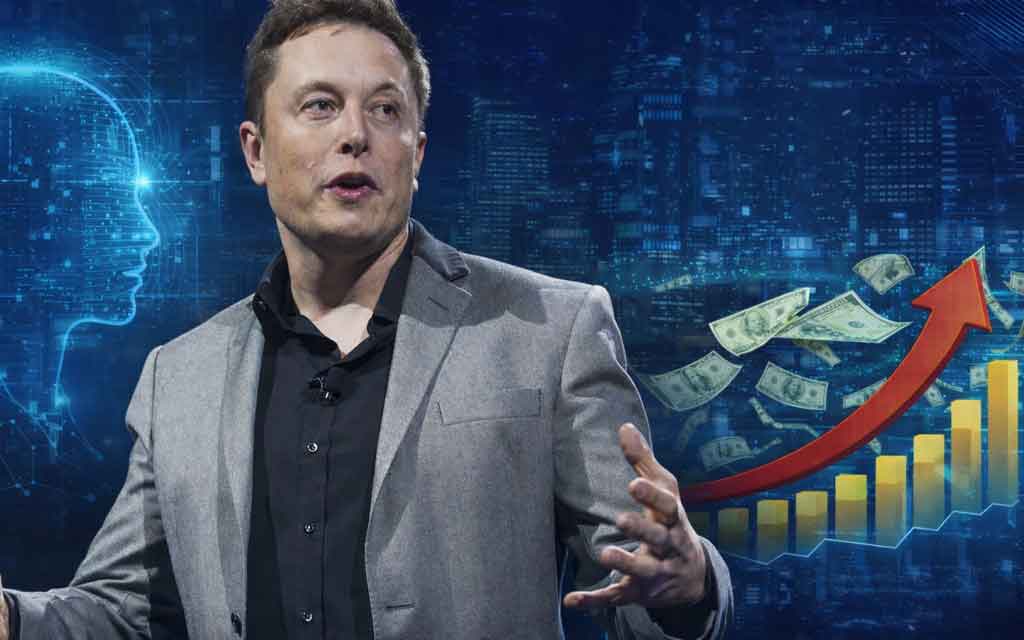
Is America ready for a future where AI and robotics replace millions of jobs? Elon Musk thinks the answer is Universal High Income (UHI) — direct monthly checks from the federal government to every American.
In a viral X post on April 17, 2026, the Tesla and xAI founder stated: “Universal HIGH INCOME via checks issued by the Federal government is the best way to deal with unemployment caused by AI. AI/robotics will produce goods & services far in excess of the increase in the money supply, so there will not be inflation.”
At VFuture Media, we explore the cutting-edge intersection of AI, robotics, and the American economy. This isn’t just another UBI debate — it’s Universal High Income, a step beyond basic survival payments toward shared prosperity in an age of abundance. Could federal checks become the smartest policy response to technological unemployment? Let’s break it down for American workers, families, and policymakers.
What Is Universal High Income (UHI) and How Does It Differ from UBI?
Traditional Universal Basic Income (UBI) provides a modest safety net — think Andrew Yang’s $1,000/month “Freedom Dividend.” Universal High Income (UHI) goes further, aiming for payments high enough to maintain a comfortable standard of living without traditional work.
Musk’s vision positions UHI as a direct federal payout funded through expanded money supply, not new taxes alone. In an AI-driven economy, these checks would let Americans benefit from the massive productivity gains of automation rather than compete against it.
For Americans, this means potential monthly deposits straight to bank accounts (like the COVID-era stimulus checks, but permanent and larger). No means-testing. No work requirements. Just guaranteed high income in exchange for letting AI and robots handle the heavy lifting.
The Looming AI Unemployment Crisis Facing American Workers
AI and robotics are already transforming U.S. industries:
- Manufacturing, trucking, retail, customer service, coding, graphic design, and even professional services face automation risks.
- Forecasts suggest 10–25% of current tasks could be automated in the coming decade, potentially displacing millions of jobs.
Unlike past industrial revolutions, AI doesn’t just augment — it replaces cognitive and physical labor at unprecedented speed and scale. Entire job categories could shrink dramatically, leaving millions of skilled American workers searching for new purpose.
Without intervention, this could spike unemployment, widen inequality, and strain social safety nets. Musk argues traditional retraining won’t scale fast enough. UHI offers a proactive bridge — giving people financial security while society transitions to an abundance economy.
Why AI/Robotics Could Prevent Inflation: The Productivity Explosion Argument
Here’s the core of Musk’s claim that makes economists take notice: AI and robotics will create far more goods and services than the extra money printed to fund UHI.
- Supply surges ahead of demand. Automated factories, self-driving fleets, AI-powered farms, and energy systems can produce at near-zero marginal cost. Prices for essentials (food, housing materials, transportation, healthcare) could actually fall (deflationary pressure).
- Money supply increase is dwarfed. Even if the Federal Reserve expands the money supply to issue checks, the real output boom from AI/robotics outpaces it. More stuff chasing the same (or slightly more) dollars keeps prices stable.
Think of it like this: during the Industrial Revolution, machines lowered costs dramatically while wages eventually rose. In the AI era, robots do the work — and UHI ensures every American gets a share of the windfall. No scarcity-driven inflation. Instead, an era of post-scarcity abundance.
Critics (including some economists) worry that relative price distortions or uneven sectoral growth could still cause localized inflation. But Musk and abundance optimists counter that the sheer scale of AI productivity gains changes the game entirely.
Key Benefits of Universal High Income for America
- Protects Workers and Families — No more fear of sudden job loss. Americans could pursue education, entrepreneurship, caregiving, or creative passions.
- Boosts Consumer Spending — High-income households spend on goods and services, fueling the very economy AI is supercharging.
- Reduces Poverty and Inequality — Direct federal checks cut bureaucracy compared to fragmented welfare programs.
- Encourages Innovation — With basic (and high) needs met, more people experiment, start businesses, or contribute to community projects.
- Prepares for Abundance — In a world where robots handle 80–90% of production, UHI becomes the fair way to distribute the gains of American ingenuity.
Challenges, Criticisms, and Realistic Concerns
No major policy is without pushback:
- Cost and Funding — Trillions annually. Even with productivity gains, transitioning requires careful monetary policy.
- Work Incentives — Will “high income” reduce motivation? Proponents say humans crave purpose beyond paychecks; critics fear labor shortages in essential non-automated roles.
- Inflation Risk (The Counter-Argument) — If supply doesn’t ramp up as fast as hoped, or if spending concentrates in non-automatable sectors (like housing or experiences), prices could rise.
- Political and Implementation Hurdles — Passing such a program in Congress would be monumental. Means-testing debates and “who pays” questions remain.
Some analysts argue AI won’t eliminate all jobs — it will create new ones in AI oversight, creative fields, and human-centric services. Others see UHI as a temporary bridge, not a permanent replacement for work.
Discussion: Is UHI the Best Path Forward for Americans?
Pros outweigh the cons in a true abundance scenario: shared prosperity, reduced stress, and a cultural shift toward meaning over mere survival.
Cons center on execution — getting the timing and scale right matters. If AI productivity explodes as Musk predicts, UHI could be transformative. If gains are slower or unevenly distributed, it risks fiscal strain.
Alternatives worth debating:
- Taxing AI/robotics profits to fund UHI.
- Massive public investment in reskilling and new industries.
- Shorter workweeks combined with targeted support.
- Public wealth funds (as suggested by some AI leaders).
What do you think? Should the U.S. government start piloting Universal High Income checks now? Would you accept a high monthly federal payment in exchange for an AI-powered future of abundance? Drop your thoughts in the comments below — this is the conversation America needs to have.
The Future Looks Abundant — If We Choose Wisely
AI and robotics aren’t coming — they’re here. At VFuture Media, we believe technology should serve humanity, not displace it without a plan. Elon Musk’s Universal High Income proposal reframes unemployment not as a crisis, but as an opportunity for shared prosperity.
By leveraging the explosive productivity of AI/robotics, federal government checks could deliver high income without high inflation — ushering in an American golden age where work is optional and fulfillment is the priority.
Ready to explore more on the AI future? Subscribe to VFuture Media for weekly insights on robotics, AI policy, and visionary tech. Share this post if you believe in building a smarter, fairer tomorrow.
Keywords: universal high income, UHI AI unemployment, federal government checks AI, AI robotics no inflation, universal high income America, Musk UHI proposal
What’s your take? Comment below and join the discussion!
Sources include recent analyses from Fox Business, Forbes, Reason, and economic discussions on AI productivity. All views are for informational purposes and do not constitute financial or policy advice.




Leave a Comment