
Published: April 20, 2026 By Ethan Brooks – USA-based Tech Analyst & Futurist
As a tech analyst who has tracked the US job market through multiple cycles — from the dot-com bust to the post-pandemic boom and recent AI acceleration — I’ve rarely seen such a polarized landscape as we’re experiencing in April 2026.
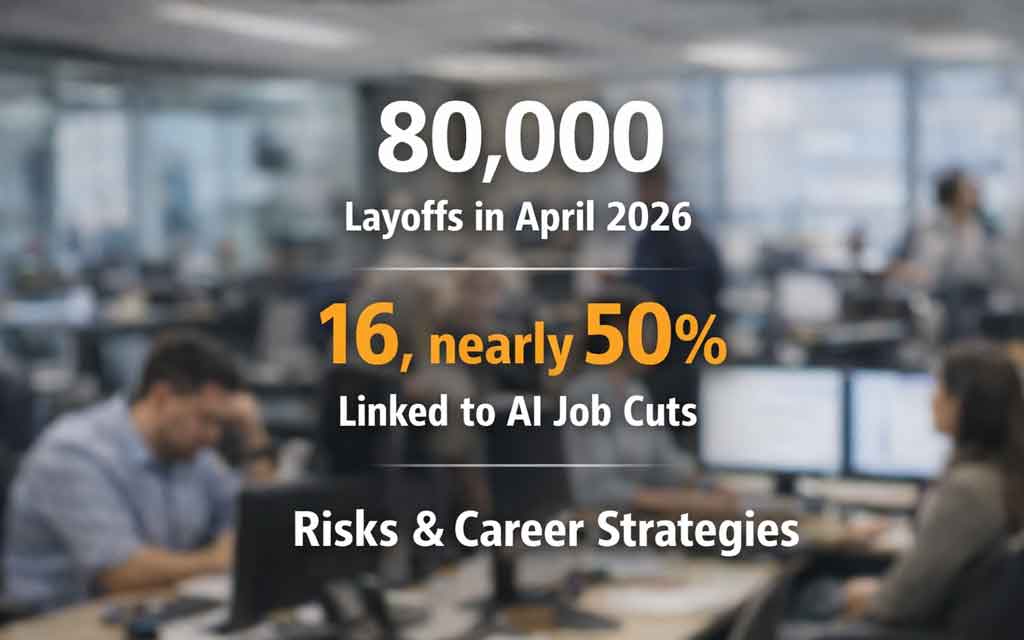
On one side, the tech sector has already shed nearly 80,000 jobs in the first three months of 2026, with AI cited as a primary or contributing factor in almost 50% of those cuts. On the other, companies are aggressively hiring for roles that demand AI fluency, while many existing jobs are being reshaped rather than eliminated outright.
The reality is nuanced: AI is accelerating churn in the tech workforce. It’s not a simple story of mass replacement, but a rapid transformation where routine tasks disappear, junior and mid-level roles shrink, and new high-value positions emerge. Here’s the realistic picture based on the latest data as of mid-April 2026.
The Layoff Reality: AI as a Major Driver
The numbers are sobering. Tech companies announced around 52,000 to 80,000 job cuts in Q1 2026 — a significant increase from the same period last year. In March alone, AI was blamed in roughly 25% of layoff announcements, making it the top cited reason ahead of restructuring or economic conditions.
Major firms continue to trim headcount while pouring billions into AI infrastructure. Examples include ongoing reductions at companies like Microsoft, Meta, and Amazon, often framed as efficiency moves to redirect resources toward AI development and deployment.
Goldman Sachs analysis suggests AI substitution has been wiping out roughly 16,000 to 25,000 jobs per month across the broader economy, though augmentation (AI helping workers) adds back about 9,000. In tech specifically, roles involving repetitive coding, data entry, basic testing, customer support scripting, and routine administrative work have been hit hardest.
Younger workers (Gen Z and early-career professionals under 25) are feeling the pain disproportionately. Employment in highly AI-exposed sectors like computer systems design has declined, with new graduates facing longer job searches and fewer entry-level openings.
However, not all cuts are pure “AI replacement.” Many companies are using AI potential as justification to streamline amid high valuations and investor pressure for profitability. Economists note that overall US unemployment remains relatively stable, and broad labor market data doesn’t yet show catastrophic displacement.
The Other Side: Surging Demand for AI Skills
While some roles shrink, demand for AI-related expertise is exploding:
- Over 275,000 active US job postings in early 2026 explicitly mentioned AI skills.
- Roughly 50% of tech job postings now require AI competencies as a baseline.
- Roles in high demand include AI/ML engineers, AI product managers, prompt engineers, automation architects, data infrastructure specialists, cybersecurity professionals with AI focus, and MLOps experts.
Employers are prioritizing professionals who can integrate AI into workflows, secure AI systems, scale infrastructure, and translate technical capabilities into business value. “AI-proof” or AI-augmented skills — systems thinking, cloud architecture, ethical AI governance, and domain expertise combined with technical fluency — are seeing strong interest.
BCG research indicates that over the next 2–3 years, 50–55% of US jobs will be reshaped by AI rather than eliminated. Many workers will stay in similar roles but with fundamentally changed expectations: higher productivity, new tools, and a shift toward oversight, creativity, and complex problem-solving.
Productivity gains from AI (estimated at 15–25% in adopting companies) are real, but they often translate into fewer people needed for the same output — or more output with the same headcount.
Who Is Most Affected? Realistic Breakdown
Highest Risk Areas (Shrinking or Reshaped):
- Junior software engineers doing routine coding or maintenance
- QA testers (automated testing tools advancing rapidly)
- Basic data analysts and entry-level BI roles
- Customer support agents handling repetitive queries
- Content moderators and certain administrative tech roles
Strong or Growing Areas:
- Senior AI/ML specialists and engineers
- AI ethics, governance, and compliance roles
- Infrastructure and platform engineers supporting AI deployment
- Cybersecurity experts focused on AI threats
- Product and business roles that bridge AI capabilities with real-world needs
Entry-level “hype” roles have largely disappeared. Competition is fierce, and companies expect candidates to demonstrate practical AI experience rather than just theoretical knowledge.
Advice for Tech Professionals in April 2026
The job market is not collapsing, but it is polarizing. Here’s practical guidance:
- Build AI Fluency Immediately — Even if your role isn’t “AI native,” learn to use tools like advanced coding assistants, multimodal models, and automation platforms. Hands-on projects matter more than certificates.
- Specialize or Hybridize — Pure generalist coding roles are under pressure. Combine deep domain knowledge (finance, healthcare, manufacturing, etc.) with AI skills for stronger positioning.
- Focus on Human + AI Strengths — Emphasize judgment, creativity, stakeholder management, ethical reasoning, and complex systems integration — areas where AI still struggles.
- Network and Upskill Aggressively — With hiring muted in some areas, internal mobility, referrals, and continuous learning are key. Many displaced workers find new roles within 6 months, though often at 10–18% lower compensation in competitive markets like the Bay Area.
- Consider Adjacent Opportunities — AI is creating demand in cybersecurity, data governance, AI operations, and even non-tech sectors adopting the technology.
Longer-term forecasts (through 2030) suggest AI could automate tasks equivalent to hundreds of millions of jobs globally while also creating new ones. In the US, the net effect will likely be transformation rather than outright mass unemployment — but the transition will be uneven and painful for those who don’t adapt.
The Bottom Line for American Tech Workers
April 2026 paints a realistic but challenging picture: AI is accelerating efficiency at the cost of certain roles, particularly repetitive or junior-level ones. At the same time, it is creating premium opportunities for those who can harness it.
Companies are betting heavily on AI to drive future growth, which means techies who position themselves as enablers and overseers of that technology — rather than competitors to it — will thrive. Those clinging to outdated skill sets or entry-level expectations face a tougher road.
The tech job market isn’t dying; it’s evolving faster than ever. Adaptability, continuous learning, and a proactive mindset toward AI integration will separate those who struggle from those who advance.
How has AI impacted your job search or role in 2026? Are you seeing more opportunities in AI-related work or feeling the pressure of automation? Share your experiences in the comments — your insights help the community navigate this shift.
Stay informed with weekly tech career and AI impact updates from vfuturemedia.com. Subscribe for practical analysis on how emerging technologies are reshaping work in America.
Related Reading on vfuturemedia.com: AI Skills for Tech Careers | Navigating Tech Layoffs 2026 | Future of Software Engineering | US Tech Workforce Trends




Leave a Comment