
By VFuture Media Team | April 21, 2026 | 12 min read
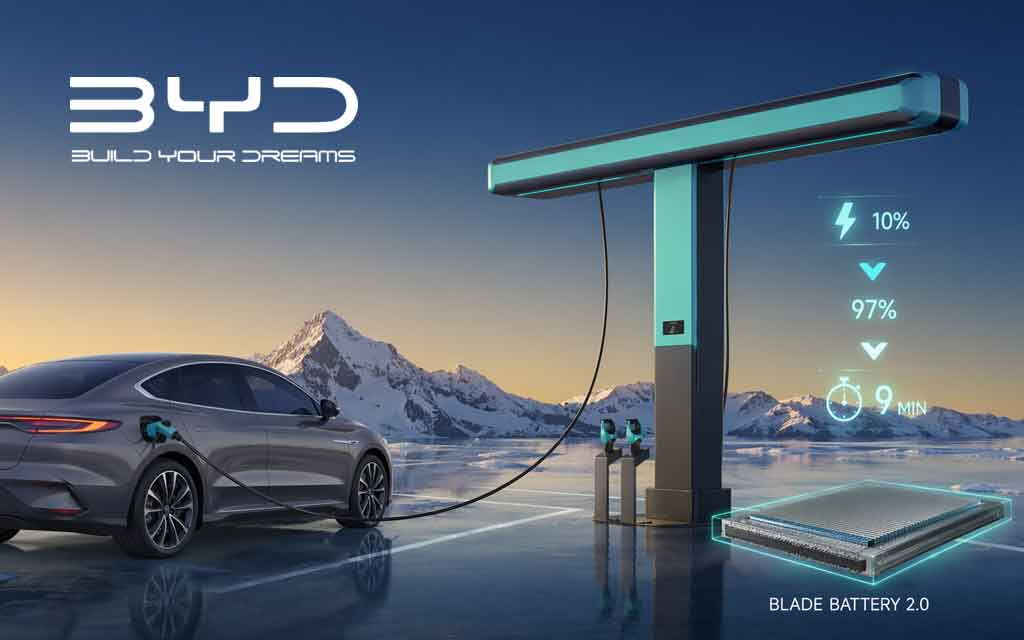
BYD has delivered one of the most significant breakthroughs in latest EV news for 2026. The Chinese EV giant unveiled its Flash Charging technology paired with the second-generation Blade Battery 2.0, enabling compatible electric vehicles to charge from 10% to 70% in just 5 minutes and reach 97% in only 9 minutes. Even in extreme cold of -30°C, the system adds a full charge in roughly 12 minutes.
This ultra-fast charging capability, supported by new 1,500 kW (1.5 MW) Flash Charging stations, brings EV refueling times tantalizingly close to filling up a gasoline car. At VFuture Media, we track every major advancement in EV news, battery technology, and global charging infrastructure. Here’s a complete, in-depth look at BYD’s Flash Charging breakthrough, how it works, rollout plans, and what it means for the future of electric mobility.
The Breakthrough: Blade Battery 2.0 Meets Flash Charging
In early March 2026, BYD officially launched the second-generation Blade Battery and its accompanying FLASH Charging Technology. This combination directly tackles two of the biggest remaining barriers to widespread EV adoption: long charging times and poor performance in cold weather.
Key performance claims include:
- 10% to 70% charge — in approximately 5 minutes
- 10% to 97% charge — in approximately 9 minutes
- 20% to 97% in -30°C (-22°F) — in only 12 minutes (just 3 minutes slower than ideal conditions)
These figures represent a massive leap over current industry standards, where even the fastest chargers typically take 20–40 minutes for an 80% charge. BYD’s system achieves this through a holistic approach: advanced battery chemistry, improved thermal management, lower internal resistance, and ultra-high-power chargers.
The technology uses LFP (lithium iron phosphate) chemistry in the Blade Battery 2.0, maintaining the structural safety advantages of the original Blade design while enabling much higher charge rates (up to 10C in some configurations). Changes to cathode, electrolyte, anode, and the solid electrolyte interphase (SEI) layer allow ions to move faster without compromising longevity or safety.
Flash Charging Stations: Up to 1,500 kW Power
Supporting the battery is BYD’s next-generation charging hardware. The new Flash Chargers can deliver up to 1,500 kW — roughly three times the peak power of Tesla’s most advanced V4 Superchargers (around 500 kW) and far beyond the 250–350 kW common in Europe and North America today.
Some stations use dual cables for even higher combined throughput. In real-world demonstrations, vehicles have sustained average charging speeds that enable the headline 5-minute and 9-minute times.
BYD has already installed thousands of these stations across China (over 4,200 reported by early March 2026) and plans to scale aggressively. The company aims for 20,000 Flash Charging stations in China by the end of 2026. Global rollout is also underway, with thousands more planned outside China, including an initial target of 3,000 stations in Europe within the next 12 months.
European Debut: Denza Z9 GT Leads the Charge
BYD is introducing Flash Charging to international markets through its premium sub-brand Denza. In April 2026, the sleek Denza Z9 GT (a luxury electric shooting brake/grand tourer) became the first vehicle to showcase the technology in Europe, launching at an event in Paris.
The Denza Z9 GT can charge from 10% to 80% in about 6.5 minutes and reach 97% in under 10 minutes. Priced as a premium offering (significantly higher than mainstream models), it serves as a flagship to demonstrate the “Ready in 5, Full in 9, Cold Add 3” principle to Western audiences.
BYD’s executive vice president Stella Li emphasized that this vehicle perfectly introduces the flash charging experience globally. More affordable models, such as updated versions of the Yuan Plus (Atto 3) and Song Ultra EV, are also receiving Blade Battery 2.0 and flash charging compatibility, with some already rolling out in China and expected overseas soon.
Technical Deep Dive: How BYD Achieved This Speed
Several innovations work together in the Blade Battery 2.0 and Flash Charging system:
- Higher voltage architecture (up to 1,000V or more in some packs)
- Advanced thermal management to handle massive heat generation during ultra-fast charging
- Optimized cell design with reduced internal resistance
- Improved electrolyte formulations for faster ion transport
- Safety-first Blade structure that continues to excel in nail penetration and structural tests
Unlike some competitors chasing higher energy density at the expense of charging speed, BYD prioritized fast-charging performance while retaining LFP’s inherent safety and cost advantages. The result is a battery that not only charges incredibly quickly but also performs well in extreme temperatures — a critical factor for markets with cold winters.
Impact on Range Anxiety and EV Adoption
This breakthrough has enormous potential to reduce range anxiety, one of the top reasons consumers hesitate to switch to EVs. Being able to add hundreds of kilometers of range in the time it takes to grab a coffee or use the restroom changes the calculus for long-distance travel.
For daily drivers, it means shorter stops and more flexible trip planning. For fleet operators and ride-hailing services, it translates to higher vehicle utilization and lower downtime. In the broader EV news context of 2026, BYD’s move could accelerate mass adoption, especially in price-sensitive and emerging markets where the company already dominates.
Comparisons to competitors:
- Tesla Superchargers: Peak ~500 kW, typical 80% charge in 20–30 minutes
- Other fast chargers in Europe/North America: 350 kW max for most vehicles
- BYD Flash: Up to 1,500 kW with compatible batteries, enabling sub-10-minute full charges
If infrastructure scales as planned, BYD could set a new global standard for public charging speed.
Challenges and Realistic Considerations
While the claims are impressive, real-world results will depend on several factors:
- Vehicle compatibility — Only models with Blade Battery 2.0 and supporting architecture can achieve these speeds.
- Grid capacity — Delivering 1.5 MW per station requires robust electrical infrastructure, which may limit deployment in some areas.
- Battery longevity — Frequent ultra-fast charging could affect long-term cycle life, though BYD claims optimizations mitigate this.
- Cost and accessibility — Premium models like the Denza Z9 GT introduce the tech first; mainstream affordability will determine broader impact.
- Global standardization — Different regions have varying voltage standards, regulations, and grid capabilities.
Independent verification of the exact times in varied conditions is still emerging, but early demonstrations and customer reports from China are highly positive.
Future Outlook: Global Rollout and Beyond
BYD’s plans extend well beyond 2026:
- Continued expansion of the Flash Charging network in China to 20,000+ stations.
- Aggressive international growth, starting with Europe and potentially expanding to other regions.
- Integration into more vehicle lines, including popular models like the Atto 3/Yuan Plus.
- Potential licensing or partnerships to bring the technology to other manufacturers.
- Further improvements in cold-weather performance and even faster charging in future generations.
This positions BYD not just as the world’s largest EV seller by volume but also as a leader in charging infrastructure and battery innovation.
Why This Matters in 2026 EV News
In a year when some Western automakers have scaled back EV ambitions due to demand softness, BYD continues to invest heavily in making electric vehicles more practical and convenient. The Flash Charging breakthrough directly addresses consumer pain points and could help tip the scales toward faster global electrification.
For enthusiasts, it means road trips become far less daunting. For policymakers and energy planners, it highlights the need for upgraded electrical grids capable of supporting megawatt-scale charging. For investors and competitors, it underscores BYD’s technological momentum and vertical integration advantages (batteries, vehicles, and chargers all under one ecosystem).
The Road Ahead for Faster EV Charging
BYD’s 2026 Flash Charging launch represents a watershed moment — proving that charging an EV can be as quick and seamless as refueling a traditional car. As the network expands and more vehicles gain compatibility, this technology could fundamentally change how people perceive and use electric vehicles.
What do you think? Would 5–9 minute charging times make you more likely to switch to an EV? How important is cold-weather performance in your region? Share your experiences and predictions in the comments below.
Stay updated with the latest in electric vehicles, battery tech, AI advancements, and startup news. Explore more on VFuture Media:
Subscribe to the VFuture Media newsletter for weekly roundups of breakthrough EV news, charging innovations, and technology updates.
Sources: Official BYD announcements, Electrek, InsideEVs, Reuters, CN EV Post, and verified industry reports as of April 21, 2026.

Leave a Comment